Robert Conroy - 1920 - America's Great War
Здесь есть возможность читать онлайн «Robert Conroy - 1920 - America's Great War» весь текст электронной книги совершенно бесплатно (целиком полную версию без сокращений). В некоторых случаях можно слушать аудио, скачать через торрент в формате fb2 и присутствует краткое содержание. Город: New York, Год выпуска: 2013, ISBN: 2013, Издательство: Baen Books, Жанр: prose_military, Альтернативная история, на английском языке. Описание произведения, (предисловие) а так же отзывы посетителей доступны на портале библиотеки ЛибКат.
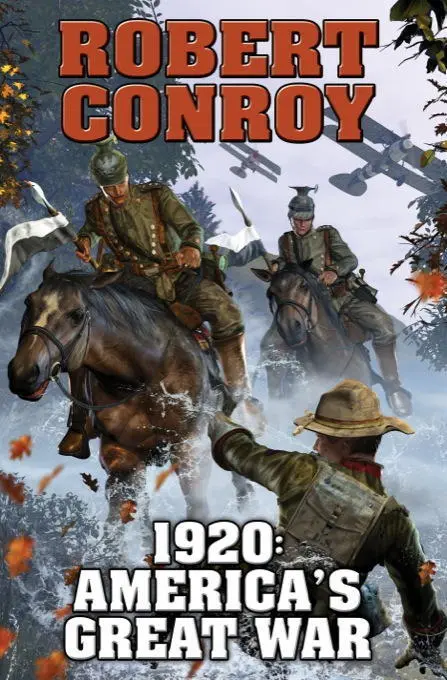
- Название:1920: America's Great War
- Автор:
- Издательство:Baen Books
- Жанр:
- Год:2013
- Город:New York
- ISBN:978-1-4516-3931-5
- Рейтинг книги:3 / 5. Голосов: 1
-
Избранное:Добавить в избранное
- Отзывы:
-
Ваша оценка:
1920: America's Great War: краткое содержание, описание и аннотация
Предлагаем к чтению аннотацию, описание, краткое содержание или предисловие (зависит от того, что написал сам автор книги «1920: America's Great War»). Если вы не нашли необходимую информацию о книге — напишите в комментариях, мы постараемся отыскать её.
and
, a compelling alternate history thriller. After winning WW I, Germany invades America in 1920, marching through California and Texas as a desperate nation resists.
Consider another 1920: Imperial Germany has become the most powerful nation in the world. In 1914, she had crushed England, France, and Russia in a war that was short but entirely devastating.
By 1920, Kaiser Wilhelm II is looking for new lands to devour. The United States is fast becoming an economic super-power and the only nation that can conceivably threaten Germany. The U.S. is militarily inept, however, and is led by a sick and delusional president who wanted to avoid war at any price.Thus, Germany is able to ship a huge army to Mexico to support a puppet government.
Her real goal: the invasion and permanent conquest of California and Texas.
America desperately resists as the mightiest and most brutal army in the world in a battle fought on land, at sea, and in the air as enemy armies savagely marched up on California, and move north towards a second Battle of the Alamo. Only the indomitable spirit of freedom can answer the Kaiser’s challenge.
1920: America's Great War — читать онлайн бесплатно полную книгу (весь текст) целиком
Ниже представлен текст книги, разбитый по страницам. Система сохранения места последней прочитанной страницы, позволяет с удобством читать онлайн бесплатно книгу «1920: America's Great War», без необходимости каждый раз заново искать на чём Вы остановились. Поставьте закладку, и сможете в любой момент перейти на страницу, на которой закончили чтение.
Интервал:
Закладка:
Tovey’s men ran cautiously up to the hacienda and into it. There was no more gunfire. Lejeune swore as he saw General Tovey far too close to the action.
Moments later, Tovey emerged and waved towards Lejeune who swore again. The crazy Texan wanted him to come over and climb up that hill.
Tovey greeted the Marine general outside the hacienda. “I think we got something Washington isn’t going to like.”
Lejeune took a deep breath. He was fifty-three and maybe getting too old to climb mountains, although he’d be double damned if he’d ever admit it.
“Come on in here, General,” Tovey said and Lejuene followed.
Two men lay on the floor. One was a young officer and the other an older man with a full beard. Lejeune recognized him from his photos. Carranza.
“Did we kill him?”
Tovey shrugged. “Not damn likely, but we’ll get the blame. Carranza’ll be a hero for standing up to us and dying for dear old Mexico. There’ll be statues of the fat asshole all over Mexico in a few days and he’ll be a rallying cry for them like the burning of Laredo was for us. No, he was shot and killed well before we got here.”
“How do you know that?”
Tovey laughed. “I was a Texas Ranger, which meant I had to know a little about police work, and even I can tell you those bodies are pretty damn cold for fresh casualties, and, oh yeah, one more thing.”
“What?”
“Along with gunshots to the chest, both those poor sons of bitches were shot in the back of the head.”
 CHAPTER 17
President Robert Lansing looked at the grisly photos. He wanted to turn away but couldn’t. This too was part of his job. The gaping wound in the back of Carranza’s head was clearly visible. He put them face down on his desk, and swallowed to keep his stomach from rising.
“Incredible,” he said. “And now the new Mexican government has the audacity to accuse us of murdering Carranza? I knew nothing was ever straightforward in Mexican politics, but to now have the Obregon government nominating that butcher Carranza for sainthood is a little much. It’s incredible after all we did to protect Obregon and his people.”
Secretary of State Charles Evans Hughes chuckled mirthlessly. “It is, of course, just their little way of deflecting blame to another source. Since we took Texas and the other states from them seventy years ago, we have been their favorite monster under the bed.”
“And what will come of this?” General March asked.
Hughes answered. “I believe a very pragmatic new government in Mexico City will ponder matters for a while and then sue for peace while they still have enough of a country left to run. The last thing a new Obregon government wishes is to have us gobble up more Mexican territory. Monterrey is an important city and a major railhead. I believe we can let them, well, huff and puff for a while and then begin back door peace talks.”
March agreed. “They also know that Pershing is consolidating his hold on the Monterrey area and is awaiting word as to whether he should push farther south. In the meantime, his men are digging in and awaiting a Mexican counterattack, which, if we sit there long enough, will surely come.”
“And what are the Germans doing in Vera Cruz?” the president asked.
March grinned. “They appear to be packing up. Vera Cruz is useless to them.”
“As is Mexico,” Hughes injected.
“Agreed,” said Lansing. “And here is what we will do. First, we will continue to reinforce and resupply Pershing. His army must become strong enough to repel any Mexican attacks. Tell him he may probe aggressively, but I do not want the army risked farther south. He may also probe from El Paso and Brownsville. Hopefully, this will frighten Obregon into thinking that we might annex northern Mexico and motivate him to the peace table.”
“And if it doesn’t?” March asked.
“Then we will annex northern Mexico,” Lansing said.
A few more comments and General March departed, leaving Hughes and Lansing alone. “Tell me, Charles, what are the British up to? Will they ever come in on our side?”
Hughes sighed. “I wonder. I’ve been in contact with Winston Churchill and he is of the opinion that the Royal Navy lusts after war with Germany, but that the British Army isn’t quite ready.”
“The British Army may never be ready,” Lansing muttered. “It is far too small and there’s no interest in enlarging it except for defensive purposes. They see Germany across the Channel and they are rightfully concerned, but worry about us and go to war for us? Never.”
Lansing sighed. “A naval confrontation between Great Britain and Imperial Germany, with us aiding the British, is a marvelous vision.”
“I’ve heard it said that the Germans have warned the British in their part of Puget Sound not to try and exit the Sound either at night or without forewarning the Germans. I understand the British are contemptuous of such requests.”
“Charles, are you saying an incident might occur?”
Hughes smiled. “One can only hope so.”
Even though he was only thirty-five, the younger guards had begun calling Pedro Sanchez “grandfather.” Of course, most of them were so much younger than he, mere children in their mid teens. What the hell was the Mexican Army coming to, he wondered, if it enlisted children who were barely out of diapers?
As to his position as a guard at the camp in southern California, he had only himself to blame. He had supported Carranza, supported the changes needed to be made in the way Mexicans lived, and, worse, had believed in Carranza’s promises. He now realized that Carranza never had any intention of keeping those high-sounding promises.
Now he was hundreds of miles away from his home in a village that was south of Ciudad Juarez, which was just across the border from the American city of El Paso. Worse, as rumors spun out of control, he was beginning to wonder if he’d ever see it or his family again. At first, joining the army had seemed like a lark. He’d never been more than a few miles away from his home and he’d wanted to see a little of the rest of the world before he died. He’d been to Monterrey, but that was it. Now he knew he’d made a terrible mistake. Staring at a couple of hundred sullen and half-starved American prisoners was nobody’s idea of seeing the world.
San Diego and the ocean were only a few days march away, but he was convinced he’d see them when he was in heaven and looking down. Even more annoying were the Germans. Their arrogance was beyond belief. Did they think he was an animal? A slave? He spat on the ground. To hell with Carranza and the Germans he’d invited in to help rule Mexico.
Because of his age and apparent maturity, Captain Torres had grandly proclaimed that Pedro was the senior sergeant in the overlarge platoon sent to help guard the Americans. Thus, the men in his platoon, his children, often came to him for advice. Rumors were spinning out of control and the men were worried. Well, so was Sergeant Pedro Sanchez.
He’d tried to ask Captain Torres, but that man was too busy either stealing German supplies or screwing a Mexican whore in Raleigh to bother. Still, Pedro had figured out that all was not well with Mexico’s campaign to drive the Americans out of Texas. He thanked his lucky stars and the Virgin Mary, whichever worked best, that he was not involved in the bloody fighting in Texas.
Communications between Mexico City, Texas, and California were miserable at best and nobody thought to inform the illiterate creatures who were the enlisted men. Captain Torres was the worst. When asked, he’d caustically told Sanchez and the others to do their duty and let officers like him do the thinking.
Читать дальшеИнтервал:
Закладка:
Похожие книги на «1920: America's Great War»
Представляем Вашему вниманию похожие книги на «1920: America's Great War» списком для выбора. Мы отобрали схожую по названию и смыслу литературу в надежде предоставить читателям больше вариантов отыскать новые, интересные, ещё непрочитанные произведения.







Обсуждение, отзывы о книге «1920: America's Great War» и просто собственные мнения читателей. Оставьте ваши комментарии, напишите, что Вы думаете о произведении, его смысле или главных героях. Укажите что конкретно понравилось, а что нет, и почему Вы так считаете.