Robert Conroy - 1920 - America's Great War
Здесь есть возможность читать онлайн «Robert Conroy - 1920 - America's Great War» весь текст электронной книги совершенно бесплатно (целиком полную версию без сокращений). В некоторых случаях можно слушать аудио, скачать через торрент в формате fb2 и присутствует краткое содержание. Город: New York, Год выпуска: 2013, ISBN: 2013, Издательство: Baen Books, Жанр: prose_military, Альтернативная история, на английском языке. Описание произведения, (предисловие) а так же отзывы посетителей доступны на портале библиотеки ЛибКат.
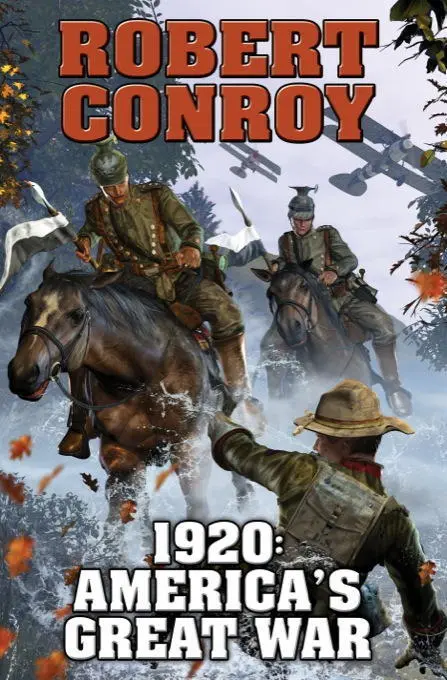
- Название:1920: America's Great War
- Автор:
- Издательство:Baen Books
- Жанр:
- Год:2013
- Город:New York
- ISBN:978-1-4516-3931-5
- Рейтинг книги:3 / 5. Голосов: 1
-
Избранное:Добавить в избранное
- Отзывы:
-
Ваша оценка:
1920: America's Great War: краткое содержание, описание и аннотация
Предлагаем к чтению аннотацию, описание, краткое содержание или предисловие (зависит от того, что написал сам автор книги «1920: America's Great War»). Если вы не нашли необходимую информацию о книге — напишите в комментариях, мы постараемся отыскать её.
and
, a compelling alternate history thriller. After winning WW I, Germany invades America in 1920, marching through California and Texas as a desperate nation resists.
Consider another 1920: Imperial Germany has become the most powerful nation in the world. In 1914, she had crushed England, France, and Russia in a war that was short but entirely devastating.
By 1920, Kaiser Wilhelm II is looking for new lands to devour. The United States is fast becoming an economic super-power and the only nation that can conceivably threaten Germany. The U.S. is militarily inept, however, and is led by a sick and delusional president who wanted to avoid war at any price.Thus, Germany is able to ship a huge army to Mexico to support a puppet government.
Her real goal: the invasion and permanent conquest of California and Texas.
America desperately resists as the mightiest and most brutal army in the world in a battle fought on land, at sea, and in the air as enemy armies savagely marched up on California, and move north towards a second Battle of the Alamo. Only the indomitable spirit of freedom can answer the Kaiser’s challenge.
1920: America's Great War — читать онлайн бесплатно полную книгу (весь текст) целиком
Ниже представлен текст книги, разбитый по страницам. Система сохранения места последней прочитанной страницы, позволяет с удобством читать онлайн бесплатно книгу «1920: America's Great War», без необходимости каждый раз заново искать на чём Вы остановились. Поставьте закладку, и сможете в любой момент перейти на страницу, на которой закончили чтение.
Интервал:
Закладка:
Eisenhower just shook his head. “Look at them. All lined up like they were on parade. Yeah, Luke, if we had our own guns we could blow them back to Berlin.”
Other German units were closing in on the American lines. Soon the city of San Francisco would be under siege. In a short while, the Germans would bring up their own heavy artillery. These would not be the truly big siege guns they’d used to smash the fortifications at Liege and Paris in 1914, but they would be large enough at 155mm.
An American artillery piece boomed and, seconds later, a cloud of dirt erupted from in front of a German trench, scattering Germans in their coal-scuttle helmets. Jake idly wondered if they were better then the pie tins some American soldiers wore. Most Americans didn’t have anything more than hat and hair to protect their skulls. Guns and ammunition had priority, not helmets.
German guns quickly responded. They were the smaller caliber ones and did no real damage. Relatively speaking, the siege was opening with a whimper, not a bang.
Luke peered through his binoculars. The Germans were already back at their digging and more men had arrived. Any chance of sortieing out and smacking them before they were dug in was quickly disappearing. Liggett had forbidden it anyhow. He would not squander his troops in a meaningless attack.
“Y’know, Ike, when they get a few miles closer, their guns will be able to hit the bridge from across the bay.”
“I know,” Ike said.
The Dumbarton Railroad Bridge had been completed in 1910, but it crossed the southern end of the bay which would put it in range of German artillery fairly soon unless, by a miracle, the Germans were halted in their tracks. Neither man believed in miracles.
German trucks were now arriving and rolls of barbed wire were thrown on the ground with practiced skill. “They’ve done this before, haven’t they?” Ike asked with grim humor.
More German shells hit near their position. American soldiers cringed in terror. Sergeants had to physically restrain a couple from running in panic for the rear. The men weren’t really cowards, just part of a poorly-trained garrison that hadn’t seen any combat, and weren’t aware that they were safer in their trenches than running around unprotected by dirt walls.
It was time to go. Martel and Eisenhower grabbed their equipment and moved back and away from the front lines. They were painfully aware of angry glares from soldiers who had to stay. Luke heard someone mutter “rear-echelon cowards.” He turned angrily but everyone was looking at the sky.
Ike grabbed his arm. “Let it be, Luke. If I had to stay here while some brass headed for a warm bed, I’d be pissed too.”
Mexican President Venustiano Carranza and his staff had commandeered a large hacienda a few miles north of Monterrey. It was located on a hill and Carranza could see for miles to the north. The Americans were coming in their thousands and he needed help to stop them. But his army, the one that had invaded Texas, no longer existed.
From his hilltop, the Mexican president sent message after message back to Mexico City calling for reinforcements. The gringos under Pershing were only a few miles away. If they took Monterrey, it would be an enormous blow to Mexican pride. Monterrey was one of the largest cities in Mexico, capital of Nueva Leon province, and a center of Mexican industry. Loss of Monterrey would also mean that the German overland supply line running west from Vera Cruz would be threatened.
An aide ran in gasping. “Horsemen coming from the south, your excellency.”
“How many?”
“Perhaps a hundred, sir.”
A hundred, he thought. That’s all? But maybe they were the advance guard of a much larger relief force. Yes, that must be it.
A little while later he heard the clatter of hoofs and the shouts of men. He heard a name and shuddered. Villa. Pancho Villa had arrived. Impossible. Villa was the bandit fool who’d started the 1916 war with the United States by attacking Texas towns and ranches thus causing an American army, again led by Pershing, to invade Mexico. It had taken almost a year to get rid of the Americans and now Pershing was back with an even larger army.
Carranza had another worry. Which side was the bandit on today?
“Excellency!” Villa boomed as he entered the living room where Carranza sat. “I bring wonderful news from Mexico City.”
Carranza forced a smile. He neither liked nor trusted the stocky, filthy, and heavily mustachioed Villa. But if he had good news and reinforcements, he would put up with the barbarian.
“Then don’t keep me waiting, General Villa,” he said with feigned warmth. “Tell me.”
A servant had brought fresh cold water that Villa gulped, then wiped his mouth on his sleeve. “Mexico City is not a happy place, but that would not surprise you. The loss of so many men, even if most were merely captured, is an enormous blow to Mexican pride. They are wondering how you will redeem it.”
Carranza felt himself flushing. How dare this oafish shit talk to him like that? “If the government in Mexico City, my government, will get off their asses and give me a new army, I will not only stop the Americans before they get to Monterrey, but I will destroy them.”
“Brave words,” Villa said and Carranza wanted to strangle him.
“They will be more than brave when I get my army. When will the rest of it arrive? The Americans are almost here. If we lose Monterrey we will be humiliated.”
Villa shrugged several more of his men had entered the room and taken station beside him. “Mexico City feels that the fall of Monterrey is inevitable and that the war with the United States was a huge and tragic mistake, and one that must be rectified.”
“Indeed?” said Carranza. “If that is what Mexico City thinks, then they are wrong. Give me another army and we will win. And once we have won, we will negotiate a treaty from a position of strength. Anything less and I will personally be humiliated.”
“Martyred,” said Villa.
“What?” said Carranza, sudden desperation growing in his voice.
“You will be revered as the President of Mexico who was brave enough to give his life for his country.”
Villa pulled a revolver from inside his shirt and fired three bullets that struck Carranza in the chest. One of his men shot Carranza’s aide. Villa himself administered the coup de grace , a bullet to the back of Carranza’s head and then to the aide’s. He detailed a squad to remain in the hacienda, while the remainder of the men who’d accompanied Carranza ran away from the killings.
Villa’s men still had a job to do.
General Lejeune watched as Tovey’s men approached the white stone hacienda at the top of the hill. Reports said there were Mexicans holed up in it. The building had to be cleared as it commanded the approach to Monterrey.
The Texans fanned out and moved cautiously up the hill. Lejeune had to admit that Tovey was a damned good general and his men fought well. And, somewhat surprisingly, there had been little in the way of discipline problems in Mexico. A few men had gotten drunk and one man was in jail accused of rape, but the drunks had their asses kicked by their sergeants, and the alleged rapist was scared to death. He’d be released later as an investigation showed that the alleged victim was a prostitute. The benefit of the doubt would go to the soldier. Still, Tovey’d decided to let the stupid kid stew in jail for a couple of days, thinking he was going to spend the rest of his miserable life in prison breaking rocks. Hopefully, he’d realize that no piece of ass was worth that much.
Gunfire erupted from the hacienda, only a few scattered shots, but enough to send Tovey’s men to ground. An American machine gun opened up and, after a few long bursts, the fire from the hacienda ceased.
Читать дальшеИнтервал:
Закладка:
Похожие книги на «1920: America's Great War»
Представляем Вашему вниманию похожие книги на «1920: America's Great War» списком для выбора. Мы отобрали схожую по названию и смыслу литературу в надежде предоставить читателям больше вариантов отыскать новые, интересные, ещё непрочитанные произведения.




Обсуждение, отзывы о книге «1920: America's Great War» и просто собственные мнения читателей. Оставьте ваши комментарии, напишите, что Вы думаете о произведении, его смысле или главных героях. Укажите что конкретно понравилось, а что нет, и почему Вы так считаете.