Robert Conroy - 1920 - America's Great War
Здесь есть возможность читать онлайн «Robert Conroy - 1920 - America's Great War» весь текст электронной книги совершенно бесплатно (целиком полную версию без сокращений). В некоторых случаях можно слушать аудио, скачать через торрент в формате fb2 и присутствует краткое содержание. Город: New York, Год выпуска: 2013, ISBN: 2013, Издательство: Baen Books, Жанр: prose_military, Альтернативная история, на английском языке. Описание произведения, (предисловие) а так же отзывы посетителей доступны на портале библиотеки ЛибКат.
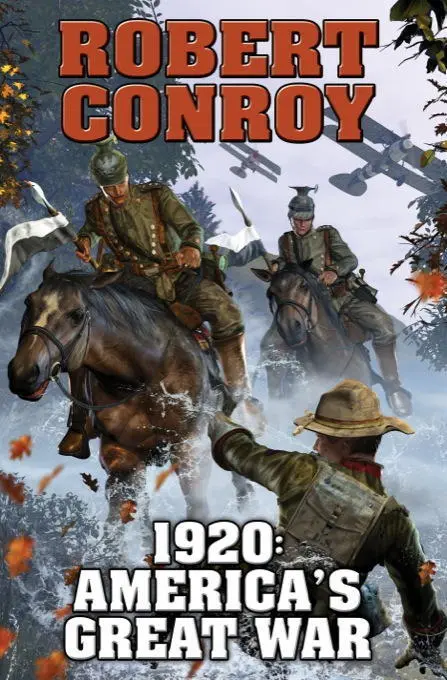
- Название:1920: America's Great War
- Автор:
- Издательство:Baen Books
- Жанр:
- Год:2013
- Город:New York
- ISBN:978-1-4516-3931-5
- Рейтинг книги:3 / 5. Голосов: 1
-
Избранное:Добавить в избранное
- Отзывы:
-
Ваша оценка:
1920: America's Great War: краткое содержание, описание и аннотация
Предлагаем к чтению аннотацию, описание, краткое содержание или предисловие (зависит от того, что написал сам автор книги «1920: America's Great War»). Если вы не нашли необходимую информацию о книге — напишите в комментариях, мы постараемся отыскать её.
and
, a compelling alternate history thriller. After winning WW I, Germany invades America in 1920, marching through California and Texas as a desperate nation resists.
Consider another 1920: Imperial Germany has become the most powerful nation in the world. In 1914, she had crushed England, France, and Russia in a war that was short but entirely devastating.
By 1920, Kaiser Wilhelm II is looking for new lands to devour. The United States is fast becoming an economic super-power and the only nation that can conceivably threaten Germany. The U.S. is militarily inept, however, and is led by a sick and delusional president who wanted to avoid war at any price.Thus, Germany is able to ship a huge army to Mexico to support a puppet government.
Her real goal: the invasion and permanent conquest of California and Texas.
America desperately resists as the mightiest and most brutal army in the world in a battle fought on land, at sea, and in the air as enemy armies savagely marched up on California, and move north towards a second Battle of the Alamo. Only the indomitable spirit of freedom can answer the Kaiser’s challenge.
1920: America's Great War — читать онлайн бесплатно полную книгу (весь текст) целиком
Ниже представлен текст книги, разбитый по страницам. Система сохранения места последней прочитанной страницы, позволяет с удобством читать онлайн бесплатно книгу «1920: America's Great War», без необходимости каждый раз заново искать на чём Вы остановились. Поставьте закладку, и сможете в любой момент перейти на страницу, на которой закончили чтение.
Интервал:
Закладка:
That is, if it worked.
Kirsten thought that her work on a ranch had inured her to the sight of blood. As a ranch owner, she’d helped mend the cut flesh and broken bones of her ranch hands. She’d stitched them and splinted them and, while some had complained, none had died. She’d known to use basic sanitation, which was still an undiscovered art in some places.
And of course, she’d helped her husband, Richard, while his infected leg grew gangrenous and caused his death. She cursed the fact that there was no doctor in the vicinity at that time, and that poor stubborn Richard had kept his injury a secret for so long. A bruise was all he’d called it until his leg had swollen up and red lines extended from the “bruise.” When she’d finally gotten him to a hospital in San Diego, the doctors there had amputated the leg, but the infection had already spread too far.
St. Ignatius College, located on the corner of Hayes and Schrader Streets, was the site of the new military hospital. Several of the Jesuits on the faculty had also volunteered and a few even had some medical experience, although informal and from the school of hard knocks.
She was stunned by the sights and smells. Even though so-called experts, including journalists, said that the fighting had barely begun, there were hundreds of casualties in St. Ignatius and elsewhere.
Kirsten’s decision to volunteer had come from the fact that she was no longer needed to distribute ration cards to civilians. Most civilians had departed, leaving San Francisco a garrisoned ghost town. Those few civilians who remained were, like her, part of the war effort.
The first time she’d seen a man disemboweled she’d vomited. Doctor Rossini, the surgeon who headed her group, had congratulated her on being able to make it outdoors before puking on his floor. Since the floor was already covered with blood and dirt, she assumed he was being sarcastic. He wasn’t. Rossini wanted the place clean and, after a brief and terse discussion, cleaning it up was Kirsten’s new job.
Over the next few days, she slowly graduated to getting supplies for the harassed doctors and nurses. When they found that she could keep her lunch down and could both read and follow directions, she was considered an asset. Even the acid-tongued Rossini grudgingly gave her respect.
If Luke was occupied, which was usually the case, she spent her spare time talking to the wounded and comforting the dying. It was a task she hated, but if she could give comfort to someone in agony, or terrified of being a cripple, or, worse, of dying, then it was her duty. She did not quite think of volunteering as an honor, but one other volunteer did.
Rossini came over and grabbed her arm. “I need a nurse and you just volunteered. Congratulations.”
He took her to a surgical table. A young man, he couldn’t have been in his twenties, lay naked on his back and on the table. Another doctor was picking pieces of shrapnel and other debris out of his body. The boy was only marginally unconscious. He groaned and tried to turn, but others held him still.
“Hold this,” Rossini said and handed her a tray. She held it while the doctors dug into the boy’s shattered body and plunked items into it.
Rossini laughed bitterly. “When he really wakes up, he’s going to be in a sea of pain and not realize how lucky he is. He’ll have a ton of sores and scars, but nothing vital was touched. All he has to do is avoid infection.”
“My husband couldn’t do that,” she blurted. “He died of gangrene despite all I and anyone else could do.”
Rossini’s expression softened a little. “I didn’t know, of course. Can you deal with this?”
“Now I can handle anything you want me to.”
Rossini laughed again, this time with a bit of humor. “Congratulations, you are now my assistant.”
 CHAPTER 18
The earth erupted and debris fell down on Luke’s helmet, making a tinny, pattering sound that would have been amusing, even pleasant, under other circumstances. Today it reminded him that death was only inches away.
Luke turned to his companion in the muddy trench, the alleged British journalist, Reggie Carville. “Is this what you would call a barrage?” Luke asked.
Carville smiled tolerantly. The Englishman was about Luke’s age, lean, and had the look of a greyhound about him. Certainly, he was an aristocrat and Luke tried not to let that intimidate him.
“A barrage? No, not even a whiff of one. This, my dear Martel, is just probing fire, not a barrage.”
Several other shells went off in the area, but other than shaking the earth, they did no harm to anyone in the trenches. The trenches were narrow, which meant that only a direct hit would cause casualties, and the trenches zigged and zagged which, along with providing flanking and covering fire, would minimize casualties in the event of a direct hit. The shock wave would be funneled and then dissipated. Luke thought it would be minimal good news if he was directly hit.
The trenches were also dirty, muddy, and cold. Luke’s toes felt clammy and he wondered if he shouldn’t have worn different boots. He noticed that other soldiers didn’t have better boots and wondered if this was something that needed to be corrected. Certainly a long siege would result in serious foot problems.
Carville peered through a firing slit at the German lines. Much of the brush and small trees on the hill had been cleared away to provide clear lines of fire. Unfortunately, this had the negative effect of showing the Germans exactly where the American lines were. Areas around the growing German trench lines had likewise been cleared. Through his binoculars, Luke could see German soldiers moving around. They had no serious fear of American artillery. If and when they desired, the Germans could launch a barrage, but not so the Americans, who were starved of cannon.
Carville turned and sat down in the trench. His expensive-looking civilian suit was getting dirty but the man didn’t seem to care. He took a drink from his flask and from the way he grimaced, Luke deduced that it didn’t contain water.
“Ah, that was good. I’d offer you some, but it may be against the rules of being an international journalist to share alcohol with combatants. Drinking might also make you lose control and want to kill someone, like those damned Germans. No, this pitiful bombardment is far from serious. German gun theory is quite simple and based on everybody else’s. When the time comes, the Krauts will simply line up all the artillery they have, some hundreds of guns, and pack them wheel to wheel. Then they will fire them all at the same time and at roughly the same place; thus pulverizing it. They did it a few times in 1914 and later, and it was damnably effective. I understand it sometimes drove good men simply insane and unable to function, except their bladders and bowels which empty continuously.”
“Sounds terrible, Mr. Carville. Effective, but terrible.”
Carville took another swallow, changed his mind and offered the flask to Luke who took a small swallow. It was scotch. “Please call me Reggie and quit looking at me like that. A soldier might get the wrong impression.”
Luke savored his drink. “I think you are more than you say.”
“Nonsense, I’m a writer for the London Times .”
“And I’m the Pope. Benedict the Fifteenth to be precise.”
Carville grinned. “Then hear my confession, Benedict, for I have surely sinned in thought, word, and deed. You are right, of course, I am more than I seem, but aren’t we all? Even if I was, say, an English officer with experience fighting the Germans in France and with a background at Eton and Sandhurst, it would be veddy inappropriate for me to admit that. After all, England is neutral and cannot be seen by your enemies as giving advice and comfort to you. Therefore, please don’t speculate as to my background and I won’t ask how many Mexicans you killed under Pershing in 1916 in order to become an officer up from the ranks.”
Читать дальшеИнтервал:
Закладка:
Похожие книги на «1920: America's Great War»
Представляем Вашему вниманию похожие книги на «1920: America's Great War» списком для выбора. Мы отобрали схожую по названию и смыслу литературу в надежде предоставить читателям больше вариантов отыскать новые, интересные, ещё непрочитанные произведения.






Обсуждение, отзывы о книге «1920: America's Great War» и просто собственные мнения читателей. Оставьте ваши комментарии, напишите, что Вы думаете о произведении, его смысле или главных героях. Укажите что конкретно понравилось, а что нет, и почему Вы так считаете.