Theodore Odrach - Wave of Terror
Здесь есть возможность читать онлайн «Theodore Odrach - Wave of Terror» весь текст электронной книги совершенно бесплатно (целиком полную версию без сокращений). В некоторых случаях можно слушать аудио, скачать через торрент в формате fb2 и присутствует краткое содержание. Год выпуска: 2008, Издательство: Chicago Review Press, Жанр: prose_military, Историческая проза, на английском языке. Описание произведения, (предисловие) а так же отзывы посетителей доступны на портале библиотеки ЛибКат.
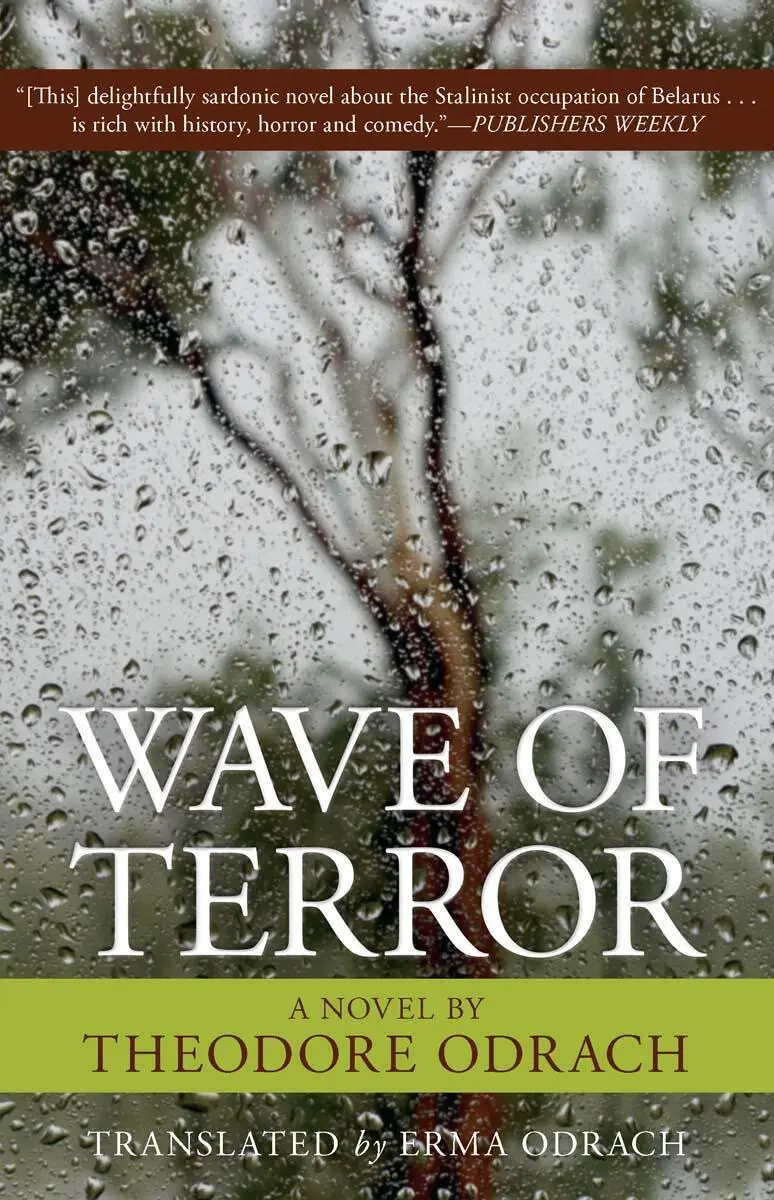
- Название:Wave of Terror
- Автор:
- Издательство:Chicago Review Press
- Жанр:
- Год:2008
- ISBN:нет данных
- Рейтинг книги:4 / 5. Голосов: 2
-
Избранное:Добавить в избранное
- Отзывы:
-
Ваша оценка:
Wave of Terror: краткое содержание, описание и аннотация
Предлагаем к чтению аннотацию, описание, краткое содержание или предисловие (зависит от того, что написал сам автор книги «Wave of Terror»). Если вы не нашли необходимую информацию о книге — напишите в комментариях, мы постараемся отыскать её.
Wave of Terror — читать онлайн бесплатно полную книгу (весь текст) целиком
Ниже представлен текст книги, разбитый по страницам. Система сохранения места последней прочитанной страницы, позволяет с удобством читать онлайн бесплатно книгу «Wave of Terror», без необходимости каждый раз заново искать на чём Вы остановились. Поставьте закладку, и сможете в любой момент перейти на страницу, на которой закончили чтение.
Интервал:
Закладка:
More people were shoved through the door. The air was thick with sweat and heavy clouds of tobacco smoke floated beneath the ceiling. The people did not understand why they had been brought here or what was going to happen to them, but they knew that there was no escape and that no one was going to help them. Never before, not under the Czar or under Polish occupation, had they ever been through anything like this. Yesterday they had peacefully farmed their land and tended to their animals and today the future was shutting down on them and fast; their past had just been destroyed.
Timushka, who sat on a bench near the back of the room, rocked back and forth, heaving deep, bitter sighs. Her daughter, Olena, who was to have married the shoemaker’s son in the spring, sat at her side, and on her other side was her little granddaughter, Claudia. Her three sons huddled in a corner, while her husband nervously paced the floor. The entire family had fallen victim to the new reality gripping the nation.
In front of Timushka sat a small-framed, rather pretty woman not much over thirty, with her two young daughters, Adriana and Oksana. Adriana, who looked like her mother, was ten years old and a pupil of Kulik’s. She was lightly dressed in a tattered gray frock, and a thick long braid of chestnut hair hung over her left shoulder. Tears streamed down her cheeks; grasping her mother’s arm, she asked her over and over, “Why are we here? Who are those men and what do they want from us? What’s going to happen to us?” Oksana, who was not yet two and bundled in rags, cried at the top of her voice, begging her mother to take her in her arms.
Then from somewhere in the crowd a girl of no more than seventeen sprang to her feet. She too was shabbily dressed in torn shoes with no stockings and her thin overcoat had been patched and mended at the elbows. Her eyes on fire, she pushed her way to the lieutenant and threw him a cold, hateful look. She said to him, “Do you think I’m going to cry too, like that baby over there? You’re mistaken! You’re vile and contemptible, you filthy bastard!” Taking a step forward, she spat directly in his face.
The lieutenant shook with rage. He pulled a handkerchief from his jacket pocket, and wiping himself clean, called to his soldiers, “Men, take her away!”
Two NKVD men jumped from behind and grabbed the girl’s arms. She kicked and cried as they dragged her across the floor and into the hallway. A few minutes passed. Then from the window a roaring wind slammed up against the panes. It was soon drowned out by howling and screaming. There were more sounds, some wailing, some clattering, and several minutes later, silence.
The lieutenant tried to contain his fury. For the longest time he stared into the crowd without saying a word. When he saw Kulik standing by the door, he walked over to him and asked as if nothing had happened, “Are you from this village?”
Kulik, hardly able to answer, said, “No, I’m pretty much a stranger to these parts. I’ve been in Hlaby only a few weeks.”
“Do you know any of the people here?”
“No, in fact, I hardly know anybody, although some I recognize as the parents of my pupils.”
The lieutenant continued in much the same nonchalant manner. “See that woman over there, the one with the two young girls? She’s the widow of a forest guard who worked for the Poles. In other words, she’s from the antagonistic class, a subversive. And her children are no better.” Then, pointing across the room, laughing, “And see that short, stumpy bastard in the corner? He keeps moving around as if he has ants in his pants. It seems he just can’t wait to take to the road. Hah! Hah! Hah!”
As the lieutenant was about to go on, Paraska flew into the room looking more flustered than ever. “Director, Director,” she cried. “You’re being summoned outside. Please, come quickly.”
Excusing himself, Kulik walked out of the school and into the schoolyard. The cold wind whipped at his face and he could feel his hands go numb. There he came upon Kirilo, the former Olivinski farmhand, who was standing in line with about ten other men. They were all lightly dressed with no hats and their hands and feet were bound by thick rope. Kirilo was shivering.
“They came and took everything,” he mumbled. “They took my wife, my children. What does anything matter anymore? They say I’m subverting and weakening the Soviet system because I worked as a farmhand on the Olivinski estate. What does all that mean? Nothing makes sense anymore.” Then shrugging and waving his hand, “If it’s off to a slave labor camp, then it’s off to a slave labor camp. And in slave labor camps they say life is so unbearable that death is a relief. We’ll see. I wanted to say goodbye to you personally. You’re a good man, Director Kulik. May God be with you.”
Kulik didn’t know what to do with himself. His heart was still throbbing. Quickly he made his way to his living quarters, and slamming the door shut, fell onto his bed. He was dizzy and a tide of nausea was rising inside him. There was no escaping the horror; with each passing minute it was moving closer and closer. He tried to keep from thinking of the insanity just steps away. But suddenly he was overcome with uncontrollable rage. If he had a machine gun in his hands he would shoot them all and watch them drop like flies, one after the other. He would sink his boot heels into their faces and wipe off those smug and arrogant smirks once and for all.
A cold damp draft came from the window and penetrated his whole body. He began to shake. Drawing a blanket over himself and burying his head in his pillow, he cried and cried and could not stop. Then he heard noise coming from his office. At first he thought he was imagining it, but when it became louder and more pronounced, he realized there was something going on in there. People were talking, shouting, shoving boxes around, banging drawers, opening and closing doors. Straining his ears to listen, it was not long before he recognized the voices of Sergei and Hrisko Suchok, father of little Ohrimko. Suchok was yelling at the top of his voice; he seemed completely beside himself. “What is there left to do? Nothing can be done, absolutely nothing.”
Kulik got up and walked to his office. He stood in the doorway several minutes in total bewilderment. There was chaos everywhere; the entire room had been turned upside down. When Sergei saw Kulik, he pointed to a big pile of clothing in the corner. “We’ve managed to collect a few things — a couple of jackets, some boot liners, scarves, mittens, hats, and three wool blankets. We tried to give them to the villagers for their journey, but those bastards won’t allow it. They say it isn’t necessary.”
Suchok asked, “Director, how about you, do you have any suggestions?”
Kulik stood a while in thought. “Hmm … We have to find a way to tame the wild beast. Nothing else will work.”
“And how does one go about taming a beast gone wild beyond control?” Sergei screwed up his mouth ironically. “Maybe we should prepare a feast?”
“A feast!” Kulik repeated. “That’s it, Sergei! What a brilliant idea! We’ll prepare a feast, and maybe that will distract them. Now quickly, we don’t have a moment to lose. Let’s add up what we’ve got. I have two liters of vodka stashed in the bottom of my dresser drawer, and if I’m not mistaken, there are a couple of bottles of wine in the kitchen cabinet.”
Sergei scowled. “And I hope they’re all tainted with arsenic.”
Kulik narrowed his eyes. “I don’t think we’re looking to find ourselves before a firing squad. We won’t be of any use to anybody that way.”
Sergei threw up his hands. “Maybe you’re right. This plan of yours, crazy as it sounds, just might work. I have at least ten eggs and some cheese in the cold cellar. I’ll be back in a few minutes.”
Читать дальшеИнтервал:
Закладка:
Похожие книги на «Wave of Terror»
Представляем Вашему вниманию похожие книги на «Wave of Terror» списком для выбора. Мы отобрали схожую по названию и смыслу литературу в надежде предоставить читателям больше вариантов отыскать новые, интересные, ещё непрочитанные произведения.







Обсуждение, отзывы о книге «Wave of Terror» и просто собственные мнения читателей. Оставьте ваши комментарии, напишите, что Вы думаете о произведении, его смысле или главных героях. Укажите что конкретно понравилось, а что нет, и почему Вы так считаете.