Theodore Odrach - Wave of Terror
Здесь есть возможность читать онлайн «Theodore Odrach - Wave of Terror» весь текст электронной книги совершенно бесплатно (целиком полную версию без сокращений). В некоторых случаях можно слушать аудио, скачать через торрент в формате fb2 и присутствует краткое содержание. Год выпуска: 2008, Издательство: Chicago Review Press, Жанр: prose_military, Историческая проза, на английском языке. Описание произведения, (предисловие) а так же отзывы посетителей доступны на портале библиотеки ЛибКат.
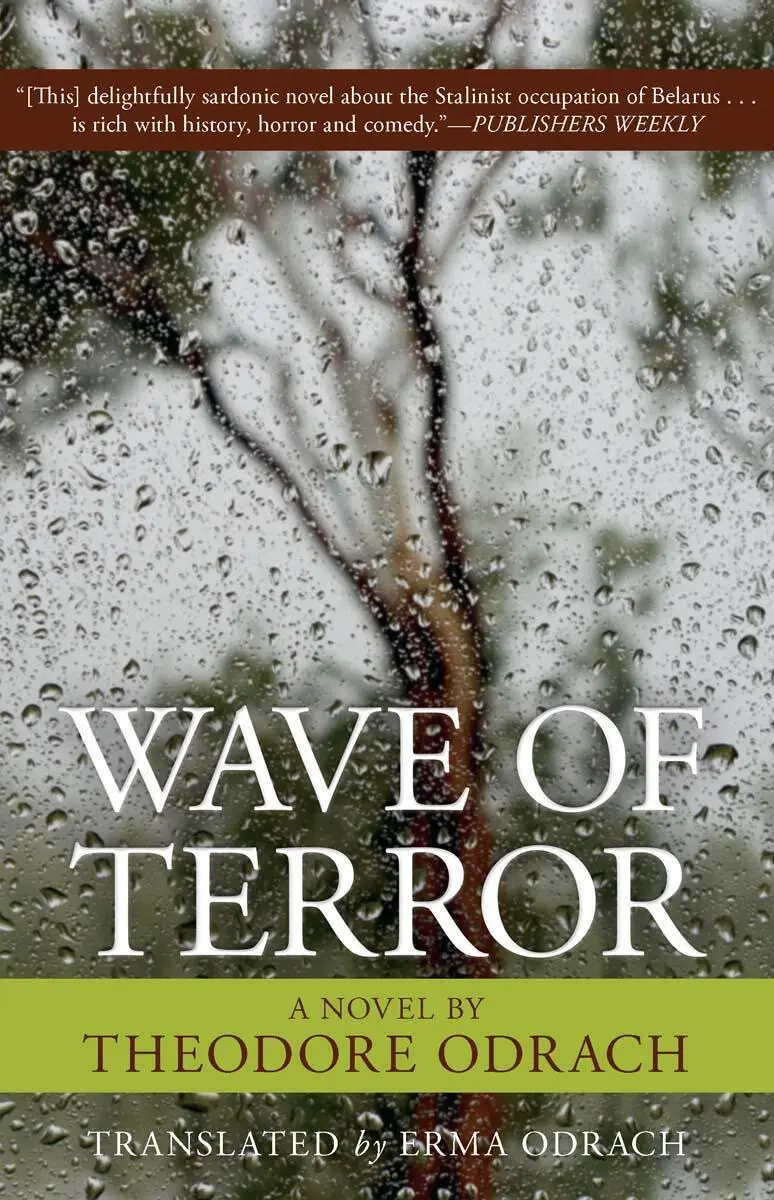
- Название:Wave of Terror
- Автор:
- Издательство:Chicago Review Press
- Жанр:
- Год:2008
- ISBN:нет данных
- Рейтинг книги:4 / 5. Голосов: 2
-
Избранное:Добавить в избранное
- Отзывы:
-
Ваша оценка:
Wave of Terror: краткое содержание, описание и аннотация
Предлагаем к чтению аннотацию, описание, краткое содержание или предисловие (зависит от того, что написал сам автор книги «Wave of Terror»). Если вы не нашли необходимую информацию о книге — напишите в комментариях, мы постараемся отыскать её.
Wave of Terror — читать онлайн бесплатно полную книгу (весь текст) целиком
Ниже представлен текст книги, разбитый по страницам. Система сохранения места последней прочитанной страницы, позволяет с удобством читать онлайн бесплатно книгу «Wave of Terror», без необходимости каждый раз заново искать на чём Вы остановились. Поставьте закладку, и сможете в любой момент перейти на страницу, на которой закончили чтение.
Интервал:
Закладка:
“I never thought I’d live to see the day,” she began. “I’m being given a goat, a pitiful goat and on its last legs. Just look at it!” Grasping Kulik’s arm, she became almost hysterical. “Director, tell Comrade Leyzarov how destitute I am! Tell him about my children! Tell him, please!”
Kulik shifted awkwardly as the eyes of the crowd fell upon him. He didn’t know how to react. Everyone stood waiting for something to happen. Suddenly an uncontrollable rage broke inside him, and looking at the crowd, he wanted to shout, “Help Paraska? Why should I help her, why should I help any of you? You all stand there knocking into one another and bobbing your heads, hoping for the new regime to grant you a small piece of the Olivinski estate. Can’t you see the hypocrisy of it all? They invade your land, and then act like your benefactors. Beg them for a fraction of what rightfully belongs to you, and then be grateful! You’re better off bashing your heads against the wall!”
But he knew he couldn’t say this; he could barely even dare to think it. It could cost him his life. Everything that was happening was entirely new and sudden; he found it strange and awful. He wanted nothing more than to return to his quarters, bury his head in his pillow and forget about everything.
Paraska tugged frantically at his sleeve, beside herself. “Director, Director! Tell the Party Representative how poor I am. Tell him how much I need a milking cow! Tell him about my children!”
Kulik turned to Leyzarov and spoke carefully. “Paraska Braskovia, our new cleaning woman, feels she has been slighted and thinks she ought to get a milking cow. A milking cow will help feed her children, who are terribly undernourished. This goat that you want to give her looks rather mangy and I can’t see how she can benefit from it. It will only consume hay and that will be very expensive, something Paraska cannot afford. You must understand, Paraska has five small children at home, yes, five, and she needs to feed them.”
Leyzarov stepped back and looked Paraska over. Stroking his chin as if considering Kulik’s every word, he seemed to agree. “Hmm … five children you say? Yes, and from what I can see, she’s still quite a young woman and could easily bear another five. Hmm … I think you’re right. Paraska Braskovia can certainly use a milking cow.”
Kulik wasted no time in picking up on Leyzarov’s benevolence. “We really must encourage women like Paraska. Her little ones need milk to grow big and strong, and the Soviet regime, as we all know, cares very much about the welfare of its children, especially the children of its workers. I beg you, comrade, give Paraska a milking cow. I understand you have at least twenty in the barn.”
Leyzarov tightened his lips. “No, I’m afraid that’s impossible. All the milking cows are to remain here. I have strict orders.”
“Well, then, maybe you can find something else for her?” Kulik was struck by his own boldness.
“Something else for Paraska? Let me see. How about a pregnant heifer? In a month’s time she will be with young and producing milk. Well, Paraska, what do you say about that?”
Paraska’s eyes opened wide. “Oh, thank you, comrade, thank you. That would be wonderful.” She grasped his hands and her face beamed with gratitude. She could scarcely believe her good fortune. “Is she really with young?”
“She certainly is.” Leyzarov turned sharply around and shouted, “Kirilo! Bring out the pregnant cow, the black-and-white spotted one at the back of the barn.”
In no time, Kirilo appeared with a rather heavy animal with broad shoulders and a strong horned head. Leyzarov forced a smile and with great formality handed her over to Paraska.
Paraska quickly took hold of the rope and, looking into the animal’s big round yellow eyes, immediately named her Rohula. She did not go directly home, but walked out into the road and proudly paraded the cow back and forth for all the villagers to see.
CHAPTER 4
The first snow fell over Hlaby. Like the soft down from a pillow, it piled in the yards and walkways of the small wooden cottages and collected high on their rooftops. A cold, harsh wind blew in from the north and hurled the flakes up into the air and over the vast frozen mudlands beyond. Before a newly erected building, home of the Lenin Clubhouse, there was a pile of snow twice the size of any other. The clubhouse had shot up several weeks ago, like a mushroom after a rainfall, on a site where had once stood a one-story barrack that housed the Olivinski farmhands. The clubhouse, now the heart of the village, bustled with activity. There were meetings almost every night and people, some known and some not, rushed in and out at all hours.
A few weeks before Christmas, something rather unexpected happened, to which all the villagers reacted with surprise and confusion. A large black-and-white poster was erected in front of the clubhouse, showing a Red Army soldier in full uniform embracing a poorly dressed peasant who held a hoe in one hand and a sickle in the other. The peasant stood gazing up at the soldier in adoration, smiling, almost teary-eyed. On the bottom of the poster was printed: LONG LIVE THE RED ARMY OF WORKERS AND PEASANTS! LONG LIVE THE REVOLUTION!
Although Bolshevism had manifested itself in almost all areas of the Pinsk Marshes, with such images popping up in towns and villages everywhere, for Hlaby at least, a display like this was a novelty. The first to take interest in it was Timushka. Standing on the frost-covered walkway, huddled in her brown frayed overcoat, she stared fixedly at it, trying to grasp its full meaning. Before long, she turned to call out to passersby and even rushed to bang on the doors of several nearby houses:
“People! People! Come see for yourselves! You won’t believe it! There’s a huge picture in front of the Lenin Clubhouse. It’s a Russian Army man and he’s embracing one of our very own. Yes, believe it or not, he’s embracing Cornelius Kovzalo! They’re standing like true brothers and out in the open for everyone to see! The soldier has a pink smooth face, and our horse thief is hiding behind his moustache. As if he hasn’t caused enough trouble already!”
This news did not take long to reach Grandfather Cemen. At first the old man could not believe that this could be possible — a man from the marshes and a Soviet together in an embrace? He decided he must see this spectacle for himself. Wrapped in his worn sheepskin, his woolen hat pulled over his ears, he leaned heavily on his walking stick and hobbled over the frozen mudland toward the clubhouse. The wind howled, cutting into his face like a knife while the frost collected on his brows and lashes. He labored painfully through the deep snow, pausing now and then, until he reached the marketplace, where he descended rather easily along a cleared path to the clubhouse entrance. A crowd had already gathered by the main door and the old man strained to get a look. People were knocking into one another, and pointing excitedly.
“Let me through! Let me through!” the old man cried, waving his cane. “I want to see!” When finally he faced the poster, he studied it for the longest time and from different angles, screwing up his mouth. The icy wind, now blowing even harder, made his eyes water, and the image became blurred. When he wiped his eyes with his coat cuffs, he was able to see what he feared most. The man whom the Red Army soldier was embracing was indeed Cornelius Kovzalo.
“Last night I dreamed of a black dog,” he shouted, “and a black dog is the sign of the Devil. Satan has embraced Satan. One of our very own has brought dishonor and shame to our village. And now God is punishing us with this brutal cold. And it won’t end here. When spring comes, the Stryy and the Pripyat rivers will overrun their banks like never before and drown all the sinners. The waves will pound against the shores and flood not only our fields but also our towns and villages. The Lenin Clubhouse will collapse and be carried off downriver in a thousand pieces.”
Читать дальшеИнтервал:
Закладка:
Похожие книги на «Wave of Terror»
Представляем Вашему вниманию похожие книги на «Wave of Terror» списком для выбора. Мы отобрали схожую по названию и смыслу литературу в надежде предоставить читателям больше вариантов отыскать новые, интересные, ещё непрочитанные произведения.




Обсуждение, отзывы о книге «Wave of Terror» и просто собственные мнения читателей. Оставьте ваши комментарии, напишите, что Вы думаете о произведении, его смысле или главных героях. Укажите что конкретно понравилось, а что нет, и почему Вы так считаете.