William Gerhardie - The Polyglots
Здесь есть возможность читать онлайн «William Gerhardie - The Polyglots» весь текст электронной книги совершенно бесплатно (целиком полную версию без сокращений). В некоторых случаях можно слушать аудио, скачать через торрент в формате fb2 и присутствует краткое содержание. Год выпуска: 2013, Издательство: Melville House, Жанр: Классическая проза, на английском языке. Описание произведения, (предисловие) а так же отзывы посетителей доступны на портале библиотеки ЛибКат.
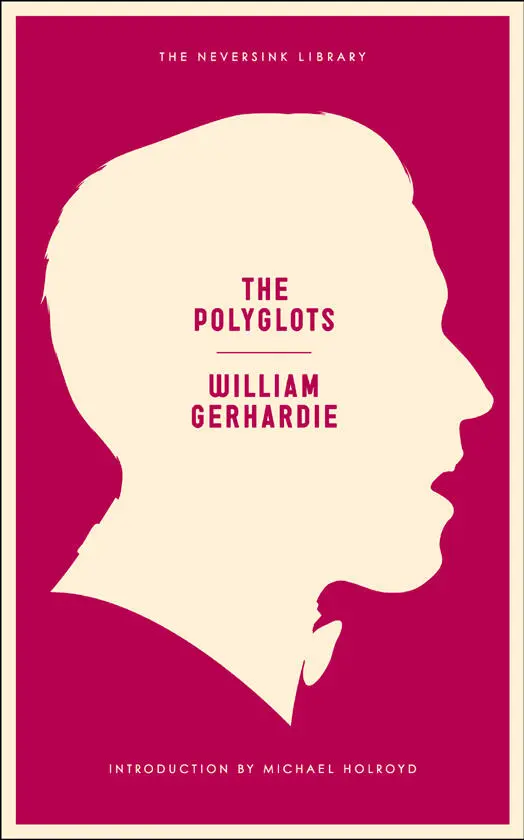
- Название:The Polyglots
- Автор:
- Издательство:Melville House
- Жанр:
- Год:2013
- ISBN:нет данных
- Рейтинг книги:5 / 5. Голосов: 1
-
Избранное:Добавить в избранное
- Отзывы:
-
Ваша оценка:
The Polyglots: краткое содержание, описание и аннотация
Предлагаем к чтению аннотацию, описание, краткое содержание или предисловие (зависит от того, что написал сам автор книги «The Polyglots»). Если вы не нашли необходимую информацию о книге — напишите в комментариях, мы постараемся отыскать её.
The Polyglots — читать онлайн бесплатно полную книгу (весь текст) целиком
Ниже представлен текст книги, разбитый по страницам. Система сохранения места последней прочитанной страницы, позволяет с удобством читать онлайн бесплатно книгу «The Polyglots», без необходимости каждый раз заново искать на чём Вы остановились. Поставьте закладку, и сможете в любой момент перейти на страницу, на которой закончили чтение.
Интервал:
Закладка:
‘ Jesus !’ she purled, ‘how I want to go on living for ever!’
Tears welled up from her eyes and hung on them, which made them seem golden, like Salomé’s. She smiled, and this shook them from her lashes.
But at dinner that night she was already laughing, drinking much wine and cooing gaily and, as always, half-audibly. Her teeth glittered as she held the glass, like a flower on a stem, and nearly spilt the wine, and because of this and her inherent gaiety, laughed more. Uncle Emmanuel and I had donned white flannels, and white almost transparent jackets — clean and crisp out of the wash — and Aunt Teresa and Aunt Molly, Berthe and Sylvia were also clad in gay white open lace; it was spring, almost summer now, and we were full of the joy of life. Aunt Molly with the children was at another table, and round the corner was Captain Negodyaev with his consort and Natàsha who kept looking round at us at intervals, laughing in her gurgling way. And suddenly she was crying softly.
‘What is it, Natàsha?’
‘What is it, dear?’
She cried very softly.
‘Darling, what is it?’
‘A wasp,’ she sobbed.
Harry laughed.
During dinner Uncle Emmanuel drank much wine and talked of the Governor’s ball that night and the mistake he had made in not calling on him. ‘I would have liked to go, too.’
‘ I ’m not going: I have no dress uniform.’
‘It’s a great pity.’
It transpired that Aunt Teresa, accompanied by Berthe, had also been on the Peak railway. ‘It pulled,’ she complained, ‘before I had sat down.’
‘That happens,’ I rejoined, ‘sometimes in sleep. One night I jumped clean out of bed.’
‘Oh yes, I remember!’ Sylvia cried happily.
‘Excuse me’—my uncle turned to her, looking suddenly like a detective—‘but how do you remember?’
‘Sorry,’ she said, lowering her lashes.
‘That won’t do at all.’
‘Sorry,’ she said. ‘Sorry.’
‘The point is that I jumped out clean on to the carpet.’
‘That is very interesting, I am sure,’ said he.
There was a stiff little pause. My uncle cleared his throat. ‘I suspected something all along. I suspected it.’
‘And I wish you joy of it!’
‘I would have advised you to be more careful, though.’
‘When I want your advice I shall cable for it.’
‘If we were here alone I would give you a bit of my mind.’
‘Then we should exchange our minds like visiting cards.’
‘She has no brother,’ he whimpered. ‘Anatole—’ And the tears came to his eyes.
‘I loved Ophelia; forty thousand brothers could not, with all their quantity of love, make up my sum.’
‘What has Ophelia got to do with it?’
‘I had made her happy.’
‘My poor daughter …’
Languidly I sipped my brandy. Wearily I raised my eyes at him. ‘ Must I really blow your silly brains out?’
‘This is scandalous! a scandalous affair!’
‘The only equity for your existence that I can tentatively advance, mon oncle , is that you may be a blessing in disguise.’
I may be — intermittently — a cynic; but he is worse: he does not know he is a cynic. His daughter! His daughter! But the daughter wanted me to love her, and her father meantime loved other men’s daughters. So why does he squeak and squeal, this future censor of films?
‘I am the last man,’ my tone was conciliatory, ‘to want to give the matter a significance it does not possess.’
‘Oh!’
‘Emmanuel,’ said Aunt Teresa in a tone which clearly implied that she was proud of his display of paternal authority but sought to show that much in life must be forgiven. She fumbled in her speech. What she meant, but found it difficult to convey in words, was that she had been unhappy all along at the thought of having done her daughter out of her birthright — which is love — but that I had somehow managed to restore that privilege. ‘But Emmanuel, Sylvia was already married at the time.’
‘On the eve of my departure, you old cuckoo of an uncle!’
‘Married?’ said Uncle Emmanuel, agreeably astonished at this extenuating circumstance. ‘Of course, that puts a different complexion on it. Well, at that rate we shall presume that she knew what she was doing. Still — still—’
But he did not get beyond that ‘still’—a protest put on record, but not pressed.
Dinner over, we lounged over coffee on deck. The big steamer had gone out into the open sea; the pier was discernible only by its string of lights. When the café orchestra subsided, in the intervals we could just catch the distant strains of the band playing in the illuminated gardens of Government House. On the bows a gramophone screamed shrilly, and some Cockney petty officers danced to it with one another in quick, vulgar movements.
This was China — the Far East! The moist heat of evening enveloped us, and standing at the rail, the ship in midstream, somehow one felt sorry for onself and all the lives that live.
49
Methinks it should be now a huge eclipse
Of sun and moon and that the affrighted globe
Should yawn at alteration.
OTHELLO.WHEN WE HAD COME BACK NEXT DAY (THE SHIP had broken down and was undergoing alterations and repairs) the General with the mad eyes was still on board, pacing the deck in his sweat-eaten canvas shoes, as a cat paces the roof of a house in flames. The General, who had come from Hong-Kong to Shanghai and had arrived again at Hong-Kong, decided to go on to Singapore, where the Russian Consul — so he hoped — would finance him and request and require that he be allowed forthwith to land on British soil. To this idea he clung with that ready hope of the fainthearted who, because he dreads the prospect of despair — his sole alternative, clutches at each straw with the assurance of salvation. The General with the mad eyes looked on the British Empire as a huge joke, while Captain Negodyaev regarded it as a refuge for himself and for his family from the imagined persecutions which he so feared on Russian soil, and gravely saluted the Union Jack on every possible occasion; and the occasions, considering that every port we touched was unequivocally British, were not few. It is a truism that whenever Russians meet they quarrel. Captain Negodyaev was a monarchist at heart, and the General with the mad eyes a Bolshevik convert. When on board I played the magnificent old Russian national anthem, the General remarked that it was most improper, while Captain Negodyaev begged me to go on. Yet, it was the Captain who was socially despised by the General, who called his junior a vulgar time-server, and scoffed at his undistinguished unit and provincial upbringing. The Bolshevik General had been a guardsman and a military academician. He prided himself on his connexions in England, and spoke a great deal of the peers with whom he was intimate. ‘I have only to write to Lord Curzon,’ he would say, with a self-satisfied smile, ‘and all the British ports will lie open before me.’
‘But in spite of all your aristocratic friends,’ rejoined Captain Negodyaev, ‘they won’t let you out to buy yourself a pack of postcards. Whereas I—’
‘Of course not, because I am a big gun; but you — you’re a nonentity, they don’t notice you.’
The Captain of H.M.T. Rhinoceros , a stout little man with an unpleasant smile, and wearing the C.M.G. ribbon, implied in all he said and did that he was every bit as good as a regular Captain of the Royal Navy. But the R.N. Commodore, who travelled as a private passenger on board and wore plain clothes, was a constant eyesore to him; and during dinner the Captain dwelt at length on the service rendered in the war by the Mercantile Marine.
Читать дальшеИнтервал:
Закладка:
Похожие книги на «The Polyglots»
Представляем Вашему вниманию похожие книги на «The Polyglots» списком для выбора. Мы отобрали схожую по названию и смыслу литературу в надежде предоставить читателям больше вариантов отыскать новые, интересные, ещё непрочитанные произведения.





Обсуждение, отзывы о книге «The Polyglots» и просто собственные мнения читателей. Оставьте ваши комментарии, напишите, что Вы думаете о произведении, его смысле или главных героях. Укажите что конкретно понравилось, а что нет, и почему Вы так считаете.