William Gerhardie - The Polyglots
Здесь есть возможность читать онлайн «William Gerhardie - The Polyglots» весь текст электронной книги совершенно бесплатно (целиком полную версию без сокращений). В некоторых случаях можно слушать аудио, скачать через торрент в формате fb2 и присутствует краткое содержание. Год выпуска: 2013, Издательство: Melville House, Жанр: Классическая проза, на английском языке. Описание произведения, (предисловие) а так же отзывы посетителей доступны на портале библиотеки ЛибКат.
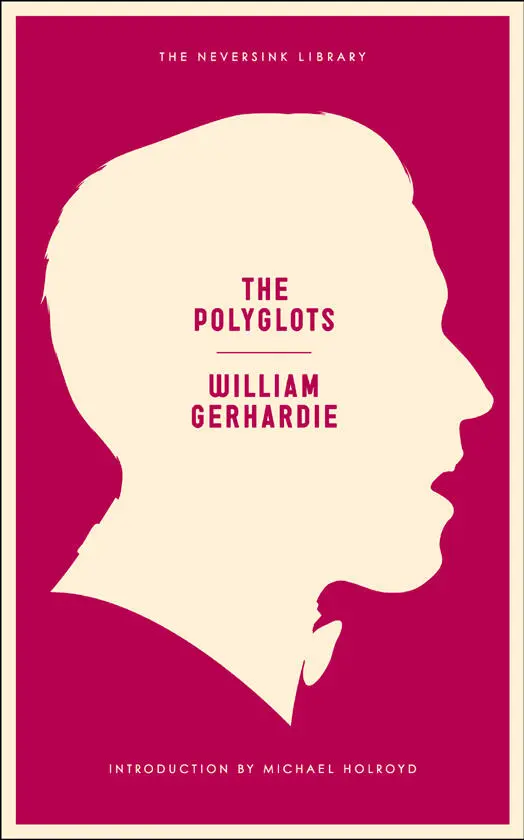
- Название:The Polyglots
- Автор:
- Издательство:Melville House
- Жанр:
- Год:2013
- ISBN:нет данных
- Рейтинг книги:5 / 5. Голосов: 1
-
Избранное:Добавить в избранное
- Отзывы:
-
Ваша оценка:
The Polyglots: краткое содержание, описание и аннотация
Предлагаем к чтению аннотацию, описание, краткое содержание или предисловие (зависит от того, что написал сам автор книги «The Polyglots»). Если вы не нашли необходимую информацию о книге — напишите в комментариях, мы постараемся отыскать её.
The Polyglots — читать онлайн бесплатно полную книгу (весь текст) целиком
Ниже представлен текст книги, разбитый по страницам. Система сохранения места последней прочитанной страницы, позволяет с удобством читать онлайн бесплатно книгу «The Polyglots», без необходимости каждый раз заново искать на чём Вы остановились. Поставьте закладку, и сможете в любой момент перейти на страницу, на которой закончили чтение.
Интервал:
Закладка:
How I have wept, the long night through, over the poor women of the past, so beautiful, so tender, so sweet, whose arms have opened for the kiss, and who are dead! The kiss — it is immortal! It passes from lip to lip, from century to century, from age to age. Men gather it, give it back, and die.
It was interminable night. Carefully I moved my foot to hers and felt her ankle. She never stirred. Yes, she was asleep and leaning on my shoulder.
Presently she sighed, tried to readjust her head upon the pillow, then gave it up as a bad job, opening her eyes.
‘Put your pillow on my knees.’
She did. ‘Better now.’ She closed her eyes. I looked at my watch. It was past 3 a.m. All were sleeping. Then Harry, who had been sleeping with his head on Berthe’s lap, woke up. He muttered: ‘Yesterday the train went; today it’s stopped.’
‘Sleep, my little one,’ Berthe whispered, ‘sleep, my darling. You’ve woken in the middle of the night. The train went yesterday and today too; it has only stopped for a few minutes and will go on directly. Sleep, my darling.’ She kissed him on the forehead. ‘Sleep, my little one. There.’
He shut his eyes, but opened them again after awhile with the remark, ‘Where’s Nora’s monkey?’
Berthe tucked the cloth monkey in the front of his coat; he shut his eyes. But soon afterwards he woke again, announcing his intention to hang the monkey.
This roused the rest of us, and no one any longer tried to sleep. I raised the window-screen. The grey dawn, showing feebly through the rain-stained window, mocked at the electric light. The air in the coupé was heavy. Uncle Emmanuel yawned into his hand and opened the door into the corridor. It was chilly. The ladies bucked up. Powder-puffs, hand-mirrors, and the like came into play; hands and eyes got busy; coiffure and complexion was remedied; scent poured out galore. And not a drop of water all the time. Water was not mentioned. Water was not thought of! Sylvia had a tiny orange-coloured crêpe-de-Chine ‘hanky’—that was all she used by way of toilet. It seemed to me touching. But had she used a bath-towel or nothing at all, it would have appeared to me — for such is the nature of love — equally touching.
The train raced towards Changchu. Another train hove in sight, and the two trains raced side by side: now one was ahead, now the other; till their ways took them asunder and the other train raced away out of sight.
At ten o’clock in the morning the train, exhausted, pulled up at Changchu. I looked out. Silence. Dusty foliage. Chinks squatting on the ground and staring at the train. Lemonade and oranges on sale on the platform. Sunshine. What a country! Peace. Relaxation. It goes on in that benevolent, watching, smiling sunshine. We got out and repaired to the hotel for lunch.
Before lunch Aunt Teresa drank a cocktail with a cherry on a matchstick. It was a lovely day in spring. We sat on the open veranda and talked.
‘Now do we live after death?’ asked my aunt.
‘The answer,’ said I, ‘is in the affirmative.’
‘How can we know?’ Captain Negodyaev interjected. ‘We have so little to go upon.’
‘A plain reason for not going upon it. Seeing that, when all is said, life is a miracle, it would be a miracle indeed if the miraculous never occurred.’
‘But you seem certain.’
‘There are umpteen ways of being alive, but there is only one way of being dead. It follows than the chances of life after death are umpteen to one.’
‘When you come to think,’ chimed in Captain Negodyaev, ‘what can we know! If I trust my inspired moments I say, yes, death is not the end. If I trust my stock moods, I say, probably it is.’
‘And you, George?’ asked my aunt. ‘How do you really feel about it?’
I sighed.
‘As George Hamlet Alexander Diabologh, author, I shall bow my adieux and never emerge after death; but as rightful shareholder in Life I am immutable, and will go on till the Universe perish with me. Perhaps as one on the board of directors of Cosmos, Unlimited . Perhaps — since I’m a holder of preference shares — as some sort of joint chairman with God. But perish I shall not: since, like any another, I am a holder of shares in the cosmic concern.’
Aunt Teresa sighed with relief. ‘Ah, if it were so!’
‘It is so. You may take my word for it, ma tante .’
‘No death?’
‘Never.’
Captain Negodyaev shook his head.
My aunt looked at him. ‘Why should we live so little,’ she asked, ‘and be dead such a time? Why?’
‘No reason at all,’ said my uncle.
‘So perhaps Anatole is alive.’
‘You bet he is! More alive than before.’
‘But does he remember? Does he remember me?’
‘He doesn’t remember a damned thing.’
‘Oh!’
‘We are but vessels of past memories,’ said Captain Negodyaev. ‘When I think of the living things around me which are to me as something that has never been, I am conscious of the nature of obliteration, of the seeds of death I already carry in me. A little more — and death will be complete.’
‘So you think,’ I said. ‘Unthinkingly. It is not the memory that lives on in you, it’s that little voice, that little lamp which is immortal. You may lose your memory forthwith and be none the worse for it; you would still go on feeling your I to be you and none else, as you do through every dream and nightmare: because this I is lit at the immortal altar of all life, and so remains immortal, may it immerse in whatever worlds, it is you , a world in itself and for ever.’
‘Well, well. It’s time we went in to lunch.’
A British merchant from Harbin who travelled with us gave us a champagne lunch. ‘You may think it a little extravagant of me,’ said he. ‘But on such occasions one lets oneself go a bit, don’t you know. And I have come to believe that generosity repays itself.’
‘Oh, I want the Daily Mail . Can we see the Daily Mail here?’ Sylvia asked.
‘Well, unfortunately you can.’
Then we drove back to the station.
How, after a champagne lunch on a sweet spring day, standing on the platform — the engine: puff-puff-puff — life is wonderful and miraculous with sweet expectancy.
At Mukden the last coach of our special train was unhooked, and we took on the ordinary train to Peking. In the early morning hours Sylvia and I rickshawed in the noisy languid din through the pagan gorgeousness of the Manchu capital, and having lost our way we were hard put to it to tell the rickshaw coolies to drive us back to the station. We imitated the sound of a railway engine with our lips, and the look of steam issuing forth from the funnel with our hands. The coolies grinned a ready comprehension, but after driving about for twenty minutes or so, stopped and scratched their heads dubiously, when we hastened to resume overtures, apparently all to no purpose. Till happily two Europeans hove in sight. We caught the train by a split second. Aunt Teresa was in hysterics. Early next morning we saw the Great Wall of China. And at midday the train steamed into Peking.
We saw what there was to see; climbed up the pagodas; visited the Summer Palace; a couple of Buddhist temples. Aunt Teresa lifted her feet high up to prevent horrible large ants from climbing up her legs.
‘And what is that?’ Berthe asked.
‘That is Buddha.’ I looked into her eyes with glee.
‘H’m,’ said she. ‘H’m. — Well, well!’
We visited the cemeteries of rank, and Uncle Emmanuel even signed his name in the register as well as on the wall and on the painted wooden pillars. Whereupon we got into our rickshaws and drove back to the hotel.
Читать дальшеИнтервал:
Закладка:
Похожие книги на «The Polyglots»
Представляем Вашему вниманию похожие книги на «The Polyglots» списком для выбора. Мы отобрали схожую по названию и смыслу литературу в надежде предоставить читателям больше вариантов отыскать новые, интересные, ещё непрочитанные произведения.








Обсуждение, отзывы о книге «The Polyglots» и просто собственные мнения читателей. Оставьте ваши комментарии, напишите, что Вы думаете о произведении, его смысле или главных героях. Укажите что конкретно понравилось, а что нет, и почему Вы так считаете.