William Gerhardie - The Polyglots
Здесь есть возможность читать онлайн «William Gerhardie - The Polyglots» весь текст электронной книги совершенно бесплатно (целиком полную версию без сокращений). В некоторых случаях можно слушать аудио, скачать через торрент в формате fb2 и присутствует краткое содержание. Год выпуска: 2013, Издательство: Melville House, Жанр: Классическая проза, на английском языке. Описание произведения, (предисловие) а так же отзывы посетителей доступны на портале библиотеки ЛибКат.
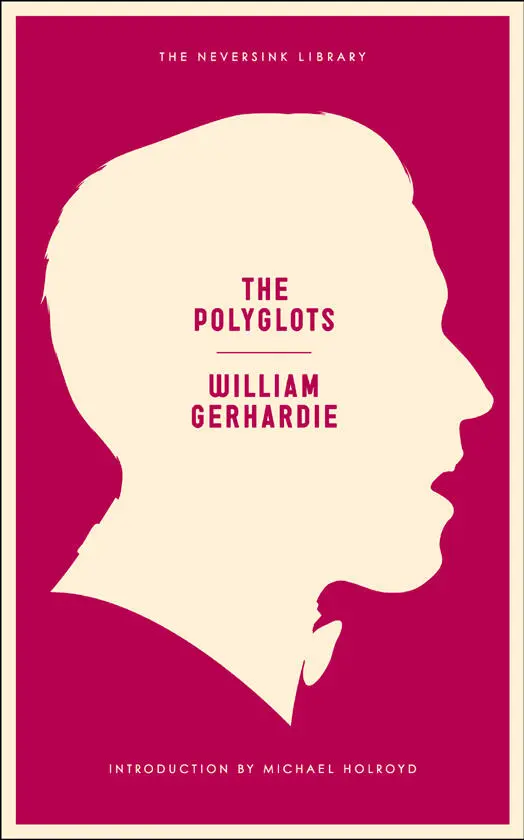
- Название:The Polyglots
- Автор:
- Издательство:Melville House
- Жанр:
- Год:2013
- ISBN:нет данных
- Рейтинг книги:5 / 5. Голосов: 1
-
Избранное:Добавить в избранное
- Отзывы:
-
Ваша оценка:
The Polyglots: краткое содержание, описание и аннотация
Предлагаем к чтению аннотацию, описание, краткое содержание или предисловие (зависит от того, что написал сам автор книги «The Polyglots»). Если вы не нашли необходимую информацию о книге — напишите в комментариях, мы постараемся отыскать её.
The Polyglots — читать онлайн бесплатно полную книгу (весь текст) целиком
Ниже представлен текст книги, разбитый по страницам. Система сохранения места последней прочитанной страницы, позволяет с удобством читать онлайн бесплатно книгу «The Polyglots», без необходимости каждый раз заново искать на чём Вы остановились. Поставьте закладку, и сможете в любой момент перейти на страницу, на которой закончили чтение.
Интервал:
Закладка:
We stopped peeping but began whispering to each other; for, indeed, Uncle Lucy was getting very strange. He did not come in to chocolate, but went up into the dark-room instead to develop some snaps. Of late, Uncle Lucy was always taking photographs and developing them in the dark-room upstairs. After chocolate, the children began playing together, at first somewhat gingerly, as if sounding one another; then more freely and boisterously. There was a boy with a withered arm, nevertheless very sturdy and strong and twice the size of Harry. Harry, in a wicked mood, came up to him suddenly, and — for no conceivable reason, but merely from an abounding sense of well-being — slapped him in the face. The boy’s impulse was to strike Harry back, but he must have remembered that he was a guest and restrained himself, with a mighty effort. For two minutes or so he brooded over the offence, as if considering whether he should be offended or no. He could not stomach the idea that a boy half his size should have dared to strike him in the face with impunity. At last, he came up to Harry and — mildly, because he was the guest, almost amicably, with a propitiatory, extenuating smile — slapped Harry in the face. Harry looked as if considering whether he should cry, but since the boy with the withered arm smiled, Harry decided to take no offence and smiled too — unconvincingly. Two little girls with a little boy came in — a curly-haired, black-eyed, clean-faced and thoroughly well-brought-up boy, who presently, quite by accident, got a black eye from the boy with the withered arm, and went off crying softly. At once his two little sisters put their arms round his neck, kissing and consoling him: ‘Oh, it was a knock. Oh, it was one!’—A microcosm of the adult world.
They bandaged the little boy’s head up, and they all went on playing again. In the end, hardly one of them escaped uninjured.
‘And now Nora will recite to us,’ said Aunt Teresa, ‘Little fly on the wall.’
‘No, “Wee Willie”,’ she said.
‘All right, “Wee Willie”, then.’ And placed on a chair, Nora said:
Wee Willie had a rittle flute
Which really was so sweet
That when he went out for a walk
He played it in the street .
And when the folks heard Willie play
They all began to dance ,
The rittle dogs sat down and howled ,
The horses did a prance .
So Willie’s mother took him home ,
And tucked him up in bed .
‘ I’ll have to take away your flute ,
It upsets folks,’ s’e said .
All clapped; and, for an encore, she told us about Bunny who was white and such a size, who had long silky floppy ears and funny wee pink eyes.
Long after chocolate, Uncle Lucy came down into the drawing-room, where already a number of guests — my friends: local intellectuals — were gathered, and sat facing us, looking on sarcastically, never saying a word. He was pale, but his nose was redder than ever. ‘What is consciousness?’ I was saying. ‘At the point where all the rays meet, there is a spark: that spark is. But the same rays meet in infinity again and again an infinite number of times (all straight lines being crooked in the infinite), and so all these other sparks are all these other I ’s. But since we are, each one of us, the sum of the same rays, all I ’s have their immortal being in the source of the One, eternally replenished by the fount of the Many: the finest distillation of this comprehension being the spirit we call God.’
Uncle Lucy as he sat there, listening, looked so wise, so derisively contemptuous in his silence; had such a seer’s look in his eyes (as if indeed he were seeing through our intellectual foibles far into the future) that it silenced even the intellectuals. They felt as if Uncle Lucy had a secret message for ever hidden from their minds. They looked respectfully expectant. Even Dr. Murgatroyd stopped talking. Uncle Lucy’s true secret, however — they did not know — was that he had quietly gone off his chump, indeed was already as mad as a hatter. Yesterday he had taken Aunt Teresa out for a drive and kept calling at shops without number, purchasing things — mostly cumbersome, useless things — without end, so that Aunt Teresa, sitting there beside him in the vehicle, thought that her poor brother had definitely turned the corner, and that his old vein of prodigious generosity was returning to him. But the extraordinary thing about it all was that the things he bought were conspicuously useless and unwieldy things — electric stoves, two ladders, a canary cage — depositing his purchases, as they drove on, at the railway station in charge of porters, at the theatre cloakroom, and suchlike places, which even to Aunt Teresa’s unsuspecting soul appeared a trifle singular. Next day he came into the drawing-room, with that sulky Charlie Chaplin look we grew to know so well, and manifesting the wish to tune up the piano, took it all to pieces, to the minutest particles, so that afterwards he was unable to put it together again. He went out, and Aunt Teresa, frightened of meeting him alone, locked the drawing-room door. He returned, and finding the door locked, smashed the window.
Now he pulled out his watch and, declaring that it was half-past twelve o’clock, said that he had some snaps to develop in the dark-room.
‘But, Uncle Lucy, it isn’t six! What is the matter with your watch?’
‘I’ve got to go by my watch — such as it is,’ he replied very gravely and earnestly, and went off to the dark-room.
I went back to my office, and Uncle Emmanuel, who had lit a cigar, said that in spite of the rain he would come out with me. The pavement was a glittering sheet, like a wet waterproof, but the evening was misty and dark and the rain that wetted my face was completely invisible, and only as you came up to a lamp-post could you see how, in the radius of yellow light, the silver rain fell steadily from the sky. We took refuge in the barred doorway of a hosiery shop, whose windows were shuttered. A young woman was standing there, and my uncle took the opportunity of ogling at her through his pince-nez. And when I returned, after having vainly looked for a cab, Uncle Emmanuel was already speaking to her in his own tongue, while she only giggled and simpered. Presently we all moved along, Uncle Emmanuel holding his new friend by the arm. I parted with them at the back stairs of a shabby building, which they slowly ascended, but the rain having now become a torrent, I returned and stood under the porch, waiting for it to subside. Then, as I stood there, I heard strange menacing sounds from the back of the stairs up which my uncle had vanished. After a while, fearing that he might be in danger, I followed the sound of the menacing voice and gingerly knocked at a door on the second landing. There was no answer, but the thick drunken voice still boomed out menacing words, punctuated, as I now distinctly discerned, by Uncle Emmanuel’s, as it seemed to me, feeble exhortations which sounded rather like ‘Allies! Allies!’ With an inward thrill of trepidation, I pushed open the door and, entering, perceived a huge fierce drunken Cossack ‘carrying on’ in the face of my uncle’s clearly unwarranted presence, while the woman was doing her best to restrain him.
‘This is my husband,’ she turned to me. ‘Returned unexpectedly.’
But here, again, I am in difficulties. My uncle was, as you may guess, the hero of an unseemly situation. I warn the reader to put down the book, for I refuse to hold myself responsible for the doings of my uncle. I am a serious young man, an intellectual. I blush all over, my very paper blushes as I think of him standing there — I can’t. You must not press me to go any further. For there, if you please, stood my uncle — No; the less said of it the better. A veil over my uncle’s private life. A veil! A veil!
Читать дальшеИнтервал:
Закладка:
Похожие книги на «The Polyglots»
Представляем Вашему вниманию похожие книги на «The Polyglots» списком для выбора. Мы отобрали схожую по названию и смыслу литературу в надежде предоставить читателям больше вариантов отыскать новые, интересные, ещё непрочитанные произведения.




Обсуждение, отзывы о книге «The Polyglots» и просто собственные мнения читателей. Оставьте ваши комментарии, напишите, что Вы думаете о произведении, его смысле или главных героях. Укажите что конкретно понравилось, а что нет, и почему Вы так считаете.