William Gerhardie - The Polyglots
Здесь есть возможность читать онлайн «William Gerhardie - The Polyglots» весь текст электронной книги совершенно бесплатно (целиком полную версию без сокращений). В некоторых случаях можно слушать аудио, скачать через торрент в формате fb2 и присутствует краткое содержание. Год выпуска: 2013, Издательство: Melville House, Жанр: Классическая проза, на английском языке. Описание произведения, (предисловие) а так же отзывы посетителей доступны на портале библиотеки ЛибКат.
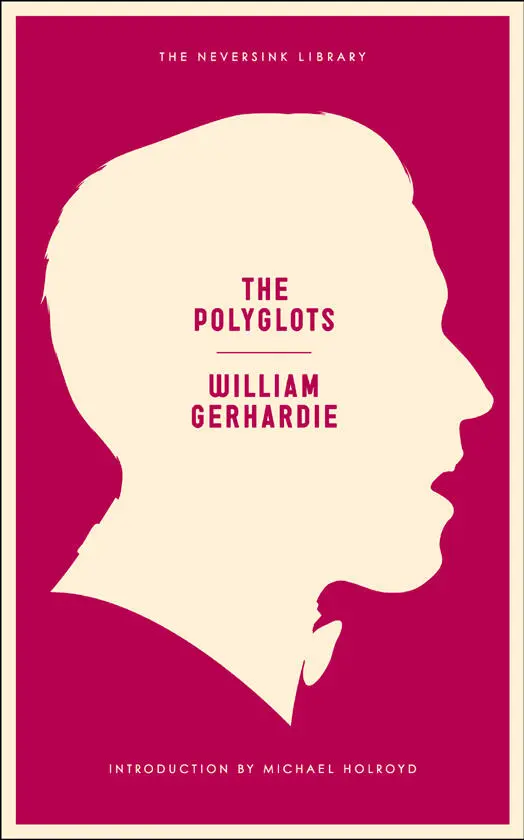
- Название:The Polyglots
- Автор:
- Издательство:Melville House
- Жанр:
- Год:2013
- ISBN:нет данных
- Рейтинг книги:5 / 5. Голосов: 1
-
Избранное:Добавить в избранное
- Отзывы:
-
Ваша оценка:
The Polyglots: краткое содержание, описание и аннотация
Предлагаем к чтению аннотацию, описание, краткое содержание или предисловие (зависит от того, что написал сам автор книги «The Polyglots»). Если вы не нашли необходимую информацию о книге — напишите в комментариях, мы постараемся отыскать её.
The Polyglots — читать онлайн бесплатно полную книгу (весь текст) целиком
Ниже представлен текст книги, разбитый по страницам. Система сохранения места последней прочитанной страницы, позволяет с удобством читать онлайн бесплатно книгу «The Polyglots», без необходимости каждый раз заново искать на чём Вы остановились. Поставьте закладку, и сможете в любой момент перейти на страницу, на которой закончили чтение.
Интервал:
Закладка:
‘Merrily-y — merrily-y — till the tenor of the song goes merrily.’
‘Gleen glow the leaves on the ole, ole tree,’ sang the small children, while Nora lagged behind—
‘navver could aglee—’
‘They razzled and they jazzled,’ came from Bubby, Harry, and Natàsha, and Nora sang—
‘and the t a nner of the song—’
‘Mère Lee—! Mère Lee—!’ came Berthe’s piercing soprano, a rendering which was an outrage on the national atmosphere of the song. ‘They razzled and they jazzled,’ Nora sang in her own time and tune, while—
‘Gleen glow the leaves’ came from the other three, when Nora, making up by a bounce, would cry—
‘could aglee —!’
And Berthe shrieked like an engine whistle—‘Mère Lee eee— !’
From the many lighted candles the room had become very hot. Beyond the drawn curtains, Harbin was eclipsing into twilight, amid cries of Mongol drivers and the sound of cracking whips, the sense of two rival civilizations bordering on each other, the piercing wind sweeping the barren, naked streets, raising clouds of cold dust, and the town mercilessly cold but snowless, miserable, like a sleepless sufferer or a tearless heart. The wax candles burnt down sadly. The smell of burning pine. Music, laughter — and I wanted to weep for all living things. Oh, why must we live? Half realized revelry! Whom were we pleasing? A mere interlude — and then back. Back at the heart of the universe, listening to the beat and the waves universal rising and falling and breaking in and about us, dreaming of all things and none, sleeping — what deep, wholesome sleep — for ever and ever and ever.
The three little chairs of the three little bears were put in a row. Berthe, who had a ‘working knowledge’ of music, sat down to the piano, and Aunt Teresa, as a special dispensation on account of the high festival, joined her, brushing aside her long, black silk skirt as she sat down on the plush stool beside Berthe (who had moved on to a plain chair), and the two women struck together the opening bars of Liszt’s Rhapsody No. 2, the children the while playing musical chairs. Harry moved very close to the chairs, ready to drop into each and even sitting down for a space and refusing to move on, and having fallen out of the game, joined again imperceptibly and strove irregularly to compete for a chair as before. Aunt Teresa and Berthe were belabouring the rhapsody, my aunt swinging her body a little to the always accelerating galloping rhythm, as though she were an expert musician, or else an expert horsewoman — or both. And possibly because the passage they were interpreting was one of chaos, they never noticed a discrepancy till Berthe turned the page. ‘ Voyons donc, Berthe ! I’m not yet half through the page!’—‘ Enfin, Thérèse !’ Nor had we noticed anything, for chaos it should have been: and chaos it certainly was. The music having abruptly ceased, the children made for the chairs, and Nora fell out.
After supper Dr. Murgatroyd was talking of the psychology of the Koreans in the light of the teaching of Confucius, when he suddenly discovered that, leaning back against a table with a lighted candle on it, he had burnt a hole in the seat of his trousers. From the adjoining room came Beastly’s resonant voice: ‘No, my dear sir, you can’t get out of that — ha, ha! Sit down, here you are, here’s the pen and here’s the ink, and get about it — ha, ha, ha!’ he guffawed loudly.
‘See here, man, you sit down right here, and write to your Marshal,’ spoke Philip Brown’s stern voice.
‘But ze maréchal he be astonished,’ protested Uncle Emmanuel excitedly.
‘Never you mind, old chap. You write him a letter and ask him for the autograph, quick.’
‘ Allons donc! le maréchal he askèd for ze French Red Cross, and ze French Red Cross zey getted nothing. You send it all to American Red Cross.’ Flushed in the face, Uncle Emmanuel expostulated: ‘Excuse to me, ’ow can I ask? He askèd where is ze money. I say, Zey send it all to Amérique! Nom de Dieu, enfin! ’ protested Uncle Emmanuel, all his muscles agog with excitement.
‘They’re Allies — ain’t they?’ Beastly interjected.
‘Sure we are!’ said Philip Brown.
‘Why, my dear sir — ha, ha, ha, ha! you don’t know your own silly business!’
‘ Comment ?’
‘Come on yourself! Get down to it and write to the Marshal for the autograph, here, now.’ The two men standing over him, Uncle Emmanuel sat down to his desk and, with tears in his eyes, began to write to the Marshal.
The three little bears played nicely together, having moved their three little chairs round the table, though now and then Harry upset their shop, and then you heard Natàsha’s voice: ‘Harry! Harry! What for you doing!’ and also you heard Nora’s voice: ‘Leave me alone! Shu p up! Harry! Leave me alone ! Stop it! Stop it !’
‘Whatever is the matter?’ Aunt Molly asked.
‘Nora’s eaten my chocolate-cream,’ Harry wailed.
‘Because he’s eaten my Easter egg last year!’ Nora cried eagerly.
Slap! Slap! Slap! came from Aunt Molly — and tears galore from the children’s eyes.
Then they played as before. They exchanged with each other some of their presents. ‘Give back?’
‘No give back?’ or ‘To keep?’ Harry changed his chocolate stick with a little boy for a watch. ‘I gave him this,’ Harry said, looking the while at the watch. ‘Is it worth it?’ The little boy ate the chocolate stick and then cried and wanted his watch back. Harry pricked Nora’s balloon, and, watching it, I thought: I’d like to die like that — fizzle out.
‘Harry’s been kicking Natàsha!’ Nora complained to her mummy. But Harry, who heard this, only called out ‘Nora!’ put his arm round her, and off they ran together happily, neither of them caring a straw. Only Bubby played demurely alone.
At half-past ten, just before retiring to bed, Captain Negodyaev had a relapse of persecution mania, and he bid his wife and daughter dress — ready for flight at a moment’s notice. They sat in the hot drawing-room, all dressed and ready, in their fur coats and muffs and hats and warm goloshes, till he declared ‘All Clear!’ and sent them off to bed.
Towards bed-time the children were overwhelmed with presents. They were dazed, almost unhappy: Nora dying from fatigue. Washed and put to bed, she knelt up and prayed: ‘Gentle Jesus meek and mile look upon a little chile pity my s-s-s-simplicity. God bless mummy and daddy and granpas and granmas and uncles and aunties and cousins — and Cousin Georgie.’
Then Harry, too, rose on his knees. ‘Green grow—’
He stopped. An impatient wave of the hand—‘Not that!’—and fell dead asleep.
35
AFTER CHRISTMAS OUR WEDDING WAS POSTPONED till after the New Year. ‘Do you mind, darling?’
‘No, just as you like, darling.’
I looked at her tenderly. ‘Lovie-dovie-cats’-eyes.’
‘This is too soppy, darling,’ she said.
Since early morning on New Year’s day visitors had been calling on us. Franz Joseph came. The spelling lady came. The virgin came. After the virgin and the daughter of the actual-state’s-councillor, there came a morose-looking Russian major general with pale mad eyes, whose conversation was largely incoherent. I was besieged by them, yet I liked them. They were good, well-behaved lunatics, trim and neat in their diminutive, harmless lunacy, compared with our war lords in their raving, disorderly madness. They were floating in a sea of bewilderment and confusion, but we who were waging this colossal war with seriousness and with method were more destructively futile in our pretensions, more grievously self-deluded. The world had got unhinged and was whirling round in a pool of madness, and those few lunatics were whirling independently within ours: wheels within wheels! And I received them with courtesy, to the pained astonishment of Vladislav, who, pointing at Franz Joseph, said: ‘In France they wouldn’t have spoken to that man.’ So sensible and nice and relevant they were in their own little world of delusion that we, big lunatics, who were engaged in making war and revolution, allowed the little lunatics to roam in peace at large: out of a latent instinct of proportion that it would have been absurd to lock them up in the face of what was being done by admittedly sane people in our midst. Asylums and prisons were open: indeed, not in Russia alone. To give Europe her due, ‘retail’ murderers had been invited to vacate their prison cells to participate in the wholesale murder going on galore upon the battlefields.
Читать дальшеИнтервал:
Закладка:
Похожие книги на «The Polyglots»
Представляем Вашему вниманию похожие книги на «The Polyglots» списком для выбора. Мы отобрали схожую по названию и смыслу литературу в надежде предоставить читателям больше вариантов отыскать новые, интересные, ещё непрочитанные произведения.

Обсуждение, отзывы о книге «The Polyglots» и просто собственные мнения читателей. Оставьте ваши комментарии, напишите, что Вы думаете о произведении, его смысле или главных героях. Укажите что конкретно понравилось, а что нет, и почему Вы так считаете.