Joseph Roth - The Silent Prophet
Здесь есть возможность читать онлайн «Joseph Roth - The Silent Prophet» весь текст электронной книги совершенно бесплатно (целиком полную версию без сокращений). В некоторых случаях можно слушать аудио, скачать через торрент в формате fb2 и присутствует краткое содержание. Год выпуска: 2003, Издательство: The Overlook Press, Жанр: Классическая проза, на английском языке. Описание произведения, (предисловие) а так же отзывы посетителей доступны на портале библиотеки ЛибКат.
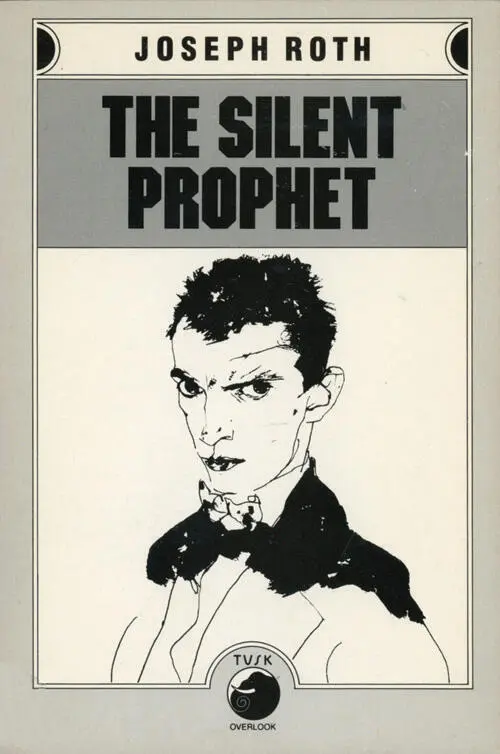
- Название:The Silent Prophet
- Автор:
- Издательство:The Overlook Press
- Жанр:
- Год:2003
- ISBN:нет данных
- Рейтинг книги:3 / 5. Голосов: 1
-
Избранное:Добавить в избранное
- Отзывы:
-
Ваша оценка:
The Silent Prophet: краткое содержание, описание и аннотация
Предлагаем к чтению аннотацию, описание, краткое содержание или предисловие (зависит от того, что написал сам автор книги «The Silent Prophet»). Если вы не нашли необходимую информацию о книге — напишите в комментариях, мы постараемся отыскать её.
The Silent Prophet — читать онлайн бесплатно полную книгу (весь текст) целиком
Ниже представлен текст книги, разбитый по страницам. Система сохранения места последней прочитанной страницы, позволяет с удобством читать онлайн бесплатно книгу «The Silent Prophet», без необходимости каждый раз заново искать на чём Вы остановились. Поставьте закладку, и сможете в любой момент перейти на страницу, на которой закончили чтение.
Интервал:
Закладка:
In that town, and on that night, he was the only human being awake. He opened the window and looked out into the dark street. From the second floor on which his window lay he saw the feeble rectangular glimmer on the wall opposite and that gave him a certain satisfaction, as if the glimmer were his reward.
It was still raining.
It also rained the next two days, while he had to wait for his passport. ‘The German authorities,’ said the tailor consolingly, ‘are even making conditions in places where they are themselves becoming illegal.’
‘How quickly Kapturak manages it!’ thought Friedrich.
Nevertheless, he was delighted when he had the passport and the tailor handed him his travelling money. ‘For the first time,’ he said to himself, ‘I have proper documents. The authorities themselves have become my accomplices. Such are the miracles of war. Things are progressing.’
The next day he travelled to Zürich.
He sat in the third class and listened to the soldiers talking. They spoke of quite ordinary things: of bacon, meat dishes, a medical officer, a field hospital, brands of cigarettes. They had already domesticated the war. They were already living at their ease. The violent and premature death that was now stalking them had become as familiar as natural death in times of peace, familiar and remote. The war, once an unnatural phenomenon, had become a natural one.
At the last station before the frontier, he put Hilde’s letter in the post. ‘By the time it reaches her, I’ll be over there.’
He telegraphed his arrival to Berzejev.
14
From that moment he thought only of Berzejev. He would be seeing him soon. He remembered the origin of this friendship. Even more easily recalled than troubles suffered in common and dangers endured together during their escape, were Berzejev’s words and gestures, fixed in Friedrich’s memory without any particular association. He remembered how Berzejev slept and how he ate, how he held his left knee between his hands when he sat down and was pensive, and how he used to wash himself in the morning, rapidly and carefully and with a visible enjoyment of cold and water that was like a daily reaffirmation of the union of man with the elements.
He was already travelling over Swiss soil. No more martial posters on the station walls and no more trains full of uniformed men. It was as if he had come straight from a battle, not just from a country at war. Only here did the peaceful world he had yearned for in Siberia begin. It seemed to him that peace held a strange and unfamiliar aspect and that war had been the more obvious and natural condition. Throughout the entire journey across Russia, Austria and Germany he had grown accustomed to the idea of the sovereignty of certain death in Europe. All of a sudden, at a frontier, ordinary life began. It was as if he had reached the edge of a downpour and had been allowed to glimpse briefly how sharp the separation was between blue and cloudy sky, damp and dry earth. Suddenly he saw young men in civilian clothes who should long ago have worn uniform. Suddenly he saw men tranquilly taking their leave of women, heard how they said to each other: ‘Till we meet again’. It was evident that all were secure in their lives. At the newsstands the newspapers of every country hung side by side, as if they did not contain reports of bloodshed. ‘So this is the substance of neutrality, he told himself. ‘Even from the train I can feel how unimportant the war is. The awareness that so much blood is flowing no longer fills everyone’s thoughts. I begin to understand the disinterestedness of God. Neutrality is a kind of divinity.’
‘He’ll be at the station,’ he said. And, immediately afterwards, ‘He won’t come to the station, he’ll wait for me at the house. There’s no point in waiting for someone at the station. Besides, so far I’ve always arrived alone. No one has ever expected me or accompanied me. All the same, I shall be pleased if he is at the station.’
But Berzejev really was waiting, placid as ever. ‘You got my telegram, then?’ asked Friedrich. ‘No,’ said Berzejev, ‘I’ve been meeting every train coming from Germany for a week.’ ‘But whom were you expecting?’ ‘You!’ said Berzejev.
For the first time they saw each other in European civilian clothes. For the first time each noticed in the other’s dress a few minor features that were like the ultimate and most irrefutable evidence of the community of their way of thought. ‘So you’re wearing your hat, then!’ said Friedrich. ‘You don’t like it?’ asked Berzejev. ‘On the contrary, I can’t picture it otherwise.’ And they talked like two young men of the world about neckties, hats, double-breasted and single-breasted coats, as if there were no war and as if they were not there to await the Revolution.
‘If Savelli could hear us!’ said Berzejev, ‘how he’d despise us. Even here he obstinately insists on going around without a collar, to spite us, to spite R. and myself, and especially all “intellectuals”. It’s no ordinary ostentation. With him, it’s real hatred.’
As a matter of fact things weren’t going well for any of them. They had nothing to live on. It was a struggle for them to raise enough money each week for the flat. Savelli ate only once a day, R. urgently needed a pair of trousers. He wrote for a review, for which Savelli despised him. ‘And you?’ asked Friedrich. ‘I have money,’ said Berzejev. ‘I’m working. I’ve found work at a theatre. An actor I’ve become friendly with got a place for me. It wasn’t easy. The Swiss theatrical employees were not friendly at first; finally they found me congenial. I’ve even saved money. We could both live for a month without lifting a finger. You’re staying at my place. No rooms available. Deserters and pacifists have occupied the whole of Switzerland.’
And they resumed their old life.
15
In Zürich Friedrich began to keep a proper diary. I reproduce below those of its passages that seem to me important.
From Friedrich’s diary:
‘I met R. again today. He was the same as ever. He spoke to me as if we had parted only yesterday. I remembered exactly our last conversation before my departure to Russia. But naturally he had forgotten it. It’s thanks to him that I decided to write this diary. “What?” he said, “you’re not keeping notes? Wrong! First it is a manifestation of individuality. Pencil in hand, a sheet of white paper in front of me. From a small piece of paper, not to mention a large sheet, there emanates a stillness and a solitude. A desert could not be more tranquil. Sit down with an empty notebook in a noisy café — you are at once alone. Second, it’s practical, because there are various things one shouldn’t forget. Third, a diary is a safeguard against the all too hectic activity to which our calling condemns us, as it were. It helps us to distance events. Fourth, I write because Savelli would despise it as bourgeois sentimentality if he knew about it.”
‘I, too, have a natural propensity for things that Savelli terms bourgeois sentimentality. I have met him again. Not a word about Siberia. Not a word about my escape. Only: “Berzejev tells me things have gone very well for you.” And it seemed for a moment as if I ought to demand pardon because I had been arrested. For the first time I have become really convinced that he hates me, at those times when he does not despise me too greatly. He repeated to me what Berzejev had already said: it would have been better if we had both remained in Russia. There was more to do there. I could not restrain myself from telling him that Russia was not, in fact, my home. “So much the worse!” he replied. It was a striking demonstration of nationalism. At that moment I felt like a European, as it were, just as R. terms himself. He means the great European traditions: Humanism, the Catholic Church, the Enlightenment, the French Revolution and Socialism. He said recently that Socialism was a concern of the West and that it would be as foolish to speak of Socialism in Russia as of Christianity to Hottentots. R. might be my older brother. We probably have more in common than qualities alone. It seems to me that we share a similar destiny. We are both sceptics. We both hate the same things. We want the Revolution for the same reasons. We are both cruel. It is laid down that we shall prepare a revolution but probably not experience its victorious outcome. I cannot believe, any more than he, that anything in the world will change except nomenclature. We hate society, personally, privately, because it happens not to please us. We hate the fat and bloody cosiness in which it lives and dies. Had we been born in a previous century we should have been reactionaries, possibly priests, lawyers, aides-de-camp, anonymous secretaries in a European court. We ought both to have been born in an age when extraordinary men could still determine their own fate, while average men remained insignificant.
Читать дальшеИнтервал:
Закладка:
Похожие книги на «The Silent Prophet»
Представляем Вашему вниманию похожие книги на «The Silent Prophet» списком для выбора. Мы отобрали схожую по названию и смыслу литературу в надежде предоставить читателям больше вариантов отыскать новые, интересные, ещё непрочитанные произведения.





Обсуждение, отзывы о книге «The Silent Prophet» и просто собственные мнения читателей. Оставьте ваши комментарии, напишите, что Вы думаете о произведении, его смысле или главных героях. Укажите что конкретно понравилось, а что нет, и почему Вы так считаете.