Irwin Shaw - Rich Man, Poor Man
Здесь есть возможность читать онлайн «Irwin Shaw - Rich Man, Poor Man» весь текст электронной книги совершенно бесплатно (целиком полную версию без сокращений). В некоторых случаях можно слушать аудио, скачать через торрент в формате fb2 и присутствует краткое содержание. Год выпуска: 1970, ISBN: 1970, Издательство: Delacorte Press, NY, Жанр: Классическая проза, на английском языке. Описание произведения, (предисловие) а так же отзывы посетителей доступны на портале библиотеки ЛибКат.
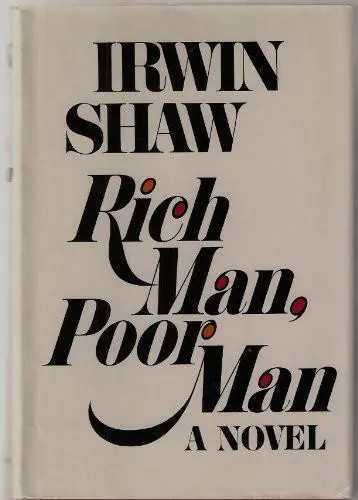
- Название:Rich Man, Poor Man
- Автор:
- Издательство:Delacorte Press, NY
- Жанр:
- Год:1970
- ISBN:9780385288583
- Рейтинг книги:5 / 5. Голосов: 1
-
Избранное:Добавить в избранное
- Отзывы:
-
Ваша оценка:
Rich Man, Poor Man: краткое содержание, описание и аннотация
Предлагаем к чтению аннотацию, описание, краткое содержание или предисловие (зависит от того, что написал сам автор книги «Rich Man, Poor Man»). Если вы не нашли необходимую информацию о книге — напишите в комментариях, мы постараемся отыскать её.
Rich Man, Poor Man — читать онлайн бесплатно полную книгу (весь текст) целиком
Ниже представлен текст книги, разбитый по страницам. Система сохранения места последней прочитанной страницы, позволяет с удобством читать онлайн бесплатно книгу «Rich Man, Poor Man», без необходимости каждый раз заново искать на чём Вы остановились. Поставьте закладку, и сможете в любой момент перейти на страницу, на которой закончили чтение.
Интервал:
Закладка:
Denton shook his head. ‘We’re all right. For the time being. We’re selling the house. Real estate values have gone up since I bought it. The country is booming.’ He laughed drily. He stood up abruptly. ‘I have to go home now,’ he said. ‘I’m giving my wife French lessons every afternoon.’
He allowed Rudolph to pay for the drinks. Outside on the street, he put his collar up, looking more like an old wino than ever, and shook Rudolph’s hand slackly. ‘I’ll write you from Geneva,’ he said. ‘Noncommittal letters. God knows who opens mail these days.’
He shuffled off, a bent, scholarly figure among the citizens of his goddamn country. Rudolph watched him for a moment, then walked back to the store. He breathed deeply, feeling young, lucky, lucky.
He was in the line waiting to laugh, while the sufferers shuffled past. Fifty million dead, but the movies were always open.
He felt sorry for Denton, but overriding that he felt joyous for himself. Everything from now on was going to be all right, everything was going to go his way. The sign had been made clear that afternoon, the omens were plain.
He was on the 11:05 the next morning with Calderwood, composed and optimistic. When they went into the dining car for lunch, he didn’t mind not being able to order a drink.
‘Why do you have to come and wait for me?’ Billy was complaining, as they walked towards home. ‘As though I’m a baby.’
‘You’ll go around by yourself soon enough,’ she said, automatically taking his hand as they crossed a street
‘When?’
‘Soon enough.’
‘When?’
‘When you’re ten.’
‘Oh, Christ’
‘You know you mustn’t say things like that’
‘Daddy does.’
“You’re not Daddy.’
‘So do you sometimes.’
‘You’re not me. And I shouldn’t say it, either,’
Then why do you say it?’
‘Because I get angry.’
‘I’m angry now. All the other kids don’t have their mothers waiting for them outside the gate like babies. They go home by themselves.’ Gretchen knew this was true and that she was being a nervous parent, not faithful to Spock, and that she or Billy or both of them would have to pay for it later, but she couldn’t bear the thought of the child wandering by himself around in the doubtful traffic of Greenwich Village. Several times she had suggested to Willie that they move to the suburbs for then-son’s sake, but Willie had vetoed the idea. ‘I’m not the Scarsdale type,’ he said.
She didn’t know what the Scarsdale type was. She knew a lot of people who lived in Scarsdale or in places very much like Scarsdale, and they seemed as various as people living anywhere else - drunks, wife-swappers, churchgoers, politicians, patriots, scholars, suicides, whatever.
‘When?’ Billy asked again, stubbornly, pulling away from her hand.
‘When you’re ten,’ she repeated.
That’s a whole year,’ he wailed.
‘You’ll’ be surprised how fast it goes,’ she said. ‘Now, button your coat. You’ll catch cold.’ He had been playing, basketball in the schoolyard and he was still sweating. The late-afternoon October air was nippy and there was a wind off the Hudson.
‘A whole year,’ Billy said. ‘That’s inhuman.’
She laughed and bent and kissed the top of his head, but he pulled away. ‘Don’t kiss me in public,’ he said.
A big dog came trotting towards them and she had to restrain herself from telling Billy not to pat him. ‘Old boy,’ Billy said, ‘old boy,’ and patted the dog’s head and pulled his ears, at home in the animal kingdom. He thinks nothing living wishes him harm, Gretchen thought. Except his mother.
The dog wagged his tail, went on.
They were on their own street now, and safe. Gretchen allowed Billy to dawdle behind her, balancing on cracks in the pavement. As she came up to the front door of the brownstone in which she lived, she saw Rudolph and Johnny Heath standing in front of the building, leaning against the stoop. They each were holding a paper bag with a bottle in it. She had just put on a scarf over her head and an old coat and she hadn’t bothered to change from the slacks she was wearing around the house when she had gone to fetch Billy. She felt dowdy as she approached Rudolph and Johnny, who were dressed like sober young businessmen and were even wearing hats.
She was used to seeing Rudolph in New York often. For the past six months or so, he had come to the city two or three times a week, in his young businessman’s suits. There was some sort of deal being arranged with Calderwood and Johnny Heath’s brokerage house, although when she asked Rudolph about it and he tried to explain, she never could quite grasp the details. It had something to do with setting up an involved corporation called Dee Cee Enterprises, after Duncan Calderwood’s initials. Eventually, it was supposed to make Rudolph a wealthy man and get him out of the store, and for half the year at least, out of Whitby. He had asked her to be on the lookout for a small furnished apartment for him.
Both Rudolph and Johnny looked somehow high, as though they had already done some drinking. She could see by the gilt paper sticking out the brown paper bags that the bottles they were carrying contained champagne. ‘Hi, boys,’ she said. Why didn’t you let me know you were coming?’
We didn’t know we were coming,’ Rudolph said. This is an impromptu celebration.’ He kissed her cheek. He had not been drinking.
‘Hi, Billy,’ he said to the little boy.
‘Hi,’ Billy said perfunctorily. The relationship between uncle and nephew was tenuous. Billy called his uncle Rudy. From time to time Gretchen tried to get the boy to be more polite and say Uncle Rudolph, but Willie backed up his son, saying, ‘Old forms, old forms. Don’t bring up the kid to be a hypocrite.’
‘Come on upstairs,’ Gretchen said, ‘and we’ll open these bottles.’
The livingroom was a mess. She worked there now, having surrendered the upstairs room completely to Billy, and there were bits and pieces of two articles she had promised for the first of the month. Books, notes, and scraps of paper were scattered all over the desk and tables. Not even the sofa was immune. She was not a methodical worker, and her occasional attempts at order soon foundered into even greater chaos than before. She had taken to chain-smoking when she worked and ash trays full of stubs were everywhere. Willie, who was far from neat himself, complained from time to time. This isn’t a home,’ he said, ‘it’s the goddamn city room of a small-time newspaper.’
She noticed Rudolph’s quick glance of disapproval around the room. Was he judging her now against the fastidious girl she had been at nineteen? She had an unreasonable flash of anger against her impeccable, well-pressed brother. I’m running a family, I’m earning a living, don’t forget any of that, brother.
‘Billy,’ she said, as she hung up her coat and scarf, with elaborate precision, to make up for the state of the room, ‘go upstairs and do your homework.’
‘Aah …’ Billy said, more for form’s sake than out of any desire to remain below with the grownups.
‘Go ahead, Billy.’
He went upstairs happily, pretending to be unhappy.
Gretchen got out three glasses. ‘What’s the occasion?’ She asked Rudolph, who was working on opening the bottle of champagne.
‘We did it,’ Rudolph said. Today we had the final signing. We can drink champagne morning, noon, and night for the rest of our lives.’ He got the cork out and let the foam splash over his hand as he poured.
“That’s wonderful,’ Gretchen said mechanically. It was difficult for her to understand Rudolph’s single-minded immersion in business.
Читать дальшеИнтервал:
Закладка:
Похожие книги на «Rich Man, Poor Man»
Представляем Вашему вниманию похожие книги на «Rich Man, Poor Man» списком для выбора. Мы отобрали схожую по названию и смыслу литературу в надежде предоставить читателям больше вариантов отыскать новые, интересные, ещё непрочитанные произведения.






Обсуждение, отзывы о книге «Rich Man, Poor Man» и просто собственные мнения читателей. Оставьте ваши комментарии, напишите, что Вы думаете о произведении, его смысле или главных героях. Укажите что конкретно понравилось, а что нет, и почему Вы так считаете.