Irwin Shaw - Rich Man, Poor Man
Здесь есть возможность читать онлайн «Irwin Shaw - Rich Man, Poor Man» весь текст электронной книги совершенно бесплатно (целиком полную версию без сокращений). В некоторых случаях можно слушать аудио, скачать через торрент в формате fb2 и присутствует краткое содержание. Год выпуска: 1970, ISBN: 1970, Издательство: Delacorte Press, NY, Жанр: Классическая проза, на английском языке. Описание произведения, (предисловие) а так же отзывы посетителей доступны на портале библиотеки ЛибКат.
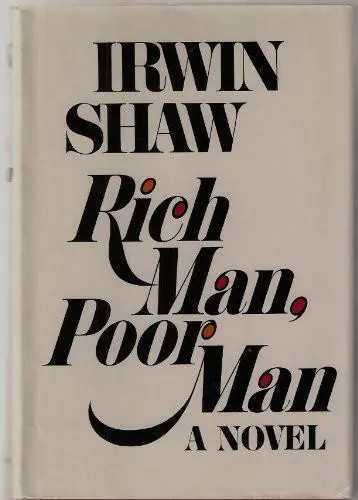
- Название:Rich Man, Poor Man
- Автор:
- Издательство:Delacorte Press, NY
- Жанр:
- Год:1970
- ISBN:9780385288583
- Рейтинг книги:5 / 5. Голосов: 1
-
Избранное:Добавить в избранное
- Отзывы:
-
Ваша оценка:
Rich Man, Poor Man: краткое содержание, описание и аннотация
Предлагаем к чтению аннотацию, описание, краткое содержание или предисловие (зависит от того, что написал сам автор книги «Rich Man, Poor Man»). Если вы не нашли необходимую информацию о книге — напишите в комментариях, мы постараемся отыскать её.
Rich Man, Poor Man — читать онлайн бесплатно полную книгу (весь текст) целиком
Ниже представлен текст книги, разбитый по страницам. Система сохранения места последней прочитанной страницы, позволяет с удобством читать онлайн бесплатно книгу «Rich Man, Poor Man», без необходимости каждый раз заново искать на чём Вы остановились. Поставьте закладку, и сможете в любой момент перейти на страницу, на которой закончили чтение.
Интервал:
Закладка:
‘It certainly is.’ Boylan nodded. ‘She’s an extraordinarily beautiful girl. I don’t suppose a brother would notice that’
‘Oh, I noticed it,’ Rudolph said.
‘Did you?’ Boylan said absently. He no longer seemed interested. He waved for Perkins to take the dishes away and got up and went over to a big phonograph and put on the Brahms Second Piano Concerto, very loud, so that they didn’t talk for the rest of the meal. Five kinds of cheese on a wooden platter. Salad. A plum tart. No wonder Boylan had a paunch.
Rudolph looked surreptitiously at his watch. If he could get out of there early enough maybe he could catch Julie. It would be too late for the movies, but maybe he could make up to her, anyway, for standing her up.
After dinner, Boylan had a brandy with the demitasse, and put on a symphony. Rudolph was tired from the long afternoon’s fishing. The two glasses of wine he had drunk had made him feel blurred and sleepy. The loud music was crushing him. Boylan was polite, but distant. Rudolph had the feeling the man was disappointed in him because he hadn’t opened up about Gretchen.
Boylan sat sunk in a deep chair, his eyes almost closed, concentrating on the music, occasionally taking a sip of brandy. He might just as well have been alone, Rudolph thought resentfully, or with his Irish wolfhound. They probably had some lively evenings here together, before the neighbours put out the poison. Maybe he’s getting ready to offer me a position as his dog.
There was a scratch on the record now and Boylan made
an irritated gesture as the clicking recurred. He stood up and turned off the machine. ‘I’m sorry about that,’ he said to Rudolph. “The revenge of the machine age on Schumann. Shall I take you on down to town now?’
‘Thank you.’ Rudolph stood up, gratefully.
Boylan looked down at Rudolph’s feet ‘Oh,’ he said. ‘You can’t go like that, can you?’
‘If you’ll give me my boots … ‘
‘I’m sure they’re still soaking wet inside,’ Boylan said. ‘Wait here a minute. I’ll find something for you.’ He went out of the room and up the stairway.
Rudolph took a long look around the room. How good it was to be rich. He wondered if ever he was going to see the room again. Thomas had seen it once, although he had not been invited in. He came down into the livingroom bare-assed, with his thing hanging down to his knees, he’s a regular horse, and made two whiskies and called up the stairs, ‘Gretchen, do you want your drink up there or do you want to come down for it?’
Now that he had had a chance to listen to Boylan, Rudolph recognised that Tom’s caricature of the man’s voice had been an accurate one. He had caught the educated flattening out on the ‘there’, and the curious way he had of making questions not sound like questions.
Rudolph shook his head. What could Gretchen have been thinking of? ‘I liked it.’ He heard her voice again in the Port Philip House bar. ‘I liked it better than anything that had ever happened to me.’
He walked restlessly around the room. He looked at the album of the symphony that Boylan had cut off. Schumann’s Third, the Rhenish Symphony. Well, at least he had learned something today. He would recognise it when he heard it again. He picked up a silver cigarette lighter a foot long and examined it. There was a monogram on it. TB. Purposely expensive gadgets for doing things that cost nothing to the poor. He flicked it open. It spouted flame. The burning cross. Enemies. He heard Boylan’s footsteps on the marble floor in the hall and hurriedly doused the flame and put the lighter down.
Boylan came into the room. He was earring a little overnight bag and a pair of mahogany-coloured moccasins. Try these on, Rudolph,’ he said.
The moccasins were old but beautifully polished, with thick soles and leather tassels. They fitted Rudolph perfectly. ‘Ah,’
Boylan said, ‘you have narrow feet, too.’ One aristocrat to another.
‘I’ll bring them back in a day or two,’ Rudolph said, as they started out.
‘Don’t bother,’ Boylan said. They’re as old as the hills. I never wear them.’
Rudolph’s rod, neatly folded, and the creel and net were on the back seat of the Buick. The fireman’s boots, still damp inside, were on the floor behind the front seat. Boylan swung the overnight bag on to the back seat and they got into the car. Rudolph had retrieved the old felt hat from the table in the hallway, but didn’t have the courage to put it on with Perkins watching him. Boylan turned on the radio in the car, jazz from New York, so they didn’t talk all the way to Vanderhoff Street. When Boylan stopped the Buick in front of the bakery, he turned the radio off.
‘Here we are,’ he said.
Thank you very much,’ Rudolph said. ‘For everything.’
Thank you. Rudolph,’ Boylan said. ‘It’s been a refreshing day.’ As Rudolph put his hand on the handle of the car door, Boylan reached out and held his arm lightly. ‘Ah, I wonder if you’d do me a favour.’
‘Of course.’
‘In that bag back there … ‘ Boylan twisted a little, holding on to the wheel, to indicate the presence of the leather overnight bag behind him. ‘ … there’s something I’d particularly like your sister to have. Do you think you could get it to her?’
‘Well,’ Rudolph said, ‘I don’t know when I’ll be seeing her.’
‘There’s no hurry,’ Boylan said. ‘It’s something I know she wants, but it’s not pressing.’
‘Okay,’ Rudolph said. It wasn’t like giving away Gretchen’s address, or anything like that. ‘Sure. When I happen to see
her.’
“That’s very good of you, Rudolph.’ He looked at his watch. ‘It’s not Very late. Would you like to come and have a drink with me someplace? I don’t fancy going back to that dreary house alone for the moment.’
‘I have to get up awfully early in the morning,’ Rudolph said. He wanted to be by himself now, to sort out his impressions of Boylan, to assess the dangers and the possible advantages in knowing the man. He didn’t want to be loaded with any new impressions, Boylan drunk, Boylan with strangers at a bar, Boylan perhaps flirting with a woman, or making a pass at a sailor. The idea was sudden. Boylan the fairy?
Making a pass at him. The delicate hands on the piano, the clothes that were like costumes, the unobtrusive touching.
‘What’s early?’ Boylan asked.
‘Five,’ Rudolph said.
‘Good. Good!’ Boylan said. ‘What in the world does anyone do up at five o’clock in the morning?’
‘I deliver rolls on a bicycle for my father,’ Rudolph said.
‘I see,’ Boylan said. ‘I suppose somebody has to deliver rolls.’ He laughed. ‘You just don’t seem like a roll-deliverer.’
‘It’s not my main function in life,’ Rudolph said.
‘What is your main function in life, Rudolph?’ Absently, Boylan switched off the headlights. It was dark in the car because they were directly under a lamppost. There was no light from the cellar. His father hadn’t begun his night’s work. If his father were asked, would he say that his main function in life was baking rolls?
‘I don’t know yet,’ Rudolph said. Then aggressively. ‘What’s yours?’
‘I don’t know,’ Boylan said. ‘Yet. Have you any idea?’
‘No.’ The man was split into a million different parts. Rudolph felt that if he were older he might be able to assemble Boylan into one coherent pattern.
‘A pity,’ Boylan said. ‘I thought perhaps the clear eyes of youth would see things in me I am incapable of seeing in myself.’
‘How old are you, anyway?’ Rudolph asked. Boylan spoke so much of the past that he seemed to stretch far, far back, to the Indians, to President Taft, to a greener geography. It occurred to Rudolph that Boylan was not old so much as old-fashioned.
Читать дальшеИнтервал:
Закладка:
Похожие книги на «Rich Man, Poor Man»
Представляем Вашему вниманию похожие книги на «Rich Man, Poor Man» списком для выбора. Мы отобрали схожую по названию и смыслу литературу в надежде предоставить читателям больше вариантов отыскать новые, интересные, ещё непрочитанные произведения.





Обсуждение, отзывы о книге «Rich Man, Poor Man» и просто собственные мнения читателей. Оставьте ваши комментарии, напишите, что Вы думаете о произведении, его смысле или главных героях. Укажите что конкретно понравилось, а что нет, и почему Вы так считаете.