Irwin Shaw - Rich Man, Poor Man
Здесь есть возможность читать онлайн «Irwin Shaw - Rich Man, Poor Man» весь текст электронной книги совершенно бесплатно (целиком полную версию без сокращений). В некоторых случаях можно слушать аудио, скачать через торрент в формате fb2 и присутствует краткое содержание. Год выпуска: 1970, ISBN: 1970, Издательство: Delacorte Press, NY, Жанр: Классическая проза, на английском языке. Описание произведения, (предисловие) а так же отзывы посетителей доступны на портале библиотеки ЛибКат.
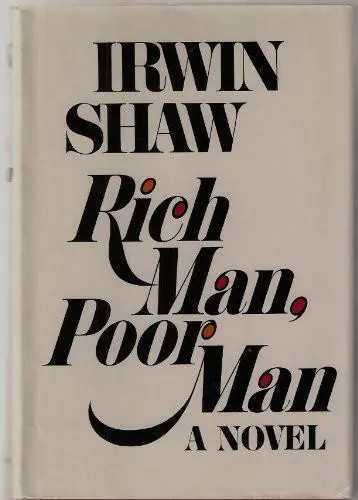
- Название:Rich Man, Poor Man
- Автор:
- Издательство:Delacorte Press, NY
- Жанр:
- Год:1970
- ISBN:9780385288583
- Рейтинг книги:5 / 5. Голосов: 1
-
Избранное:Добавить в избранное
- Отзывы:
-
Ваша оценка:
Rich Man, Poor Man: краткое содержание, описание и аннотация
Предлагаем к чтению аннотацию, описание, краткое содержание или предисловие (зависит от того, что написал сам автор книги «Rich Man, Poor Man»). Если вы не нашли необходимую информацию о книге — напишите в комментариях, мы постараемся отыскать её.
Rich Man, Poor Man — читать онлайн бесплатно полную книгу (весь текст) целиком
Ниже представлен текст книги, разбитый по страницам. Система сохранения места последней прочитанной страницы, позволяет с удобством читать онлайн бесплатно книгу «Rich Man, Poor Man», без необходимости каждый раз заново искать на чём Вы остановились. Поставьте закладку, и сможете в любой момент перейти на страницу, на которой закончили чтение.
Интервал:
Закладка:
It had rained the night before and there was rain in the grey, late-afternoon air. The brook was a bit muddy and the trout were shy. But just slowly moving upstream, getting the fly lightly, lightly, where he wanted it, with nobody around, and the only sound the water tumbling over the rocks, was happiness enough. School began again in a week and he was making the most of the last days of the holiday.
He was near one of the stream’s two ornamental bridges, working the water, when he heard footsteps on gravel. A little path, overgrown with weeds, led to the bridge. He reeled in and waited. Boylan, hatless, dressed in a suede jacket, a paisley scarf, and jodhpur boots, came down the path and stopped on the bridge. ‘Hello, Mr Boylan,’ Rudolph said. He was a little uneasy, seeing the man, worried that perhaps Boylan hadn’t remembered inviting him to fish the stream, or had merely said it for politeness’ sake, not really meaning it. ‘Any luck?’ Boylan asked. There’re two in the basket.’
‘Not bad for a day like this,’ Boylan said, examining the muddied water. ‘With flies.’
‘Do you fish?’ Rudolph moved nearer the bridge, so that they wouldn’t have to talk so loud.
*I used to,’ Boylan said. ‘Don’t let me interfere. I’m just taking a walk. I’ll be back this way. If you’re still here, perhaps you’ll do me the pleasure of joining me in a drink up at the ouse.’
‘Thank you,’ Rudolph said. He didn’t say whether he’d it or not.
With a wave, Boylan continued his walk. Rudolph changed the fly, taking the new one from where it was stuck in the band of the battered old brown felt hat he used when it rained or when he went fishing. He made the knots precisely, losing no time: Perhaps one day he would be a surgeon, suturing incisions. ‘I think the patient will five, nurse.’ How many years? Three in pre-med, four in medical school, two more as an intern. Who had that much money? Forget it. On his third cast, the fly was taken. There was a thrash of water, dirty white against the brown current. It felt like a big one. He played it carefully, trying to keep the fish away from rocks and brushwood anchored in the stream. He didn’t know, how long it took him. Twice the fish was nearly his and twice it streaked away, taking line with it. The third time, he felt it tiring. He waded out with his net. The water rushed in over the top of his fireman’s boots, icy cold. It was only when he had the trout in the net that he was conscious that Boylan had come back and was on the bridge watching him.
‘Bravo,’ Boylan said, as Rudolph stepped back on shore, water squelching up from the top of his boots. ‘Very well done.’ Rudolph killed the trout and Boylan came around and watched him as he laid the fish with the two others in the creel. ‘I could never do that,’ Boylan said. ‘Kill anything with my hands.’ He was wearing gloves. ‘They look like miniature sharks,’ he said, ‘don’t they?’
They looked like trout to Rudolph. ‘I’ve never seen a shark,’ he said. He plucked some more fern and stuffed it in the creel, around the fish. His father would have trout for breakfast. His father liked trout. A return on his investment in the birthday rod and reel. ‘Do you ever fish in the Hudson?’ Boylan asked. ‘Once in a while. Sometimes, in season, a shad gets up this far.’
‘When my father was a boy, he caught salmon in the Hudson,’ Boylan said. ‘Can you imagine what the Hudson must have been like when the Indians were here? Before the Roosevelts. With bear and lynx on the shores and deer coming down to the banks.’
‘I see a deer once in a while,’ Rudolph said. It had never occurred to him to wonder what the Hudson must have looked like with Iroquois canoes furrowing it.
‘Bad for the crops, deer, bad for the crops,’ Boylan said. Rudolph would have liked to sit down and take his boots off and get the water out, but he knew his socks were darned, and he didn’t cherish the idea of displaying the thick patches of his mother’s handiwork to Boylan.
As though reading his mind, Boylan said, ‘I do believe you ought to empty the water out of those boots. That water must be cold.’
‘It is.’ Rudolph pulled off one boot, then another. Boylan didn’t seem to notice. He was looking around him at the overgrown wood that had been in his family’s possession since just after the Civil War. ‘You used to be able to see the house from here. There was no underbrush. Ten gardeners used to work this land, winter and summer. Now the only ones who come are the state fisheries people once a year. You can’t get anybody anymore. No sense to it, really, anyway.’ He
studied the massed foliage of the shrub oak and blossomless dogwood and alder. Trash trees,’ he said. ‘The forest primeval. Where only Man is vile. Who said that?’
‘Longfellow,’ Rudolph said. His socks were soaking wet, as he put his boots back on. ‘You read a lot?’ Boylan said. ‘We had to learn it in school.’ Rudolph refused to boast.
‘I’m happy to see that our educational system does not neglect our native birds and their native wood-notes wild,’ Boylan said.
Fancy talk again, Rudolph thought. Who’s he impressing? Rudolph didn’t much like Longfellow, himself, but who did Boylan think he was to be so superior? What poems have you written, brother?
‘By the way, I believe there’s an old pair of hip-length waders up at the house. God knows when I bought them. If they fit you, you can have them. Why don’t you come up and try them on?’
Rudolph had planned to go right on home. It was a long walk to the bus and he had been invited for dinner at Julie’s house. After dinner they were to go to a movie. But waders … They cost over twenty dollars new. Thank you, sir,’ he said.
‘Don’t call me sir,’ Boylan said. ‘I feel old enough as it is.’
They started towards the house, on the overgrown path. ‘Let me carry the creel,’ Boylan said.
‘It’s not heavy,’ Rudolph said.
‘Please,’ said Boylan. ‘It will make me feel as though I’ve done something useful today.’
He’s sad, Rudolph thought with surprise. Why, he’s as sad as my mother. He handed the creel to Boylan, who slung it over his shoulder.
The house sat on the hill, huge, a useless fortress in Gothic stone, with ivy running wild all over it, defensive against knights in armour and dips in the Market.
‘Ridiculous, isn’t it?’ Boylan murmured.
“Yes,’ Rudolph said.
‘You have a nice turn of phrase, my boy.’ Boylan laughed. ‘Come on in.’ He opened the massive oak front doors.
My sister has passed through here, Rudolph thought. I should turn back.
But he didn’t.
They went into a large, dark, marble-floored hall, with a big staircase winding up from it. An old man in a grey alpaca
jacket and bow tie appeared immediately, as though merely by entering the house Boylan set up waves of pressure that drove servants into his presence.
‘Good evening, Perkins,’ Boylan said. “This is Mr Jordache, a young friend of the family.’
Perkins nodded, the ghost of a bow. He looked English. He had a for King and Country face. He took Rudolph’s battered hat and laid it on a’ table along the wall, a wreath on a royal tomb.
‘I wonder if you could be kind enough, Perkins, to go into the Armoury,’ Boylan said, ‘and hunt around a bit for my old pair of waders. Mr Jordache is a fisherman.’ He opened the creel. ‘As you can see.’
Perkins regarded the fish. ‘Very good size, sir.’ Caterer to the Crown.
‘Aren’t they?’ The two men played an elaborate game with each other, the rules of which were unknown to Rudolph. ‘Take them into Cook,’ Boylan said to Perkins. ‘Ask her if she can’t do something with them for dinner. You are staying to dinner, aren’t you, Rudolph?’
Читать дальшеИнтервал:
Закладка:
Похожие книги на «Rich Man, Poor Man»
Представляем Вашему вниманию похожие книги на «Rich Man, Poor Man» списком для выбора. Мы отобрали схожую по названию и смыслу литературу в надежде предоставить читателям больше вариантов отыскать новые, интересные, ещё непрочитанные произведения.







Обсуждение, отзывы о книге «Rich Man, Poor Man» и просто собственные мнения читателей. Оставьте ваши комментарии, напишите, что Вы думаете о произведении, его смысле или главных героях. Укажите что конкретно понравилось, а что нет, и почему Вы так считаете.