Irwin Shaw - Rich Man, Poor Man
Здесь есть возможность читать онлайн «Irwin Shaw - Rich Man, Poor Man» весь текст электронной книги совершенно бесплатно (целиком полную версию без сокращений). В некоторых случаях можно слушать аудио, скачать через торрент в формате fb2 и присутствует краткое содержание. Год выпуска: 1970, ISBN: 1970, Издательство: Delacorte Press, NY, Жанр: Классическая проза, на английском языке. Описание произведения, (предисловие) а так же отзывы посетителей доступны на портале библиотеки ЛибКат.
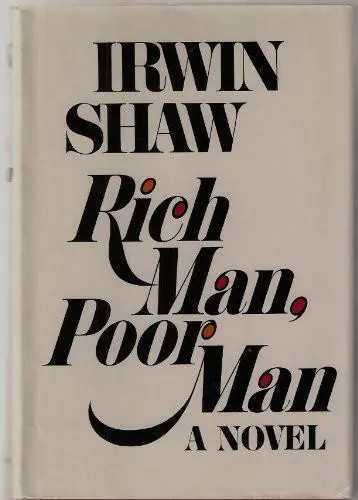
- Название:Rich Man, Poor Man
- Автор:
- Издательство:Delacorte Press, NY
- Жанр:
- Год:1970
- ISBN:9780385288583
- Рейтинг книги:5 / 5. Голосов: 1
-
Избранное:Добавить в избранное
- Отзывы:
-
Ваша оценка:
Rich Man, Poor Man: краткое содержание, описание и аннотация
Предлагаем к чтению аннотацию, описание, краткое содержание или предисловие (зависит от того, что написал сам автор книги «Rich Man, Poor Man»). Если вы не нашли необходимую информацию о книге — напишите в комментариях, мы постараемся отыскать её.
Rich Man, Poor Man — читать онлайн бесплатно полную книгу (весь текст) целиком
Ниже представлен текст книги, разбитый по страницам. Система сохранения места последней прочитанной страницы, позволяет с удобством читать онлайн бесплатно книгу «Rich Man, Poor Man», без необходимости каждый раз заново искать на чём Вы остановились. Поставьте закладку, и сможете в любой момент перейти на страницу, на которой закончили чтение.
Интервал:
Закладка:
Giving nothing, right up to the last moment, he went into the vestibule and into the car without looking back. The train started and Rudolph could see the lieutenant standing at an open window waving to the girl, who was running along the platform.
The train gathered speed and the girl stopped running. She became conscious of Rudolph looking at her and, her face closed down, erasing public sorrow, public love. She wheeled and hurried off, the wind whipping her dress about her body. Warrior’s woman.
Rudolph went back to park and sat on the bench again and waited for the bus back to Port Philip.
What a goddamn birthday.
Gretchen was packing a bag. It was a big, frayed, yellow-stippled, cardboardish rectangle, studded with brass knobs, that had held her mother’s bridal trousseau when she arrived in Port Philip. Gretchen had never spent a night away from home in her whole life so she had never had a valise of her own. When she had made her decision, after her father had come up from the conference with Thomas and the Tinkers, to announce that Thomas was going away for a long time, Gretchen had climbed to the narrow little attic where the few things that the Jordache’s had collected and had no further use for were stored. She had found the bag and brought it down to her own room. Her mother had seen her with the bag and must have guessed what it meant, but had said nothing. Her mother hadn’t talked to her in weeks, ever since the night she had come in at dawn after the trip to New York with Boylan. It was as though she felt that conversation between them brought with it the contagion of Gretchen’s rank corruption.
The air of crisis, of hidden conflicts, the strange look in her father’s eyes when he had come back into the livingroom and told Rudolph to come with him, had finally pushed Gretchen to action. There would never be a better day to leave than this Sunday afternoon.
She packed carefully. The bag wasn’t big enough to take everything she might need and she had to choose deliberately, putting things in, then taking them out in favour of other things that might be more useful. She hoped that she could get out of the house before her father came back, but she was prepared to face him and tell him that she had lost he? job and was going down to New York to look for another. There
had been something in his face as he started downstairs with Rudolph that was passive and stunned and she guessed that today might be the one day she could walk past him without a struggle.
She had to turn almost every book upside down before she found the envelope with the money in it. That crazy game her mother played. There was a fifty-fifty chance that her mother would wind up in an asylum. Eventually, she hoped, she would be able to learn to pity her,
She was sorry that she was going without a chance to say goodbye to Rudolph but it was growing dark already and she didn’t want to reach New York after midnight. She had no notion of where she was going to go in New York. There must be a YWCA somewhere. Girls had spent their first nights in New York in worse places.
She looked around her stripped room without emotion. Her goodbye to her room was flippant. She took the envelope, now empty of money, and laid it squarely in the middle of her narrow bed.
She lugged the suitcase out into the hallway. She could see her mother sitting at the table, smoking. The remains of the dinner, the goose carcass, the cold cabbage, the dumplings jellied in slime, the stained napkins, had remained untouched all these hours on the table, as her mother had sat there, wordless, staring at the wall. Gretchen went into the room. ‘Ma,’ she said, ‘this is going away day, I guess. I’m packed and I’m leaving.’
Her mother turned her head slowly and Wearily towards her. ‘Go to your fancy man,’ she said thickly. Her vocabulary of abuse dated from earlier in the century. She had finished all the wine and she was drunk. It was the first time Gretchen had seen her mother drunk and it made her want to laugh.
‘I’m not going to anybody,’ she said. ‘I lost my job and I’m going to New York to look for another one. When I’m settled, I’ll write you and let you know.’
“Harlot,’ the mother said.
Gretchen grimaced. Who said harlot in 1945? It made her going unimportant, comic. But she forced herself to kiss her mother’s cheek. The skin was rough and seamed with broken capillaries.
‘False kisses,’ the mother said, staring. ‘The dagger in the rose.’
What books she must have read as a young girl!
The mother pushed back a wisp of hair from her forehead
with the back of her hand, in the gesture that had been weary since she was twenty-one years old. It occurred to Gretchen that her mother had been born worn out and that much should be forgiven her because of it. For a moment she, hesitated, searching for some vestige of affection within her for the drunken woman sitting wreathed in smoke at the cluttered table.
‘Goose,’ her mother said disdainfully. ‘Who eats goose?’
Gretchen shook her head hopelessly and went out into the hallway and picked up the bag and struggled down the staircase with it She unlocked the door below and pushed the suitcase out over the sill into the street. The sun was just setting and the shadows on the street were violet and indigo. As she picked up the bag, the street lamps went on, lemony and pale, doing premature and useless service.
Then she saw Rudolph hurrying down the street towards the house. He was alone. She put down her bag and waited for him. As he approached she thought how well the blazer fitted him, how neat he looked, and was glad she had spent the money.
When Rudolph saw her, he broke into a run. ‘Where’re you going?’ he said as he came up to her.
‘New York,’ she said lightly. ‘Come along?’
I wish I could,’ he said.
‘Help a lady to a taxi?’
‘I want to talk to you,’ he said.
‘Not here,’ she said, glancing at the bakery window. ‘I want to get away from here.’
‘Yeah,’ Rudolph said, picking up her bag. ‘This is for sure no place to talk.’
They started down the street together to look for a taxi. Goodbye, goodbye, Gretchen sang to herself, as she passed the familiar names, goodbye Clancy’s Garage, Body Work, goodbye Soriano’s Hand Laundry, goodbye Fenelli’s, Prime Beef, goodbye the A and P, goodbye Bolton’s Drug Store, goodbye Wharton’s Paints and Hardware, goodbye Bruno’s Barber Shop, goodbye Jardino’s Fruits and Vegetables. The song inside her head was lilting as she walked briskly beside her brother, but there was a minor undertone in it You leave no place after nineteen years without regrets.
They found a taxi two blocks farther on and drove to the station. While Gretchen went over to the window to buy her ticket Rudolph sat on the old-fashioned valise, thinking, I am spending my eighteenth year saying goodbye in every station of the New York Central railroad
Rudolph couldn’t help but feel a little bruised by the rippling lightness in his sister’s movements and the pinpoints of joy in her eyes. After all, she was not only leaving home, she was leaving him. He felt strange with her now, since he knew she had made love with a man. Let her screw in peace. He must find a more melodious vocabulary.
She touched him on the sleeve. The train won’t be along for more than a half hour,’ she said. ‘I feel like a drink. Celebrate. Put the valise in the baggage room and we’ll go across the street to Port Philip House.’
Rudolph picked up the valise. ‘I’ll carry it,’ he said. ‘It costs ten cents in the baggage room.’
‘Let’s be big for once.’ Gretchen laughed. ‘Squander our inheritance. Let the dimes flow.’
As he took a check for the valise, he wondered if she had been drinking all afternoon.
Читать дальшеИнтервал:
Закладка:
Похожие книги на «Rich Man, Poor Man»
Представляем Вашему вниманию похожие книги на «Rich Man, Poor Man» списком для выбора. Мы отобрали схожую по названию и смыслу литературу в надежде предоставить читателям больше вариантов отыскать новые, интересные, ещё непрочитанные произведения.







Обсуждение, отзывы о книге «Rich Man, Poor Man» и просто собственные мнения читателей. Оставьте ваши комментарии, напишите, что Вы думаете о произведении, его смысле или главных героях. Укажите что конкретно понравилось, а что нет, и почему Вы так считаете.