Irwin Shaw - Rich Man, Poor Man
Здесь есть возможность читать онлайн «Irwin Shaw - Rich Man, Poor Man» весь текст электронной книги совершенно бесплатно (целиком полную версию без сокращений). В некоторых случаях можно слушать аудио, скачать через торрент в формате fb2 и присутствует краткое содержание. Год выпуска: 1970, ISBN: 1970, Издательство: Delacorte Press, NY, Жанр: Классическая проза, на английском языке. Описание произведения, (предисловие) а так же отзывы посетителей доступны на портале библиотеки ЛибКат.
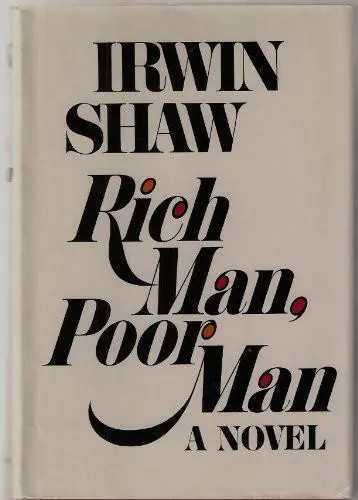
- Название:Rich Man, Poor Man
- Автор:
- Издательство:Delacorte Press, NY
- Жанр:
- Год:1970
- ISBN:9780385288583
- Рейтинг книги:5 / 5. Голосов: 1
-
Избранное:Добавить в избранное
- Отзывы:
-
Ваша оценка:
Rich Man, Poor Man: краткое содержание, описание и аннотация
Предлагаем к чтению аннотацию, описание, краткое содержание или предисловие (зависит от того, что написал сам автор книги «Rich Man, Poor Man»). Если вы не нашли необходимую информацию о книге — напишите в комментариях, мы постараемся отыскать её.
Rich Man, Poor Man — читать онлайн бесплатно полную книгу (весь текст) целиком
Ниже представлен текст книги, разбитый по страницам. Система сохранения места последней прочитанной страницы, позволяет с удобством читать онлайн бесплатно книгу «Rich Man, Poor Man», без необходимости каждый раз заново искать на чём Вы остановились. Поставьте закладку, и сможете в любой момент перейти на страницу, на которой закончили чтение.
Интервал:
Закладка:
If he had been at the other end of the platform he’d have seen his brother Rudolph getting out of one of the sleeping cars from Paris, with a slender, pretty, young girl and a lot of new luggage.
When they walked through the exit gate of the station, they saw the Hertz sign and Rudolph said, There’s the man with our car.’ The concierge at the hotel in Paris had taken care of everything. As Jean had said, after the concierge had arranged for tickets to the theatre, for a limousine to tour the chateaux of the Loire, for tables at ten restaurants, for places at the Opera and Longchamps, ‘Every marriage should have its own private Paris concierge.’
The porter trundled their luggage over to the car, said merci for the tip and smiled, although they were plainly American. According to the newspapers back home Frenchmen were not smiling at Americans this year. The man from the Hertz agency started to talk in English but Rudolph showed off with his French, mostly to amuse Jean, and the remaining formalities for renting the Peugeot convertible were concluded in the language of Racine. Rudolph had bought a Michelin map of the Alpes-Maritimes in Paris, and after consulting it, with the car top down, and the soft Mediterranean morning shining on their bare heads, they drove through the white town and then along the edge of the sea, through Golf e Juan, where Napoleon had landed, through Juan-les-Pins, its big hotels still in their pre-season sleep, to the Hotel du Cap, shapely, cream coloured and splendid on its gentle hill among the pines.
As the manager showed them up to their suite, with a balcony overlooking the calm, blue sea below the hotel park, Rudolph said, coolly, ‘It’s very nice, thank you.’ But it was only with the greatest difficulty that he kept himself from grinning idiotically at how perfectly the manager, himself, and Jean were playing their roles in his ancient dream. Only it was better than the dream. The suite was larger and more luxuriously furnished; the air was sweeter, the manager was more of a manager than anyone could imagine; he himself was richer and cooler and better dressed than he had been in his poor-boy reverie; Jean, in her slim Paris suit, was more beautiful than the imaginary girl who had walked out on to the balcony overlooking the sea and kissed him in his fantasy.
The manager bowed himself out, the porters finished placing the bags on folding stools around the gigantic bedroom. Solid, real, with a solid, real wife, he said, ‘Let’s go out on the balcony.’
The went out on the balcony and kissed in the sunlight
They nearly hadn’t married at all. Jean had hesitated and hesitated, refusing to say yes or no for a while he was on the brink of delivering an ultimatum to her every time he saw her, which was tantalisingly seldom. He was kept in Whitby and Port Philip a great deal of the time by work and then, when he did get to New York it was often only to find a message with his answering service from Jean telling him that she was out of town on a job. One night, he had seen her in a restaurant after the theatre with a small, beady-eyed young
man with matted long hair and a week-old growth of dark stubble on his jaws. The next time he saw her he asked her who the young man was and she admitted it still was the same one, the one she was overlapping with. When he asked her if she was still sleeping with him, she answered that it was none of his business.
He had felt humiliated that he was in competition with anyone that unsavoury looking and it didn’t make him feel any better to be told by Jean that the man was one of the most famous fashion photographers in the country. He had walked out on her that time and waited for her to get in touch with him, but she never called him and finally he couldn’t bear it any longer and called her, swearing to himself that he would screw her but he’d be damned if he ever would marry her.
His whole conception of himself was damaged by her treatment of him and it was only in bed, where she delighted him and seemed to be delighted by him that he found any relief from his brooding feeling that he was being debased by the entire affair. All the men he knew assured him that all the girls they knew did nothing but plot constantly to get married. What sensational lack was there in his character or his lovemaking or general desirability that had made the only two girls he had asked to marry reject him?
Virginia Calderwood hadn’t helped matters either. Old man Calderwood had followed Rudolph’s advice about allowing his daughter to come down to New York and live alone and take a secretarial course. But if she was learning typing and stenography, Virginia must have done it at very odd hours indeed, because almost every time Rudolph went to his New York apartment, he would spot her, lurking in a doorway across the street or pretending just to be walking by. She would telephone in the middle of the night, sometimes three or four times, to say, ‘Rudy, I love you, I love you. I want you to fuck me.’
To avoid her, he took to staying in different hotels when he came to New York, but for some prudish reason, Jean refused to visit him in a hotel and even the pleasures of the bed were denied him. Jean still wouldn’t let him call for her at her apartment and he had never seen the place where she lived or met her roommate.
Virginia sent him long letters, horrifyingly explicit about her sensual longings for him, the language straight out of Henry Miller, whom Virginia must have studied assiduously. The letters were sent to his home at Whitby, to his apartment, to the main office at the store, and all it would take would be for one careless secretary to open any of them and he doubted if old man Calderwood would ever talk to him again.
When he told Jean about Virginia, she just laughed and said, ‘Oh, you poor attractive man.’ Mischievously, one night, when they came back late to his apartment and he spotted Virginia in the shadows across the street, Jean wanted to go over and invite the girl up for a drink.
His work suffered and he found that he had to read simple reports over three and four times before they registered on his brain. He slept restlessly and awoke weary. For the first time in his life he had a rash of pimples on his chin.
At a party in New York he met a bosomy blonde lady who seemed to have three men around her at all times during the evening, but who made it plain to him that she wanted to go home with him. He took her to her apartment in the East Eighties, off Fifth Avenue, learned that she was rich, that she was divorced, that she was lonely, that she was tired of the men who pursued her around New York, that she found him ravishingly sexy (he wished she had found another style of expressing herself). They went to bed together after one drink and he was impotent and he left on a volley of coarse laughter from the useless bed.
“The unluckiest day of my life,’ he told Jean, ‘was the day you came up to Port Philip to take those pictures.’
Nothing that happened made him stop loving her or wanting to marry her and live with her for the rest of his life.
He had called her all day, ten times, a dozen times, but there never was any answer. One more time, he decided, sitting disconsolately in the livingroom of his apartment, I’ll try one more goddamn time and if she’s not home I will go out and get roaring drunk and pick up girls and fight in bars and if Virginia Calderwood is outside the door when I come home I will bring her up here and screw her and then call the men with the straight jacket and tell them to come and take us both away.
The phone rang and rang and he was just about-to put it down when it was picked up and Jean said, ‘Hello,’ in the hushed childish little way she had.
‘Has your phone been out of order?’ he asked.
Читать дальшеИнтервал:
Закладка:
Похожие книги на «Rich Man, Poor Man»
Представляем Вашему вниманию похожие книги на «Rich Man, Poor Man» списком для выбора. Мы отобрали схожую по названию и смыслу литературу в надежде предоставить читателям больше вариантов отыскать новые, интересные, ещё непрочитанные произведения.






Обсуждение, отзывы о книге «Rich Man, Poor Man» и просто собственные мнения читателей. Оставьте ваши комментарии, напишите, что Вы думаете о произведении, его смысле или главных героях. Укажите что конкретно понравилось, а что нет, и почему Вы так считаете.