Шарлотта Бронте - The Professor
Здесь есть возможность читать онлайн «Шарлотта Бронте - The Professor» — ознакомительный отрывок электронной книги совершенно бесплатно, а после прочтения отрывка купить полную версию. В некоторых случаях можно слушать аудио, скачать через торрент в формате fb2 и присутствует краткое содержание. Год выпуска: 2014, Издательство: epubBooks Classics, Жанр: Классическая проза, на английском языке. Описание произведения, (предисловие) а так же отзывы посетителей доступны на портале библиотеки ЛибКат.
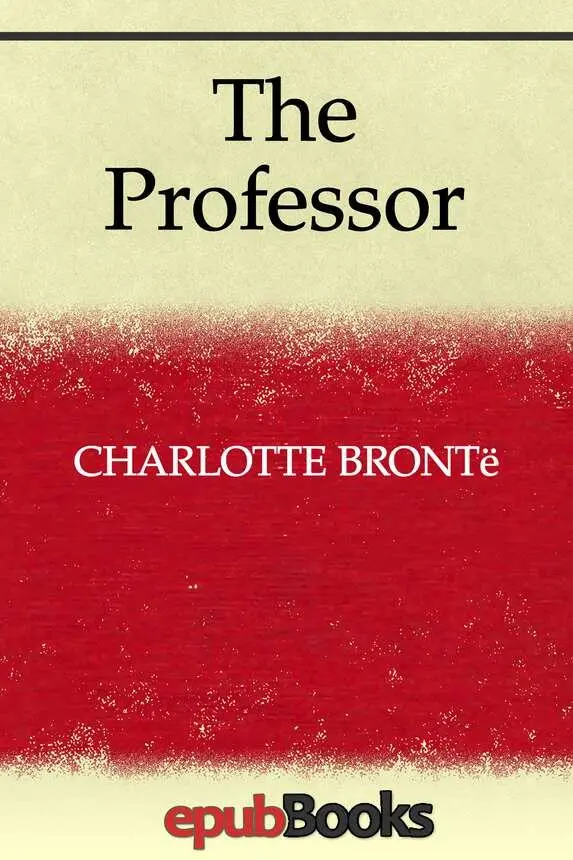
- Название:The Professor
- Автор:
- Издательство:epubBooks Classics
- Жанр:
- Год:2014
- ISBN:нет данных
- Рейтинг книги:3 / 5. Голосов: 1
-
Избранное:Добавить в избранное
- Отзывы:
-
Ваша оценка:
The Professor: краткое содержание, описание и аннотация
Предлагаем к чтению аннотацию, описание, краткое содержание или предисловие (зависит от того, что написал сам автор книги «The Professor»). Если вы не нашли необходимую информацию о книге — напишите в комментариях, мы постараемся отыскать её.
The Professor — читать онлайн ознакомительный отрывок
Ниже представлен текст книги, разбитый по страницам. Система сохранения места последней прочитанной страницы, позволяет с удобством читать онлайн бесплатно книгу «The Professor», без необходимости каждый раз заново искать на чём Вы остановились. Поставьте закладку, и сможете в любой момент перейти на страницу, на которой закончили чтение.
Интервал:
Закладка:
The public reading of one of her devoirs achieved the revelation of her talents to all and sundry; I remember the subject—it was an emigrant's letter to his friends at home. It opened with simplicity; some natural and graphic touches disclosed to the reader the scene of virgin forest and great, New–World river—barren of sail and flag—amidst which the epistle was supposed to be indited. The difficulties and dangers that attend a settler's life, were hinted at; and in the few words said on that subject, Mdlle. Henri failed not to render audible the voice of resolve, patience, endeavour. The disasters which had driven him from his native country were alluded to; stainless honour, inflexible independence, indestructible self–respect there took the word. Past days were spoken of; the grief of parting, the regrets of absence, were touched upon; feeling, forcible and fine, breathed eloquent in every period. At the close, consolation was suggested; religious faith became there the speaker, and she spoke well.
The devoir was powerfully written in language at once chaste and choice, in a style nerved with vigour and graced with harmony.
Mdlle. Reuter was quite sufficiently acquainted with English to understand it when read or spoken in her presence, though she could neither speak nor write it herself. During the perusal of this devoir, she sat placidly busy, her eyes and fingers occupied with the formation of a "riviere" or open–work hem round a cambric handkerchief; she said nothing, and her face and forehead, clothed with a mask of purely negative expression, were as blank of comment as her lips. As neither surprise, pleasure, approbation, nor interest were evinced in her countenance, so no more were disdain, envy, annoyance, weariness; if that inscrutable mien said anything, it was simply this—
"The matter is too trite to excite an emotion, or call forth an opinion."
As soon as I had done, a hum rose; several of the pupils, pressing round Mdlle. Henri, began to beset her with compliments; the composed voice of the directress was now heard:—
"Young ladies, such of you as have cloaks and umbrellas will hasten to return home before the shower becomes heavier" (it was raining a little), "the remainder will wait till their respective servants arrive to fetch them." And the school dispersed, for it was four o'clock.
"Monsieur, a word," said Mdlle. Reuter, stepping on to the estrade, and signifying, by a movement of the hand, that she wished me to relinquish, for an instant, the castor I had clutched.
"Mademoiselle, I am at your service."
"Monsieur, it is of course an excellent plan to encourage effort in young people by making conspicuous the progress of any particularly industrious pupil; but do you not think that in the present instance, Mdlle. Henri can hardly be considered as a concurrent with the other pupils? She is older than most of them, and has had advantages of an exclusive nature for acquiring a knowledge of English; on the other hand, her sphere of life is somewhat beneath theirs; under these circumstances, a public distinction, conferred upon Mdlle. Henri, may be the means of suggesting comparisons, and exciting feelings such as would be far from advantageous to the individual forming their object. The interest I take in Mdlle. Henri's real welfare makes me desirous of screening her from annoyances of this sort; besides, monsieur, as I have before hinted to you, the sentiment of AMOUR–PROPRE has a somewhat marked preponderance in her character; celebrity has a tendency to foster this sentiment, and in her it should be rather repressed—she rather needs keeping down than bringing forward; and then I think, monsieur—it appears to me that ambition, LITERARY ambition especially, is not a feeling to be cherished in the mind of a woman: would not Mdlle. Henri be much safer and happier if taught to believe that in the quiet discharge of social duties consists her real vocation, than if stimulated to aspire after applause and publicity? She may never marry; scanty as are her resources, obscure as are her connections, uncertain as is her health (for I think her consumptive, her mother died of that complaint), it is more than probable she never will. I do not see how she can rise to a position, whence such a step would be possible; but even in celibacy it would be better for her to retain the character and habits of a respectable decorous female."
"Indisputably, mademoiselle," was my answer. "Your opinion admits of no doubt;" and, fearful of the harangue being renewed, I retreated under cover of that cordial sentence of assent.
At the date of a fortnight after the little incident noted above, I find it recorded in my diary that a hiatus occurred in Mdlle. Henri's usually regular attendance in class. The first day or two I wondered at her absence, but did not like to ask an explanation of it; I thought indeed some chance word might be dropped which would afford me the information I wished to obtain, without my running the risk of exciting silly smiles and gossiping whispers by demanding it. But when a week passed and the seat at the desk near the door still remained vacant, and when no allusion was made to the circumstance by any individual of the class—when, on the contrary, I found that all observed a marked silence on the point—I determined, COUTE QUI COUTE, to break the ice of this silly reserve. I selected Sylvie as my informant, because from her I knew that I should at least get a sensible answer, unaccompanied by wriggle, titter, or other flourish of folly.
"Ou donc est Mdlle. Henri?" I said one day as I returned an exercise–book I had been examining.
"Elle est partie, monsieur."
"Partie? et pour combien de temps? Quand reviendra–t–elle?"
"Elle est partie pour toujours, monsieur; elle ne reviendra plus."
"Ah!" was my involuntary exclamation; then after a pause:—
"En etes–vous bien sure, Sylvie?"
"Oui, oui, monsieur, mademoiselle la directrice nous l'a dit elle–meme il y a deux ou trois jours."
And I could pursue my inquiries no further; time, place, and circumstances forbade my adding another word. I could neither comment on what had been said, nor demand further particulars. A question as to the reason of the teacher's departure, as to whether it had been voluntary or otherwise, was indeed on my lips, but I suppressed it—there were listeners all round. An hour after, in passing Sylvie in the corridor as she was putting on her bonnet, I stopped short and asked:—
"Sylvie, do you know Mdlle. Henri's address? I have some books of hers," I added carelessly, "and I should wish to send them to her."
"No, monsieur," replied Sylvie; "but perhaps Rosalie, the portress, will be able to give it you."
Rosalie's cabinet was just at hand; I stepped in and repeated the inquiry. Rosalie—a smart French grisette—looked up from her work with a knowing smile, precisely the sort of smile I had been so desirous to avoid exciting. Her answer was prepared; she knew nothing whatever of Mdlle. Henri's address—had never known it. Turning from her with impatience—for I believed she lied and was hired to lie—I almost knocked down some one who had been standing at my back; it was the directress. My abrupt movement made her recoil two or three steps. I was obliged to apologize, which I did more concisely than politely. No man likes to be dogged, and in the very irritable mood in which I then was the sight of Mdlle. Reuter thoroughly incensed me. At the moment I turned her countenance looked hard, dark, and inquisitive; her eyes were bent upon me with an expression of almost hungry curiosity. I had scarcely caught this phase of physiognomy ere it had vanished; a bland smile played on her features; my harsh apology was received with good–humoured facility.
"Oh, don't mention it, monsieur; you only touched my hair with your elbow; it is no worse, only a little dishevelled." She shook it back, and passing her fingers through her curls, loosened them into more numerous and flowing ringlets. Then she went on with vivacity:
Читать дальшеИнтервал:
Закладка:
Похожие книги на «The Professor»
Представляем Вашему вниманию похожие книги на «The Professor» списком для выбора. Мы отобрали схожую по названию и смыслу литературу в надежде предоставить читателям больше вариантов отыскать новые, интересные, ещё непрочитанные произведения.








Обсуждение, отзывы о книге «The Professor» и просто собственные мнения читателей. Оставьте ваши комментарии, напишите, что Вы думаете о произведении, его смысле или главных героях. Укажите что конкретно понравилось, а что нет, и почему Вы так считаете.