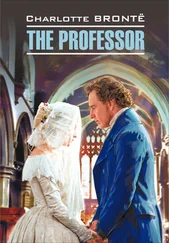
Шарлотта Бронте - The Professor
Здесь есть возможность читать онлайн «Шарлотта Бронте - The Professor» — ознакомительный отрывок электронной книги совершенно бесплатно, а после прочтения отрывка купить полную версию. В некоторых случаях можно слушать аудио, скачать через торрент в формате fb2 и присутствует краткое содержание. Год выпуска: 2014, Издательство: epubBooks Classics, Жанр: Классическая проза, на английском языке. Описание произведения, (предисловие) а так же отзывы посетителей доступны на портале библиотеки ЛибКат.

- Название:The Professor
- Автор:
- Издательство:epubBooks Classics
- Жанр:
- Год:2014
- ISBN:нет данных
- Рейтинг книги:3 / 5. Голосов: 1
-
Избранное:Добавить в избранное
- Отзывы:
-
Ваша оценка:
The Professor: краткое содержание, описание и аннотация
Предлагаем к чтению аннотацию, описание, краткое содержание или предисловие (зависит от того, что написал сам автор книги «The Professor»). Если вы не нашли необходимую информацию о книге — напишите в комментариях, мы постараемся отыскать её.
The Professor — читать онлайн ознакомительный отрывок
Ниже представлен текст книги, разбитый по страницам. Система сохранения места последней прочитанной страницы, позволяет с удобством читать онлайн бесплатно книгу «The Professor», без необходимости каждый раз заново искать на чём Вы остановились. Поставьте закладку, и сможете в любой момент перейти на страницу, на которой закончили чтение.
Интервал:
Закладка:
To this wise speech I received no answer; and, when I looked up, my pupil was smiling to herself a much–meaning, though not very gay smile; it seemed to say, "He talks of he knows not what:" it said this so plainly, that I determined to request information on the point concerning which my ignorance seemed to be thus tacitly affirmed.
"Are you solicitous for your own improvement?"
"Rather."
"How do you prove it, mademoiselle?"
An odd question, and bluntly put; it excited a second smile.
"Why, monsieur, I am not inattentive—am I? I learn my lessons well—"
"Oh, a child can do that! and what more do you do?"
"What more can I do?"
"Oh, certainly, not much; but you are a teacher, are you not, as well as a pupil?"
"Yes."
"You teach lace–mending?"
"Yes."
"A dull, stupid occupation; do you like it?"
"No—it is tedious."
"Why do you pursue it? Why do you not rather teach history, geography, grammar, even arithmetic?"
"Is monsieur certain that I am myself thoroughly acquainted with these studies?"
"I don't know; you ought to be at your age."
"But I never was at school, monsieur—"
"Indeed! What then were your friends—what was your aunt about? She is very much to blame."
"No monsieur, no—my aunt is good—she is not to blame—she does what she can; she lodges and nourishes me" (I report Mdlle. Henri's phrases literally, and it was thus she translated from the French). "She is not rich; she has only an annuity of twelve hundred francs, and it would be impossible for her to send me to school."
"Rather," thought I to myself on hearing this, but I continued, in the dogmatical tone I had adopted:—
"It is sad, however, that you should be brought up in ignorance of the most ordinary branches of education; had you known something of history and grammar you might, by degrees, have relinquished your lace–mending drudgery, and risen in the world."
"It is what I mean to do."
"How? By a knowledge of English alone? That will not suffice; no respectable family will receive a governess whose whole stock of knowledge consists in a familiarity with one foreign language."
"Monsieur, I know other things."
"Yes, yes, you can work with Berlin wools, and embroider handkerchiefs and collars—that will do little for you."
Mdlle. Henri's lips were unclosed to answer, but she checked herself, as thinking the discussion had been sufficiently pursued, and remained silent.
"Speak," I continued, impatiently; "I never like the appearance of acquiescence when the reality is not there; and you had a contradiction at your tongue's end."
"Monsieur, I have had many lessons both in grammar, history, geography, and arithmetic. I have gone through a course of each study."
"Bravo! but how did you manage it, since your aunt could not afford to send you to school?"
"By lace–mending; by the thing monsieur despises so much."
"Truly! And now, mademoiselle, it will be a good exercise for you to explain to me in English how such a result was produced by such means."
"Monsieur, I begged my aunt to have me taught lace–mending soon after we came to Brussels, because I knew it was a METIER, a trade which was easily learnt, and by which I could earn some money very soon. I learnt it in a few days, and I quickly got work, for all the Brussels ladies have old lace—very precious—which must be mended all the times it is washed. I earned money a little, and this money I grave for lessons in the studies I have mentioned; some of it I spent in buying books, English books especially; soon I shall try to find a place of governess, or school–teacher, when I can write and speak English well; but it will be difficult, because those who know I have been a lace–mender will despise me, as the pupils here despise me. Pourtant j'ai mon projet," she added in a lower tone.
"What is it?"
"I will go and live in England; I will teach French there."
The words were pronounced emphatically. She said "England" as you might suppose an Israelite of Moses' days would have said Canaan.
"Have you a wish to see England?"
"Yes, and an intention."
And here a voice, the voice of the directress, interposed:
"Mademoiselle Henri, je crois qu'il va pleuvoir; vous feriez bien, ma bonne amie, de retourner chez vous tout de suite."
In silence, without a word of thanks for this officious warning, Mdlle. Henri collected her books; she moved to me respectfully, endeavoured to move to her superior, though the endeavour was almost a failure, for her head seemed as if it would not bend, and thus departed.
Where there is one grain of perseverance or wilfulness in the composition, trifling obstacles are ever known rather to stimulate than discourage. Mdlle. Reuter might as well have spared herself the trouble of giving that intimation about the weather (by–the–by her prediction was falsified by the event—it did not rain that evening). At the close of the next lesson I was again at Mdlle. Henri's desk. Thus did I accost her:—
"What is your idea of England, mademoiselle? Why do you wish to go there?"
Accustomed by this time to the calculated abruptness of my manner, it no longer discomposed or surprised her, and she answered with only so much of hesitation as was rendered inevitable by the difficulty she experienced in improvising the translation of her thoughts from French to English.
"England is something unique, as I have heard and read; my idea of it is vague, and I want to go there to render my idea clear, definite."
"Hum! How much of England do you suppose you could see if you went there in the capacity of a teacher? A strange notion you must have of getting a clear and definite idea of a country! All you could see of Great Britain would be the interior of a school, or at most of one or two private dwellings."
"It would be an English school; they would be English dwellings."
"Indisputably; but what then? What would be the value of observations made on a scale so narrow?"
"Monsieur, might not one learn something by analogy? An—echantillon—a—a sample often serves to give an idea of the whole; besides, narrow and wide are words comparative, are they not? All my life would perhaps seem narrow in your eyes—all the life of a—that little animal subterranean—une taupe—comment dit–on?"
"Mole."
"Yes—a mole, which lives underground would seem narrow even to me."
"Well, mademoiselle—what then? Proceed."
"Mais, monsieur, vous me comprenez."
"Not in the least; have the goodness to explain."
"Why, monsieur, it is just so. In Switzerland I have done but little, learnt but little, and seen but little; my life there was in a circle; I walked the same round every day; I could not get out of it; had I rested—remained there even till my death, I should never have enlarged it, because I am poor and not skilful, I have not great acquirements; when I was quite tired of this round, I begged my aunt to go to Brussels; my existence is no larger here, because I am no richer or higher; I walk in as narrow a limit, but the scene is changed; it would change again if I went to England. I knew something of the bourgeois of Geneva, now I know something of the bourgeois of Brussels; if I went to London, I would know something of the bourgeois of London. Can you make any sense out of what I say, monsieur, or is it all obscure?"
"I see, I see—now let us advert to another subject; you propose to devote your life to teaching, and you are a most unsuccessful teacher; you cannot keep your pupils in order."
A flush of painful confusion was the result of this harsh remark; she bent her head to the desk, but soon raising it replied—
"Monsieur, I am not a skilful teacher, it is true, but practice improves; besides, I work under difficulties; here I only teach sewing, I can show no power in sewing, no superiority—it is a subordinate art; then I have no associates in this house, I am isolated; I am too a heretic, which deprives me of influence."
Читать дальшеИнтервал:
Закладка:
Похожие книги на «The Professor»
Представляем Вашему вниманию похожие книги на «The Professor» списком для выбора. Мы отобрали схожую по названию и смыслу литературу в надежде предоставить читателям больше вариантов отыскать новые, интересные, ещё непрочитанные произведения.








Обсуждение, отзывы о книге «The Professor» и просто собственные мнения читателей. Оставьте ваши комментарии, напишите, что Вы думаете о произведении, его смысле или главных героях. Укажите что конкретно понравилось, а что нет, и почему Вы так считаете.