Arnold Bennett - The Old Wives' Tale
Здесь есть возможность читать онлайн «Arnold Bennett - The Old Wives' Tale» весь текст электронной книги совершенно бесплатно (целиком полную версию без сокращений). В некоторых случаях можно слушать аудио, скачать через торрент в формате fb2 и присутствует краткое содержание. Год выпуска: 2005, ISBN: 2005, Издательство: Kessinger Publishing, Жанр: Классическая проза, на английском языке. Описание произведения, (предисловие) а так же отзывы посетителей доступны на портале библиотеки ЛибКат.
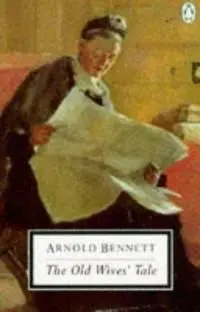
- Название:The Old Wives' Tale
- Автор:
- Издательство:Kessinger Publishing
- Жанр:
- Год:2005
- ISBN:9781417903672
- Рейтинг книги:5 / 5. Голосов: 1
-
Избранное:Добавить в избранное
- Отзывы:
-
Ваша оценка:
The Old Wives' Tale: краткое содержание, описание и аннотация
Предлагаем к чтению аннотацию, описание, краткое содержание или предисловие (зависит от того, что написал сам автор книги «The Old Wives' Tale»). Если вы не нашли необходимую информацию о книге — напишите в комментариях, мы постараемся отыскать её.
The Old Wives' Tale — читать онлайн бесплатно полную книгу (весь текст) целиком
Ниже представлен текст книги, разбитый по страницам. Система сохранения места последней прочитанной страницы, позволяет с удобством читать онлайн бесплатно книгу «The Old Wives' Tale», без необходимости каждый раз заново искать на чём Вы остановились. Поставьте закладку, и сможете в любой момент перейти на страницу, на которой закончили чтение.
Интервал:
Закладка:
Constance had food ready for his waking, and she approached the bed and leaned over him. The fever had increased somewhat, the breathing was more rapid, and his lips were covered with tiny purple pimples. He feebly shook his head, with a disgusted air, at her mention of food. It was this obstinate refusal of food which first alarmed her. A little uncomfortable suspicion shot up in her: Surely there's nothing the MATTER with him?
Something--impossible to say what--caused her to bend still lower, and put her ear to his chest. She heard within that mysterious box a rapid succession of thin, dry, crackling sounds: sounds such as she would have produced by rubbing her hair between her fingers close to her ear. The crepitation ceased, then recommenced, and she perceived that it coincided with the intake of his breath. He coughed; the sounds were intensified; a spasm of pain ran over his face; and he put his damp hand to his side.
"Pain in my side!" he whispered with difficulty.
Constance stepped into the drawing-room, where Cyril was sketching by the fire.
"Cyril," she said, "go across and ask Dr. Harrop to come round at once. And if he isn't in, then his new partner."
"Is it for father?"
"Yes."
"What's the matter?"
"Now do as I say, please," said Constance, sharply, adding: "I don't know what's the matter. Perhaps nothing. But I'm not satisfied."
The venerable Harrop pronounced the word 'pneumonia.' It was acute double pneumonia that Samuel had got. During the three worst months of the year, he had escaped the fatal perils which await a man with a flat chest and a chronic cough, who ignores his condition and defies the weather. But a journey of five hundred yards to the Rectory had been one journey too many. The Rectory was so close to the shop that he had not troubled to wrap himself up as for an excursion to Stafford. He survived the crisis of the disease and then died of toxsemia, caused by a heart that would not do its duty by the blood. A casual death, scarce noticed in the reaction after the great febrile demonstration! Besides, Samuel Povey never could impose himself on the burgesses. He lacked individuality. He was little. I have often laughed at Samuel Povey. But I liked and respected him. He was a very honest man. I have always been glad to think that, at the end of his life, destiny took hold of him and displayed, to the observant, the vein of greatness which runs through every soul without exception. He embraced a cause, lost it, and died of it.
CHAPTER VI
THE WIDOW
I
Constance, alone in the parlour, stood expectant by the set tea- table. She was not wearing weeds; her mother and she, on the death of her father, had talked of the various disadvantages of weeds; her mother had worn them unwillingly, and only because a public opinion not sufficiently advanced had intimidated her. Constance had said: "If ever I'm a widow I won't wear them," positively, in the tone of youth; and Mrs. Baines had replied: "I hope you won't, my dear." That was over twenty years ago, but Constance perfectly remembered. And now, she was a widow! How strange and how impressive was life! And she had kept her word; not positively, not without hesitations; for though times were changed, Bursley was still Bursley; but she had kept it.
This was the first Monday after Samuel's funeral. Existence in the house had been resumed on the plane which would henceforth be the normal plane. Constance had put on for tea a dress of black silk with a jet brooch of her mother's. Her hands, just meticulously washed, had that feeling of being dirty which comes from roughening of the epidermis caused by a day spent in fingering stuffs. She had been 'going through' Samuel's things, and her own, and ranging all anew. It was astonishing how little the man had collected, of 'things,' in the course of over half a century. All his clothes were contained in two long drawers and a short one. He had the least possible quantity of haberdashery and linen, for he invariably took from the shop such articles as he required, when he required them, and he would never preserve what was done with. He possessed no jewellery save a set of gold studs, a scarf-ring, and a wedding-ring; the wedding-ring was buried with him. Once, when Constance had offered him her father's gold watch and chain, he had politely refused it, saying that he preferred his own--a silver watch (with a black cord) which kept excellent time; he had said later that she might save the gold watch and chain for Cyril when he was twenty-one. Beyond these trifles and a half-empty box of cigars and a pair of spectacles, he left nothing personal to himself. Some men leave behind them a litter which takes months to sift and distribute. But Samuel had not the mania for owning. Constance put his clothes in a box to be given away gradually (all except an overcoat and handkerchiefs which might do for Cyril); she locked up the watch and its black cord, the spectacles and the scarf-ring; she gave the gold studs to Cyril; she climbed on a chair and hid the cigar-box on the top of her wardrobe; and scarce a trace of Samuel remained!
By his own wish the funeral had been as simple and private as possible. One or two distant relations, whom Constance scarcely knew and who would probably not visit her again until she too was dead, came--and went. And lo! the affair was over. The simple celerity of the funeral would have satisfied even Samuel, whose tremendous self-esteem hid itself so effectually behind such externals that nobody had ever fully perceived it. Not even Constance quite knew Samuel's secret opinion of Samuel. Constance was aware that he had a ridiculous side, that his greatest lack had been a lack of spectacular dignity. Even in the coffin, where nevertheless most people are finally effective, he had not been imposing--with his finicky little grey beard persistently sticking up.
The vision of him in his coffin--there in the churchyard, just at the end of King Street!--with the lid screwed down on that unimportant beard, recurred frequently in the mind of the widow, as something untrue and misleading. She had to say to herself: "Yes, he is really there! And that is why I have this particular feeling in my heart." She saw him as an object pathetic and wistful, not majestic. And yet she genuinely thought that there could not exist another husband quite so honest, quite so just, quite so reliable, quite so good, as Samuel had been. What a conscience he had! How he would try, and try, to be fair with her! Twenty years she could remember, of ceaseless, constant endeavour on his part to behave rightly to her! She could recall many an occasion when he had obviously checked himself, striving against his tendency to cold abruptness and to sullenness, in order to give her the respect due to a wife. What loyalty was his! How she could depend on him! How much better he was than herself (she thought with modesty)!
His death was an amputation for her. But she faced it with calmness. She was not bowed with sorrow. She did not nurse the idea that her life was at an end; on the contrary, she obstinately put it away from her, dwelling on Cyril. She did not indulge in the enervating voluptuousness of grief. She had begun in the first hours of bereavement by picturing herself as one marked out for the blows of fate. She had lost her father and her mother, and now her husband. Her career seemed to be punctuated by interments. But after a while her gentle commonsense came to insist that most human beings lose their parents, and that every marriage must end in either a widower or a widow, and that all careers are punctuated by interments. Had she not had nearly twenty-one years of happy married life? (Twenty-one years--rolled up! The sudden thought of their naive ignorance of life, hers and his, when they were first married, brought tears into her eyes. How wise and experienced she was now!) And had she not Cyril? Compared to many women, she was indeed very fortunate.
Читать дальшеИнтервал:
Закладка:
Похожие книги на «The Old Wives' Tale»
Представляем Вашему вниманию похожие книги на «The Old Wives' Tale» списком для выбора. Мы отобрали схожую по названию и смыслу литературу в надежде предоставить читателям больше вариантов отыскать новые, интересные, ещё непрочитанные произведения.








Обсуждение, отзывы о книге «The Old Wives' Tale» и просто собственные мнения читателей. Оставьте ваши комментарии, напишите, что Вы думаете о произведении, его смысле или главных героях. Укажите что конкретно понравилось, а что нет, и почему Вы так считаете.