Arnold Bennett - The Old Wives' Tale
Здесь есть возможность читать онлайн «Arnold Bennett - The Old Wives' Tale» весь текст электронной книги совершенно бесплатно (целиком полную версию без сокращений). В некоторых случаях можно слушать аудио, скачать через торрент в формате fb2 и присутствует краткое содержание. Год выпуска: 2005, ISBN: 2005, Издательство: Kessinger Publishing, Жанр: Классическая проза, на английском языке. Описание произведения, (предисловие) а так же отзывы посетителей доступны на портале библиотеки ЛибКат.
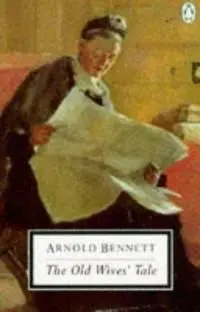
- Название:The Old Wives' Tale
- Автор:
- Издательство:Kessinger Publishing
- Жанр:
- Год:2005
- ISBN:9781417903672
- Рейтинг книги:5 / 5. Голосов: 1
-
Избранное:Добавить в избранное
- Отзывы:
-
Ваша оценка:
The Old Wives' Tale: краткое содержание, описание и аннотация
Предлагаем к чтению аннотацию, описание, краткое содержание или предисловие (зависит от того, что написал сам автор книги «The Old Wives' Tale»). Если вы не нашли необходимую информацию о книге — напишите в комментариях, мы постараемся отыскать её.
The Old Wives' Tale — читать онлайн бесплатно полную книгу (весь текст) целиком
Ниже представлен текст книги, разбитый по страницам. Система сохранения места последней прочитанной страницы, позволяет с удобством читать онлайн бесплатно книгу «The Old Wives' Tale», без необходимости каждый раз заново искать на чём Вы остановились. Поставьте закладку, и сможете в любой момент перейти на страницу, на которой закончили чтение.
Интервал:
Закладка:
Mr. Povey turned to face her, swallowing his emotion.
"A telegram!" said Miss Insull. "The postmaster brought it down himself--"
"What? Mr. Derry?" asked Samuel, opening the telegram with an affectation of majesty.
"Yes. He said it was too late for delivery by rights. But as it seemed very important ..."
Samuel scanned it and nodded gravely; then gave it to his wife. Tears came into her eyes.
"I'll get Cousin Daniel to drive me over at once," said Samuel, master of himself and of the situation.
"Wouldn't it be better to hire?" Constance suggested. She had a prejudice against Daniel.
Mr. Povey shook his head. "He offered," he replied. "I can't refuse his offer."
"Put your thick overcoat on, dear," said Constance, in a dream, descending with him.
"I hope it isn't--" Miss Insull stopped.
"Yes it is, Miss Insull," said Samuel, deliberately.
In less than a minute he was gone.
Constance ran upstairs. But the cry had ceased. She turned the door-knob softly, slowly, and crept into the chamber. A night- light made large shadows among the heavy mahogany and the crimson, tasselled rep in the close-curtained room. And between the bed and the ottoman (on which lay Samuel's newly-bought family Bible) the cot loomed in the shadows. She picked up the night-light and stole round the bed. Yes, he had decided to fall asleep. The hazard of death afar off had just defeated his devilish obstinacy. Fate had bested him. How marvellously soft and delicate that tear-stained cheek! How frail that tiny, tiny clenched hand! In Constance grief and joy were mystically united.
II
The drawing-room was full of visitors, in frocks of ceremony. The old drawing-room, but newly and massively arranged with the finest Victorian furniture from dead Aunt Harriet's house at Axe; two "Canterburys," a large bookcase, a splendid scintillant table solid beyond lifting, intricately tortured chairs and armchairs! The original furniture of the drawing-room was now down in the parlour, making it grand. All the house breathed opulence; it was gorged with quiet, restrained expensiveness; the least considerable objects, in the most modest corners, were what Mrs. Baines would have termed 'good.' Constance and Samuel had half of all Aunt Harriet's money and half of Mrs. Baines's; the other half was accumulating for a hypothetical Sophia, Mr. Critchlow being the trustee. The business continued to flourish. People knew that Samuel Povey was buying houses. Yet Samuel and Constance had not made friends; they had not, in the Five Towns phrase, 'branched out socially,' though they had very meetly branched out on subscription lists. They kept themselves to themselves (emphasizing the preposition). These guests were not their guests; they were the guests of Cyril.
He had been named Samuel because Constance would have him named after his father, and Cyril because his father secretly despised the name of Samuel; and he was called Cyril; 'Master Cyril,' by Amy, definite successor to Maggie. His mother's thoughts were on Cyril as long as she was awake. His father, when not planning Cyril's welfare, was earning money whose unique object could be nothing but Cyril's welfare. Cyril was the pivot of the house; every desire ended somewhere in Cyril. The shop existed now solely for him. And those houses that Samuel bought by private treaty, or with a shamefaced air at auctions--somehow they were aimed at Cyril. Samuel and Constance had ceased to be self-justifying beings; they never thought of themselves save as the parents of Cyril.
They realized this by no means fully. Had they been accused of monomania they would have smiled the smile of people confident in their commonsense and their mental balance. Nevertheless, they were monomaniacs. Instinctively they concealed the fact as much as possible; They never admitted it even to themselves. Samuel, indeed, would often say: "That child is not everybody. That child must be kept in his place." Constance was always teaching him consideration for his father as the most important person in the household. Samuel was always teaching him consideration for his mother as the most important person in the household. Nothing was left undone to convince him that he was a cipher, a nonentity, who ought to be very glad to be alive. But he knew all about his importance. He knew that the entire town was his. He knew that his parents were deceiving themselves. Even when he was punished he well knew that it was because he was so important. He never imparted any portion of this knowledge to his parents; a primeval wisdom prompted him to retain it strictly in his own bosom.
He was four and a half years old, dark, like his father; handsome like his aunt, and tall for his age; not one of his features resembled a feature of his mother's, but sometimes he 'had her look.' From the capricious production of inarticulate sounds, and then a few monosyllables that described concrete things and obvious desires, he had gradually acquired an astonishing idiomatic command over the most difficult of Teutonic languages; there was nothing that he could not say. He could walk and run, was full of exact knowledge about God, and entertained no doubt concerning the special partiality of a minor deity called Jesus towards himself.
Now, this party was his mother's invention and scheme. His father, after flouting it, had said that if it was to be done at all, it should be done well, and had brought to the doing all his organizing skill. Cyril had accepted it at first--merely accepted it; but, as the day approached and the preparations increased in magnitude, he had come to look on it with favour, then with enthusiasm. His father having taken him to Daniel Povey's opposite, to choose cakes, he had shown, by his solemn and fastidious waverings, how seriously he regarded the affair.
Of course it had to occur on a Thursday afternoon. The season was summer, suitable for pale and fragile toilettes. And the eight children who sat round Aunt Harriet's great table glittered like the sun. Not Constance's specially provided napkins could hide that wealth and profusion of white lace and stitchery. Never in after-life are the genteel children of the Five Towns so richly clad as at the age of four or five years. Weeks of labour, thousands of cubic feet of gas, whole nights stolen from repose, eyesight, and general health, will disappear into the manufacture of a single frock that accidental jam may ruin in ten seconds. Thus it was in those old days; and thus it is to-day. Cyril's guests ranged in years from four to six; they were chiefly older than their host; this was a pity, it impaired his importance; but up to four years a child's sense of propriety, even of common decency, is altogether too unreliable for a respectable party.
Round about the outskirts of the table were the elders, ladies the majority; they also in their best, for they had to meet each other. Constance displayed a new dress, of crimson silk; after having mourned for her mother she had definitely abandoned the black which, by reason of her duties in the shop, she had constantly worn from the age of sixteen to within a few months of Cyril's birth; she never went into the shop now, except casually, on brief visits of inspection. She was still fat; the destroyer of her figure sat at the head of the table. Samuel kept close to her; he was the only male, until Mr. Critchlow astonishingly arrived; among the company Mr. Critchlow had a grand-niece. Samuel, if not in his best, was certainly not in his everyday suit. With his large frilled shirt-front, and small black tie, and his little black beard and dark face over that, he looked very nervous and self-conscious. He had not the habit of entertaining. Nor had Constance; but her benevolence ever bubbling up to the calm surface of her personality made self-consciousness impossible for her. Miss Insull was also present, in shop-black, 'to help.' Lastly there was Amy, now as the years passed slowly assuming the character of a faithful retainer, though she was only twenty- three. An ugly, abrupt, downright girl, with convenient notions of pleasure! For she would rise early and retire late in order to contrive an hour to go out with Master Cyril; and to be allowed to put Master Cyril to bed was, really, her highest bliss.
Читать дальшеИнтервал:
Закладка:
Похожие книги на «The Old Wives' Tale»
Представляем Вашему вниманию похожие книги на «The Old Wives' Tale» списком для выбора. Мы отобрали схожую по названию и смыслу литературу в надежде предоставить читателям больше вариантов отыскать новые, интересные, ещё непрочитанные произведения.






Обсуждение, отзывы о книге «The Old Wives' Tale» и просто собственные мнения читателей. Оставьте ваши комментарии, напишите, что Вы думаете о произведении, его смысле или главных героях. Укажите что конкретно понравилось, а что нет, и почему Вы так считаете.