Arnold Bennett - The Old Wives' Tale
Здесь есть возможность читать онлайн «Arnold Bennett - The Old Wives' Tale» весь текст электронной книги совершенно бесплатно (целиком полную версию без сокращений). В некоторых случаях можно слушать аудио, скачать через торрент в формате fb2 и присутствует краткое содержание. Год выпуска: 2005, ISBN: 2005, Издательство: Kessinger Publishing, Жанр: Классическая проза, на английском языке. Описание произведения, (предисловие) а так же отзывы посетителей доступны на портале библиотеки ЛибКат.
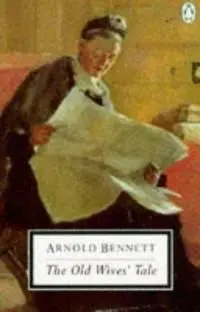
- Название:The Old Wives' Tale
- Автор:
- Издательство:Kessinger Publishing
- Жанр:
- Год:2005
- ISBN:9781417903672
- Рейтинг книги:5 / 5. Голосов: 1
-
Избранное:Добавить в избранное
- Отзывы:
-
Ваша оценка:
The Old Wives' Tale: краткое содержание, описание и аннотация
Предлагаем к чтению аннотацию, описание, краткое содержание или предисловие (зависит от того, что написал сам автор книги «The Old Wives' Tale»). Если вы не нашли необходимую информацию о книге — напишите в комментариях, мы постараемся отыскать её.
The Old Wives' Tale — читать онлайн бесплатно полную книгу (весь текст) целиком
Ниже представлен текст книги, разбитый по страницам. Система сохранения места последней прочитанной страницы, позволяет с удобством читать онлайн бесплатно книгу «The Old Wives' Tale», без необходимости каждый раз заново искать на чём Вы остановились. Поставьте закладку, и сможете в любой момент перейти на страницу, на которой закончили чтение.
Интервал:
Закладка:
On the fifteenth of October she paid the quarter's rent of the flat, four hundred francs, and was accepted as tenant. Her ears were soon quite accustomed to the sound of cannon, and she felt that she had always been a citizeness of Paris, and that Paris had always been besieged. She did not speculate about the end of the siege; she lived from day to day. Occasionally she had a qualm of fear, when the firing grew momentarily louder, or when she heard that battles had been fought in such and such a suburb. But then she said it was absurd to be afraid when you were with a couple of million people, all in the same plight as yourself. She grew reconciled to everything. She even began to like her tiny bedroom, partly because it was so easy to keep warm (the question of artificial heat was growing acute in Paris), and partly because it ensured her privacy. Down in the flat, whatever was done or said in one room could be more or less heard in all the others, owing to the prevalence of doors.
Her existence, in the first half of November, had become regular with a monotony almost absolute. Only the number of meals served to her boarders varied slightly from day to day. All these repasts, save now and then one in the evening, were carried into the bedrooms by the charwoman. Sophia did not allow herself to be seen much, except in the afternoons. Though Sophia continued to increase her prices, and was now selling her stores at an immense profit, she never approached the prices current outside. She was very indignant against the exploitation of Paris by its shopkeepers, who had vast supplies of provender, and were hoarding for the rise. But the force of their example was too great for her to ignore it entirely; she contented herself with about half their gains. Only to M. Niepce did she charge more than to the others, because he was a shopkeeper. The four men appreciated their paradise. In them developed that agreeable feeling of security which solitary males find only under the roof of a landlady who is at once prompt, honest, and a votary of cleanliness. Sophia hung a slate near the frontdoor, and on this slate they wrote their requests for meals, for being called, for laundry-work, etc. Sophia never made a mistake, and never forgot. The perfection of the domestic machine amazed these men, who had been accustomed to something quite different, and who every day heard harrowing stories of discomfort and swindling from their acquaintances. They even admired Sophia for making them pay, if not too high, still high. They thought it wonderful that she should tell them the price of all things in advance, and even show them how to avoid expense, particularly in the matter of warmth. She arranged rugs for each of them, so that they could sit comfortably in their rooms with nothing but a small charcoal heater for the hands. Quite naturally they came to regard her as the paragon and miracle of women. They endowed her with every fine quality. According to them there had never been such a woman in the history of mankind; there could not have been! She became legendary among their friends: a young and elegant creature, surpassingly beautiful, proud, queenly, unapproachable, scarcely visible, a marvellous manager, a fine cook and artificer of strange English dishes, utterly reliable, utterly exact and with habits of order ...! They adored the slight English accent which gave a touch of the exotic to her very correct and freely idiomatic French. In short, Sophia was perfect for them, an impossible woman. Whatever she did was right.
And she went up to her room every night with limbs exhausted, but with head clear enough to balance her accounts and go through her money. She did this in bed with thick gloves on. If often she did not sleep well, it was not because of the distant guns, but because of her preoccupation with the subject of finance. She was making money, and she wanted to make more. She was always inventing ways of economy. She was so anxious to achieve independence that money was always in her mind. She began to love gold, to love hoarding it, and to hate paying it away.
One morning her charwoman, who by good fortune was nearly as precise as Sophia herself, failed to appear. When the moment came for serving M. Niepce's breakfast, Sophia hesitated, and then decided to look after the old man personally. She knocked at his door, and went boldly in with the tray and candle. He started at seeing her; she was wearing a blue apron, as the charwoman did, but there could be no mistaking her for the charwoman. Niepce looked older in bed than when dressed. He had a rather ridiculous, undignified appearance, common among old men before their morning toilette is achieved; and a nightcap did not improve it. His rotund paunch lifted the bedclothes, upon which, for the sake of extra warmth, he had spread unmajestic garments. Sophia smiled to herself; but the contempt implied by that secret smile was softened by the thought: "Poor old man!" She told him briefly that she supposed the charwoman to be ill. He coughed and moved nervously. His benevolent and simple face beamed on her paternally as she fixed the tray by the bed.
"I really must open the window for one little second," she said, and did so. The chill air of the street came through the closed shutters, and the old man made a noise as of shivering. She pushed back the shutters, and closed the window, and then did the same with the other two windows. It was almost day in the room.
"You will no longer need the candle," she said, and came back to the bedside to extinguish it.
The benign and fatherly old man put his arm round her waist. Fresh from the tonic of pure air, and with the notion of his ridiculousness still in her mind, she was staggered for an instant by this gesture. She had never given a thought to the temperament of the old grocer, the husband of a young wife. She could not always imaginatively keep in mind the effect of her own radiance, especially under such circumstances. But after an instant her precocious cynicism, which had slept, sprang up. "Naturally! I might have expected it!" she thought with blasting scorn.
"Take away your hand!" she said bitterly to the amiable old fool. She did not stir.
He obeyed, sheepishly.
"Do you wish to remain with me?" she asked, and as he did not immediately answer, she said in a most commanding tone: "Answer, then!"
"Yes," he said feebly.
"Well, behave properly."
She went towards the door.
"I wished only--" he stammered.
"I do not wish to know what you wished," she said.
Afterwards she wondered how much of the incident had been overheard. The other breakfasts she left outside the respective doors; and in future Niepce's also.
The charwoman never came again. She had caught smallpox and she died of it, thus losing a good situation. Strange to say, Sophia did not replace her; the temptation to save her wages and food was too strong. She could not, however, stand waiting for hours at the door of the official baker and the official butcher, one of a long line of frozen women, for the daily rations of bread and tri- weekly rations of meat. She employed the concierge's boy, at two sous an hour, to do this. Sometimes he would come in with his hands so blue and cold that he could scarcely hold the precious cards which gave the right to the rations and which cost Chirac an hour or two of waiting at the mayoral offices each week. Sophia might have fed her flock without resorting to the official rations, but she would not sacrifice the economy which they represented. She demanded thick clothes for the concierge's boy, and received boots from Chirac, gloves from Carlier, and a great overcoat from Niepce. The weather increased in severity, and provisions in price. One day she sold to the wife of a chemist who lived on the first floor, for a hundred and ten francs, a ham for which she had paid less than thirty francs. She was conscious of a thrill of joy in receiving a beautiful banknote and a gold coin in exchange for a mere ham. By this time her total cash resources had grown to nearly five thousand francs. It was astounding. And the reserves in the cellar were still considerable, and the sack of flour that encumbered the kitchen was still more than half full. The death of the faithful charwoman, when she heard of it, produced but little effect on Sophia, who was so overworked and so completely absorbed in her own affairs that she had no nervous energy to spare for sentimental regrets. The charwoman, by whose side she had regularly passed many hours in the kitchen, so that she knew every crease in her face and fold of her dress, vanished out of Sophia's memory.
Читать дальшеИнтервал:
Закладка:
Похожие книги на «The Old Wives' Tale»
Представляем Вашему вниманию похожие книги на «The Old Wives' Tale» списком для выбора. Мы отобрали схожую по названию и смыслу литературу в надежде предоставить читателям больше вариантов отыскать новые, интересные, ещё непрочитанные произведения.









Обсуждение, отзывы о книге «The Old Wives' Tale» и просто собственные мнения читателей. Оставьте ваши комментарии, напишите, что Вы думаете о произведении, его смысле или главных героях. Укажите что конкретно понравилось, а что нет, и почему Вы так считаете.