Олдос Хаксли - Antic Hay
Здесь есть возможность читать онлайн «Олдос Хаксли - Antic Hay» весь текст электронной книги совершенно бесплатно (целиком полную версию без сокращений). В некоторых случаях можно слушать аудио, скачать через торрент в формате fb2 и присутствует краткое содержание. Год выпуска: 2017, Издательство: epubBooks Classics, Жанр: Классическая проза, на английском языке. Описание произведения, (предисловие) а так же отзывы посетителей доступны на портале библиотеки ЛибКат.
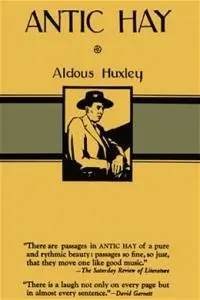
- Название:Antic Hay
- Автор:
- Издательство:epubBooks Classics
- Жанр:
- Год:2017
- ISBN:нет данных
- Рейтинг книги:5 / 5. Голосов: 1
-
Избранное:Добавить в избранное
- Отзывы:
-
Ваша оценка:
Antic Hay: краткое содержание, описание и аннотация
Предлагаем к чтению аннотацию, описание, краткое содержание или предисловие (зависит от того, что написал сам автор книги «Antic Hay»). Если вы не нашли необходимую информацию о книге — напишите в комментариях, мы постараемся отыскать её.
Antic Hay — читать онлайн бесплатно полную книгу (весь текст) целиком
Ниже представлен текст книги, разбитый по страницам. Система сохранения места последней прочитанной страницы, позволяет с удобством читать онлайн бесплатно книгу «Antic Hay», без необходимости каждый раз заново искать на чём Вы остановились. Поставьте закладку, и сможете в любой момент перейти на страницу, на которой закончили чтение.
Интервал:
Закладка:
'What's he to Hecuba?
Nothing at all.
That's why there'll be no wedding on Wednesday week,
Way down in old Bengal.'
'What unspeakable sadness,' said Gumbril, as he stepped, stepped through the intricacies of the trot. 'Eternal passion, eternal pain. Les chants désespérés sont les chants les plus beaux, Et j'en sais d'immortels qui sont de purs sanglots. Rum tiddle–um–tum, pom–pom. Amen. What's he to Hecuba? Nothing at all. Nothing, mark you. Nothing, nothing.'
'Nothing,' repeated Mrs Viveash. 'I know all about that.' She sighed.
'I am nothing to you,' said Gumbril, gliding with skill between the wall and the Charybdis of a couple dangerously experimenting with a new step. 'You are nothing to me. Thank God. And yet here we are, two bodies with but a single thought, a beast with two backs, a perfectly united centaur trotting, trotting.' They trotted.
'What's he to Hecuba?' The grinning blackamoors repeated the question, reiterated the answer on a tone of frightful unhappiness. The saxophone warbled on the verge of anguish. The couples revolved, marked time, stepped and stepped with an habitual precision, as though performing some ancient and profoundly significant rite. Some were in fancy dress, for this was a gala night at the cabaret. Young women disguised as callipygous Florentine pages, blue–breeched Gondoliers, black–breeched Toreadors circulated, moon–like, round the hall, clasped sometimes in the arms of Arabs, or white clowns, or more often of untravestied partners. The faces reflected in the mirrors were the sort of faces one feels one ought to know by sight; the cabaret was 'Artistic'.
'What's he to Hecuba?'
Mrs Viveash murmured the response, almost piously, as though she were worshipping almighty and omnipresent Nil. 'I adore this tune,' she said, 'this divine tune.' It filled up a space, it moved, it jigged, it set things twitching in you, it occupied time, it gave you a sense of being alive. 'Divine tune, divine tune,' she repeated with emphasis, and she shut her eyes, trying to abandon herself, trying to float, trying to give Nil the slip.
'Ravishing little Toreador, that,' said Gumbril, who had been following the black–breeched travesty with affectionate interest.
Mrs Viveash opened her eyes. Nil was unescapable. 'With Piers Cotton, you mean? Your tastes are a little common, my dear Theodore.'
'Green–eyed monster!'
Mrs Viveash laughed. 'When I was being "finished" in Paris,' she said, 'Mademoiselle always used to urge me to take fencing lessons. C'est un exercice très gracieux. Et puis ,' Mrs Viveash mimicked a passionate earnestness, ' et puis, ça dévelope le bassin . Your Toreador, Gumbril, looks as though she must be a champion with the foils. Quel bassin! '
'Hush,' said Gumbril. They were abreast of the Toreador and her partner. Piers Cotton turned his long greyhound's nose in their direction.
'How are you?' he asked across the music.
They nodded. 'And you?'
'Ah, writing such a book,' cried Piers Cotton, 'such a brilliant, brilliant, flashing book.' The dance was carrying them apart. 'Like a smile of false teeth,' he shouted across the widening gulf, and disappeared in the crowd.
'What's he to Hecuba?' Lachrymosely, the hilarious blackamoors chanted their question, mournfully pregnant with its foreknown reply.
Nil, omnipresent nil, world–soul, spiritual informer of all matter. Nil in the shape of a black–breeched moon–basined Toreador. Nil, the man with the greyhound's nose. Nil, as four blackamoors. Nil in the form of a divine tune. Nil, the faces, the faces one ought to know by sight, reflected in the mirrors of the hall. Nil this Gumbril whose arm is round one's waist, whose feet step in and out among one's own. Nothing at all.
That's why there'll be no wedding. No wedding at St George's, Hanover Square,—oh, desperate experiment!—with Nil Viveash, that charming boy, that charming nothing at all, engaged at the moment in hunting elephants, hunting fever and carnivores among the Tikki–tikki pygmies. That's why there'll be no wedding on Wednesday week. For Lycidas is dead, dead ere his prime. For the light strawy hair (not a lock left), the brown face, the red–brown hands and the smooth boy's body, milk–white, milk–warm, are nothing at all, nothing, now, at all—nil these five years—and the shining blue eyes as much nil as the rest.
'Always the same people,' complained Mrs Viveash, looking round the room. 'The old familiar faces. Never any one new. Where's the younger generation, Gumbril? We're old, Theodore. There are millions younger than we are. Where are they?'
'I'm not responsible for them,' said Gumbril. 'I'm not even responsible for myself.' He imagined a cottagey room, under a roof, with a window near the floor and a sloping ceiling where you were always bumping your head; and in the candle–light Emily's candid eyes, her grave and happy mouth; in the darkness, the curve, under his fingers, of her firm body.
'Why don't they come and sing for their supper?' Mrs Viveash went on petulantly. 'It's their business to amuse us.'
'They're probably thinking of amusing themselves,' Gumbril suggested.
'Well, then, they should do it where we can see them.'
'What's he to Hecuba?'
'Nothing at all,' Gumbril clownishly sang. The room, in the cottage, had nothing to do with him. He breathed Mrs Viveash's memories of Italian jasmines, laid his cheek for a moment against her smooth hair. 'Nothing at all.' Happy clown!
Way down in old Bengal, under the green Paradisiac palms, among the ecstatic mystagogues and the saints who scream beneath the divine caresses, the music came to an end. The four negroes wiped their glistening faces. The couples fell apart. Gumbril and Mrs Viveash sat down and smoked a cigarette.
Chapter XVI
The blackamoors had left the platform at the end of the hall. The curtains looped up at either side had slid down, cutting it off from the rest of the room—'making two worlds,' Gumbril elegantly and allusively put it, 'where only one grew before—and one of them a better world,' he added too philosophically, 'because unreal.' There was the theatrical silence, the suspense. The curtains parted again.
On a narrow bed—on a bier perhaps—the corpse of a woman. The husband kneels beside it. At the foot stands the doctor, putting away his instruments. In a beribboned pink cradle reposes a monstrous baby.
THE HUSBAND: Margaret! Margaret!
THE DOCTOR: She is dead.
THE HUSBAND: Margaret!
THE DOCTOR: Of septicæmia, I tell you.
THE HUSBAND: I wish that I too were dead!
THE DOCTOR: But you won't to–morrow.
THE HUSBAND: To–morrow! But I don't want to live to see to–morrow.
THE DOCTOR: You will to–morrow.
THE HUSBAND: Margaret! Margaret! Wait for me there; I shall not fail to meet you in that hollow vale.
THE DOCTOR: You will not be slow to survive her.
THE HUSBAND: Christ have mercy upon us!
THE DOCTOR: You would do better to think of the child.
THE HUSBAND ( rising and standing menacingly over the cradle ): Is that the monster?
THE DOCTOR: No worse than others.
THE HUSBAND: Begotten in a night of immaculate pleasure, monster, may you live loveless, in dirt and impurity!
THE DOCTOR: Conceived in lust and darkness, may your own impurity always seem heavenly, monster, in your own eyes!
THE HUSBAND: Murderer, slowly the all your life long!
THE DOCTOR: The child must be fed.
THE HUSBAND: Fed? With what?
THE DOCTOR: With milk.
THE HUSBAND: Her milk is cold in her breasts.
THE DOCTOR: There are still cows.
THE HUSBAND: Tubercular shorthorns. ( Calling. ) Let Short–i'–the–horn be brought!
Читать дальшеИнтервал:
Закладка:
Похожие книги на «Antic Hay»
Представляем Вашему вниманию похожие книги на «Antic Hay» списком для выбора. Мы отобрали схожую по названию и смыслу литературу в надежде предоставить читателям больше вариантов отыскать новые, интересные, ещё непрочитанные произведения.

![Олдос Хаксли - О дивный новый мир [Прекрасный новый мир]](/books/11834/oldos-haksli-o-divnyj-novyj-mir-prekrasnyj-novyj-thumb.webp)



Обсуждение, отзывы о книге «Antic Hay» и просто собственные мнения читателей. Оставьте ваши комментарии, напишите, что Вы думаете о произведении, его смысле или главных героях. Укажите что конкретно понравилось, а что нет, и почему Вы так считаете.