ROBBINS Harold - The Carpetbaggers
Здесь есть возможность читать онлайн «ROBBINS Harold - The Carpetbaggers» весь текст электронной книги совершенно бесплатно (целиком полную версию без сокращений). В некоторых случаях можно слушать аудио, скачать через торрент в формате fb2 и присутствует краткое содержание. Жанр: Классическая проза, на английском языке. Описание произведения, (предисловие) а так же отзывы посетителей доступны на портале библиотеки ЛибКат.
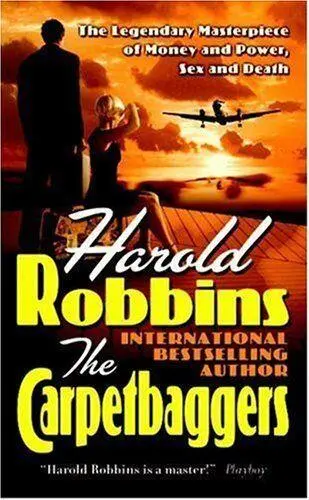
- Название:The Carpetbaggers
- Автор:
- Жанр:
- Год:неизвестен
- ISBN:нет данных
- Рейтинг книги:4 / 5. Голосов: 1
-
Избранное:Добавить в избранное
- Отзывы:
-
Ваша оценка:
The Carpetbaggers: краткое содержание, описание и аннотация
Предлагаем к чтению аннотацию, описание, краткое содержание или предисловие (зависит от того, что написал сам автор книги «The Carpetbaggers»). Если вы не нашли необходимую информацию о книге — напишите в комментариях, мы постараемся отыскать её.
The Carpetbaggers — читать онлайн бесплатно полную книгу (весь текст) целиком
Ниже представлен текст книги, разбитый по страницам. Система сохранения места последней прочитанной страницы, позволяет с удобством читать онлайн бесплатно книгу «The Carpetbaggers», без необходимости каждый раз заново искать на чём Вы остановились. Поставьте закладку, и сможете в любой момент перейти на страницу, на которой закончили чтение.
Интервал:
Закладка:
"O.K.," the agent said. He started toward his own car, then stopped and came back. "This talking-picture business bothers me. A couple of other companies have announced they're going to make talkies."
"Let 'em," Nevada said. "It's their headache." He turned the key, pressed the starter and the big motor sprang into life with a roar. "It's a novelty," he shouted to the agent over the noise. "By the time our picture comes out people will have forgotten all about talkies."
The telephone on the small table near the bed rang softly. Rina walked over and picked it up. It was one of those new French telephones, the first she'd seen since she'd returned from Europe. The now familiar insignia was in the center of the dial, where the number usually was printed. "Hello."
Nevada's familiar voice was in her ear. "Howdy, friend. You all settled in?"
"Nevada!" she exclaimed.
"You got other friends?"
She laughed. "I'm unpacked," she said. "And amazed."
"At what?"
"Everything. This place. It's fabulous. I never saw anything like it."
His voice was a quiet whisper in her ear. "It's not very much. Paltry little spread, but I call it home."
"Oh, Nevada," she laughed, "I still can't believe it. Why did you ever build such a fantastic house? It's not like you at all."
"It's part of the act, Rina," he said. "Like the big white hat, the fancy shirts and the colored boots. You're not really a star unless you have the trappings."
"With N Bar S on everything?" she asked.
"With N Bar S on everything," he repeated. "But don't let it throw you. There are crazier things in Hollywood."
"I've got so much to tell you," she said. "What time will you be home?"
"Home?" He laughed. "I am home. I’m down in the bar, waiting for you."
"I’ll be down in a minute," she said, then hesitated. "But, Nevada, how will I find the bar? This place is so immense."
"We got Indian guides just for occasions like this," he said. "I’ll send one up after you."
She put down the telephone and went over to the mirror. By the time she had finished applying lipstick to her mouth, there was a soft knock at the door.
She crossed the room and opened it.
Nevada stood there, smiling. "Beg pardon, ma'am," he said with mock formality. "I jes’ checked the entire joint an' you won't believe it, but I was the only Indian around!"
"Oh, Nevada!" she said softly.
Then suddenly she was in his arms, her face buried against the hard muscles of his chest, her tears staining the soft white front of his fancy shirt.
JONAS – 1930
____________________
Book Three
1
THE LIGHTS OF LOS ANGELES CAME UP UNDER the right wing. I looked over at Buzz, sitting next to me in the cockpit. "We're almost home."
His pug-nosed face crinkled in a smile. He looked at his watch. "I think we got us a new record, too."
"The hell with the record," I said. "All I want is that mail contract."
He nodded. "We’ll get it now for sure." He reached over and patted the dashboard. "This baby insured that for us."
I swung wide over the city, heading for Burbank. If we got the airmail contract, Chicago to Los Angeles, it wouldn't be long before Inter-Continental would span the country. From Chicago east to New York would be the next step.
"I see in the papers that Ford has a tri-motor job on the boards that will carry thirty-two passengers," Buzz said.
"When will it be ready?"
"Two, maybe three years," he answered. "That's the next step."
"Yeah," I said. "But we can't afford to wait for Ford. It could take five years before something practical came from them. We gotta be ready in two years."
Buzz stared at me. "Two years? How are we gonna do it? It's impossible."
I glanced at him. "How many mail planes are we flying now?"
"About thirty-four," he said.
"And if we get the new mail contract?"
"Double, maybe triple that many," he said. He looked at me shrewdly. "What're you gettin' at?"
"The manufacturers of those planes are making more out of our mail contracts than we are," I said.
"If you're talkin' about buildin' our own planes, you're nuts!" Buzz said. "It would take us two years just to set up a factory."
"Not if we bought one that was already in business," I answered.
He thought for a moment. "Lockheed, Martin, Curtiss-Wright, they're all too busy. They wouldn't sell. The only one who might is Winthrop. They're layin' off since they lost that Army contract."
I smiled at him. "You're thinkin' good, Buzz."
He stared at me in the dim light. "Oh, no. I worked for old man Winthrop. He swore he'd never- "
We were over Burbank airport now. I swung wide to the south end of the field where the Winthrop plant stood. I banked the plane so Buzz could see from his side. "Look down there."
Up through the darkness, illuminated by two searchlights, rose the giant white letters painted on the black tarred roof.
CORD AIRCRAFT, INC.
The reporters clustered around us as soon as we hit the ground. Their flash bulbs kept hitting my eyes and I blinked. "You tired, Mr. Cord?" one of them yelled.
I rubbed my unshaven cheeks and grinned. "Fresh as a daisy," I said. A stone on the field cut into my foot. I turned back to the plane and yelled up to Buzz. "Hey, throw me my shoes, will you?"
He laughed and threw them down and the reporters made a great fuss about taking my picture while I was putting them on.
Buzz climbed down beside me. They took some more pictures and we started to walk toward the hangar. "How does it feel to be home?" another reporter yelled.
"Good."
"Real good," Buzz added.
We meant it. Five days ago, we took off from Le Bourget in Paris. Newfoundland, New York, Chicago, Los Angeles – five days.
A reporter came running up, waving a sheet of paper. "You just broke the Chicago-to-L-A. record!" he said. "That makes five records you broke on this flight!"
"One for each day." I grinned. "That's nothin' to complain about."
"Does that mean you'll get the mail contract?" a reporter asked.
Behind them, at the entrance to the hangar, I could see McAllister waving frantically. "That's the business end," I said. "I leave that to my partner, Buzz. He'll fill you gentlemen in on it."
I cut away from them quickly, leaving them to surround Buzz while I walked over to McAllister. His face wore a harassed expression. "I thought you'd never get here on time."
"I said I'd be in by nine o'clock."
He took my arm. "I’ve got a car waiting," he said. "We'll go right to the bank from here. I told them I'd bring you down."
"Wait a minute," I said, shaking my arm free. "Told who?"
"The syndication group that agreed to meet your price for the sublicensing of the high-speed injection mold. Even Du Pont's coming in with them now." He took my arm again and began to hurry me to the car.
I pulled free again. "Wait a minute," I said. "I haven't been near a bed for five days and I'm beat. I'll see them tomorrow."
'Tomorrow?" he yelled. "They're waiting down there now!"
"I don't give a damn," I said. "Let 'em wait."
"But they're giving you ten million dollars!"
"They're giving me nothing," I said. "They had the same chance to buy that patent we did. They were all in Europe that year but they were too tight. Now they need it, they can wait until tomorrow."
I got into the car. "The Beverly Hills Hotel."
McAllister climbed in beside me. He looked distraught. "Tomorrow?" he said. "They don't want to wait."
The chauffeur started the car. I looked over at McAllister and grinned. I began to feel a little sorry for him. I knew it hadn't been an easy deal to swing.
"Tell you what," I said gently. "Let me get six hours' shut-eye and then we can meet."
Читать дальшеИнтервал:
Закладка:
Похожие книги на «The Carpetbaggers»
Представляем Вашему вниманию похожие книги на «The Carpetbaggers» списком для выбора. Мы отобрали схожую по названию и смыслу литературу в надежде предоставить читателям больше вариантов отыскать новые, интересные, ещё непрочитанные произведения.











Обсуждение, отзывы о книге «The Carpetbaggers» и просто собственные мнения читателей. Оставьте ваши комментарии, напишите, что Вы думаете о произведении, его смысле или главных героях. Укажите что конкретно понравилось, а что нет, и почему Вы так считаете.