William Thackeray - Vanity Fair
Здесь есть возможность читать онлайн «William Thackeray - Vanity Fair» — ознакомительный отрывок электронной книги совершенно бесплатно, а после прочтения отрывка купить полную версию. В некоторых случаях можно слушать аудио, скачать через торрент в формате fb2 и присутствует краткое содержание. Жанр: Классическая проза, на английском языке. Описание произведения, (предисловие) а так же отзывы посетителей доступны на портале библиотеки ЛибКат.

- Название:Vanity Fair
- Автор:
- Жанр:
- Год:неизвестен
- ISBN:нет данных
- Рейтинг книги:5 / 5. Голосов: 1
-
Избранное:Добавить в избранное
- Отзывы:
-
Ваша оценка:
Vanity Fair: краткое содержание, описание и аннотация
Предлагаем к чтению аннотацию, описание, краткое содержание или предисловие (зависит от того, что написал сам автор книги «Vanity Fair»). Если вы не нашли необходимую информацию о книге — напишите в комментариях, мы постараемся отыскать её.
Vanity Fair — читать онлайн ознакомительный отрывок
Ниже представлен текст книги, разбитый по страницам. Система сохранения места последней прочитанной страницы, позволяет с удобством читать онлайн бесплатно книгу «Vanity Fair», без необходимости каждый раз заново искать на чём Вы остановились. Поставьте закладку, и сможете в любой момент перейти на страницу, на которой закончили чтение.
Интервал:
Закладка:
She and Sir Pitt performed the same salute with great gravity; but Rawdon, having been smoking, hung back rather from his sister-in-law, whose two children came up to their cousin; and, while Matilda held out her hand and kissed him, Pitt Binkie Southdown, the son and heir, stood aloof rather and examined him as a little dog does a big dog.
Then the kind hostess conducted her guests to the snug apartments blazing with cheerful fires. Then the young ladies came and knocked at Mrs. Rawdon’s door, under the pretence that they were desirous to be useful, but in reality to have the pleasure of inspecting the contents of her band and bonnet-boxes, and her dresses which, though black, were of the newest London fashion. And they told her how much the Hall was changed for the better, and how old Lady Southdown was gone, and how Pitt was taking his station in the county, as became a Crawley in fact. Then the great dinner-bell having rung, the family assembled at dinner, at which meal Rawdon Junior was placed by his aunt, the good-natured lady of the house, Sir Pitt being uncommonly attentive to his sister-in-law at his own right hand.
Little Rawdon exhibited a fine appetite and showed a gentlemanlike behaviour.
“I like to dine here,” he said to his aunt when he had completed his meal, at the conclusion of which, and after a decent grace by Sir Pitt, the younger son and heir was introduced, and was perched on a high chair by the Baronet’s side, while the daughter took possession of the place and the little wine-glass prepared for her near her mother. “I like to dine here,” said Rawdon Minor, looking up at his relation’s kind face.
“Why?” said the good Lady Jane.
“I dine in the kitchen when I am at home,” replied Rawdon Minor, “or else with Briggs.” But Becky was so engaged with the Baronet, her host, pouring out a flood of compliments and delights and raptures, and admiring young Pitt Binkie, whom she declared to be the most beautiful, intelligent, noble-looking little creature, and so like his father, that she did not hear the remarks of her own flesh and blood at the other end of the broad shining table.
As a guest, and it being the first night of his arrival, Rawdon the Second was allowed to sit up until the hour when tea being over, and a great gilt book being laid on the table before Sir Pitt, all the domestics of the family streamed in, and Sir Pitt read prayers. It was the first time the poor little boy had ever witnessed or heard of such a ceremonial.
The house had been much improved even since the Baronet’s brief reign, and was pronounced by Becky to be perfect, charming, delightful, when she surveyed it in his company. As for little Rawdon, who examined it with the children for his guides, it seemed to him a perfect palace of enchantment and wonder. There were long galleries, and ancient state bedrooms, there were pictures and old China, and armour. There were the rooms in which Grandpapa died, and by which the children walked with terrified looks. “Who was Grandpapa?” he asked; and they told him how he used to be very old, and used to be wheeled about in a garden-chair, and they showed him the garden-chair one day rotting in the out-house in which it had lain since the old gentleman had been wheeled away yonder to the church, of which the spire was glittering over the park elms.
The brothers had good occupation for several mornings in examining the improvements which had been effected by Sir Pitt’s genius and economy. And as they walked or rode, and looked at them, they could talk without too much boring each other. And Pitt took care to tell Rawdon what a heavy outlay of money these improvements had occasioned, and that a man of landed and funded property was often very hard pressed for twenty pounds. “There is that new lodge-gate,” said Pitt, pointing to it humbly with the bamboo cane, “I can no more pay for it before the dividends in January than I can fly.”
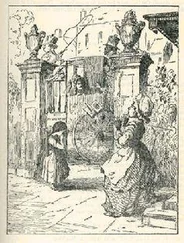
“I can lend you, Pitt, till then,” Rawdon answered rather ruefully; and they went in and looked at the restored lodge, where the family arms were just new scraped in stone, and where old Mrs. Lock, for the first time these many long years, had tight doors, sound roofs, and whole windows.
CHAPTER XLV
Sir Pitt Crawley had done more than repair fences and restore dilapidated lodges on the Queen’s Crawley estate. Like a wise man he had set to work to rebuild the injured popularity of his house and stop up the gaps and ruins in which his name had been left by his disreputable and thriftless old predecessor. He was elected for the borough speedily after his father’s demise; a magistrate, a member of parliament, a county magnate and representative of an ancient family, he made it his duty to show himself before the Hampshire public, subscribed handsomely to the county charities, called assiduously upon all the county folk, and laid himself out in a word to take that position in Hampshire, and in the Empire afterwards, to which he thought his prodigious talents justly entitled him. Lady Jane was instructed to be friendly with the Fuddlestones, and the Wapshots, and the other famous baronets, their neighbours. Their carriages might frequently be seen in the Queen’s Crawley avenue now; they dined pretty frequently at the Hall (where the cookery was so good that it was clear Lady Jane very seldom had a hand in it), and in return Pitt and his wife most energetically dined out in all sorts of weather and at all sorts of distances. For though Pitt did not care for joviality, being a frigid man of poor hearth and appetite, yet he considered that to be hospitable and condescending was quite incumbent on his station, and every time that he got a headache from too long an after-dinner sitting, he felt that he was a martyr to duty. He talked about crops, corn-laws, politics, with the best country gentlemen. He (who had been formerly inclined to be a sad free-thinker on these points) entered into poaching and game preserving with ardour. He didn’t hunt; he wasn’t a hunting man; he was a man of books and peaceful habits; but he thought that the breed of horses must be kept up in the country, and that the breed of foxes must therefore be looked to, and for his part, if his friend, Sir Huddlestone Fuddlestone, liked to draw his country and meet as of old the F. hounds used to do at Queen’s Crawley, he should be happy to see him there, and the gentlemen of the Fuddlestone hunt. And to Lady Southdown’s dismay too he became more orthodox in his tendencies every day; gave up preaching in public and attending meeting-houses; went stoutly to church; called on the Bishop and all the Clergy at Winchester; and made no objection when the Venerable Archdeacon Trumper asked for a game of whist. What pangs must have been those of Lady Southdown, and what an utter castaway she must have thought her son-in-law for permitting such a godless diversion! And when, on the return of the family from an oratorio at Winchester, the Baronet announced to the young ladies that he should next year very probably take them to the “county balls,” they worshipped him for his kindness. Lady Jane was only too obedient, and perhaps glad herself to go. The Dowager wrote off the direst descriptions of her daughter’s worldly behaviour to the authoress of the Washerwoman of Finchley Common at the Cape; and her house in Brighton being about this time unoccupied, returned to that watering-place, her absence being not very much deplored by her children. We may suppose, too, that Rebecca, on paying a second visit to Queen’s Crawley, did not feel particularly grieved at the absence of the lady of the medicine chest; though she wrote a Christmas letter to her Ladyship, in which she respectfully recalled herself to Lady Southdown’s recollection, spoke with gratitude of the delight which her Ladyship’s conversation had given her on the former visit, dilated on the kindness with which her Ladyship had treated her in sickness, and declared that everything at Queen’s Crawley reminded her of her absent friend.
Читать дальшеИнтервал:
Закладка:
Похожие книги на «Vanity Fair»
Представляем Вашему вниманию похожие книги на «Vanity Fair» списком для выбора. Мы отобрали схожую по названию и смыслу литературу в надежде предоставить читателям больше вариантов отыскать новые, интересные, ещё непрочитанные произведения.









Обсуждение, отзывы о книге «Vanity Fair» и просто собственные мнения читателей. Оставьте ваши комментарии, напишите, что Вы думаете о произведении, его смысле или главных героях. Укажите что конкретно понравилось, а что нет, и почему Вы так считаете.