Irwin Shaw - The Young Lions
Здесь есть возможность читать онлайн «Irwin Shaw - The Young Lions» весь текст электронной книги совершенно бесплатно (целиком полную версию без сокращений). В некоторых случаях можно слушать аудио, скачать через торрент в формате fb2 и присутствует краткое содержание. Жанр: Классическая проза, на английском языке. Описание произведения, (предисловие) а так же отзывы посетителей доступны на портале библиотеки ЛибКат.
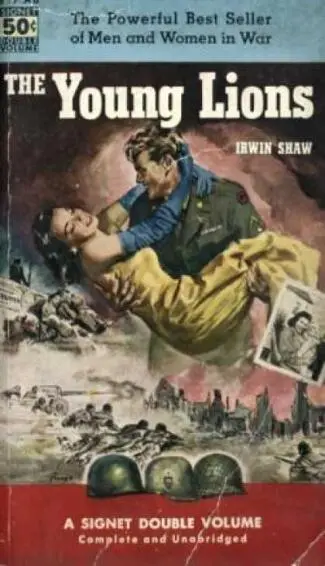
- Название:The Young Lions
- Автор:
- Жанр:
- Год:неизвестен
- ISBN:нет данных
- Рейтинг книги:4 / 5. Голосов: 1
-
Избранное:Добавить в избранное
- Отзывы:
-
Ваша оценка:
The Young Lions: краткое содержание, описание и аннотация
Предлагаем к чтению аннотацию, описание, краткое содержание или предисловие (зависит от того, что написал сам автор книги «The Young Lions»). Если вы не нашли необходимую информацию о книге — напишите в комментариях, мы постараемся отыскать её.
The Young Lions — читать онлайн бесплатно полную книгу (весь текст) целиком
Ниже представлен текст книги, разбитый по страницам. Система сохранения места последней прочитанной страницы, позволяет с удобством читать онлайн бесплатно книгу «The Young Lions», без необходимости каждый раз заново искать на чём Вы остановились. Поставьте закладку, и сможете в любой момент перейти на страницу, на которой закончили чтение.
Интервал:
Закладка:
They were in front of the hotel now. Noah hadn't noticed it, listening to the old man's earnest voice, but the door of the hotel opened and Hope came quickly out. The old man stopped and wiped his mouth reflectively as his daughter stood there staring at him, her face worried and set-looking.
Noah felt as though he had been confined to a sick bed for weeks, and the list of names on the store-fronts, the Kinnes and Wests and Swifts marshalled behind him, and the names on the tombstones in the churchyard, and the cold, unrelenting church itself, and the deliberate voice of the old man, suddenly, all together, with the pale, harrowed sight of Hope herself, became intolerable. He had a vision of his warm, untidy room near the river, with the books and the old piano, and he longed for it with an aching intensity.
"Well?" Hope said.
"Well," her father said slowly. "I've just been telling Mr Ackerman, there's turkey for dinner."
Slowly, Hope's face broke into a smile. She leaned over and kissed her father. "What in Heaven took so long?" she asked, and, dazedly, Noah knew it was going to be all right, although at the moment he was too spent and weary to feel anything about it.
"Might as well take your things, young man," Mr Plowman said. "No sense giving those robbers all your money."
"Yes," Noah said. "Yes, of course." He moved slowly and dreamily up the steps into the hotel. He opened the door and looked back. Hope was holding her father's arm. The old man was grinning. It was a little forced and a little painful, but it was a grin.
"Oh," said Noah, "I forgot. Merry Christmas."
Then he went in to get his bag.
CHAPTER TWELVE
THE draft board was in a large, bare loft over a Greek restaurant. The smell of frying oil and misused fish swept up in waves. The floor was dirty. There were only two bare lights glaring down on the rickety wooden camp chairs and the cluttered desks with the two plain secretaries boredly typing forms. A composition wall divided the waiting-room from the section where the board was meeting, and a hum of voices filtered through. There were about a dozen people sitting on camp chairs, grave, almost middle-aged men in good business suits, an Italian boy, in a leather jacket, with his mother, several young couples, holding hands defensively. They all look, Michael thought, as though they are at bay, resentful, bitter, staring at the frayed paper American flag and the mimeographed and printed announcements on the walls.
They all sit, Michael thought, like people with dependants or deferable physical ailments. And their women, the wives and mothers, glared accusingly at all the other men, as though they were on the verge of saying, "I can see through you. You're in perfect health and you have plenty of money hidden away in the vault, and you want my son or my husband to go instead of you. Well, you're not going to get away with it."
There was a buzz from the machine on the desk of one of the secretaries. She stood up and looked bleakly out across the room.
"Michael Whitacre," she called. Her voice was rasping and bored. She was an ugly girl with a large nose and a great deal of lipstick. Michael noticed, as he stood up, that her legs were bowed and her stockings were crooked and wrinkled.
"Whitacre," she called again, her voice bristling and impatient. He waved to her and smiled. "Control yourself, darling," he said. "I'm on my way."
She stared at him with cold superiority. Michael couldn't blame her. Added to the automatic insolence of a government employee was the heady sense of power that she was sending men out to die for her, who obviously had never had a man look kindly at her in her life. Each oppressed minority, Negroes, Mormons, Nudists, loveless women, Michael thought as he approached the door, to its own peculiar compensations. It would take a saint to behave well on a draft board.
As he opened the door, Michael noticed with surprise that he was trembling a little. Ridiculous, he thought, annoyed with himself, as he faced the seven men sitting at the long table. They swung round and looked at him. Their faces were the other side of the draftee's coin. To match the fear and resentment and argument waiting in the outside room, here were unrelenting suspicion, shrewd, constantly reinforced hardness. There isn't one of them, Michael thought, staring unsmilingly at their unwelcoming faces, that I would ever talk to under any other circumstances. My neighbours. Who picked them? Where did they come from? What made them so eager to send their fellow-citizens off to war?
"Sit down, please, Mr Whitacre," said the chairman. He motioned glumly to the vacant chair at the head of the table. He was an old man, fat, with a face that had heavy, cold dewlaps, and angry, peering eyes. Even when he said "Please", there was a peremptory challenge in his voice. What war, Michael thought, as he walked to his chair, did you fight in?
The other faces swung round at him, like the guns of a cruiser preparing for a bombardment. Amazing, Michael thought, as he sat down, I've lived in this neighbourhood for ten years and I've never seen a single one of these faces before. They must have been lying in wait, lurking secretly in the cellars, for this moment.
There was an American flag on the long wall behind the board, real cloth this time, a garish spot of colour in the drab room, behind the grey and blue business suits of the board and their yellow complexions. Michael had a sudden vision of thousands of such rooms all over the country, thousands of such greying, cold-faced, suspicious men with the flag behind their balding heads, facing thousands of resentful, captured boys. It was probably the key scene of the moment, 1942's most common symbol, the lines of terror and violence and guile brought to this single point, shabby, loveless, with only the promise of wounds and death to add any stature or nobility to the proceedings.
"Now, Mr Whitacre," the chairman said, fumbling nearsightedly with a dossier, "you claim a 3 A exemption here because of dependency." He peered at Michael angrily, as though he had just said, "Where is the gun with which you shot the deceased?"
"Yes," Michael said.
"We have found out," the chairman said loudly, "that you are not living with your wife." He looked triumphantly around him, and several of the other members of the board nodded eagerly.
"We are divorced," Michael said.
"Divorced!" the chairman said. "Why did you hide that fact?"
"Look," Michael said, "I'm going to save you a lot of time. I'm going to enlist."
"When?"
"As soon as the play I'm working on is put on."
"When will that be?" a little fat man at the other end of the table asked in a sour voice.
"Two months," said Michael. "I don't know what you have down on that paper, but I have to provide for my mother and father, and I have to pay alimony…"
"Your wife," the chairman said bitterly, looking down at the papers before him, "makes five hundred and fifty dollars a week…"
"When she works," Michael said.
"She worked thirty weeks last year," the chairman said.
"That's right," Michael said wearily. "And not a week this year."
"Well," said the chairman, with a wave, "we have to consider the probable earnings. She's worked for the last five years and there's no reason to suppose she won't continue. Also," he glared down once more at the papers in front of him, "you claim your mother and father as dependants."
"Yes," said Michael, sighing.
"Your father, we have discovered, has a pension of sixty-eight dollars a month."
"That's right," said Michael. "Have you ever tried to support two people on sixty-eight dollars a month?"
"Everybody," said the chairman with dignity, "has to expect to make some sacrifices at a time like this."
Читать дальшеИнтервал:
Закладка:
Похожие книги на «The Young Lions»
Представляем Вашему вниманию похожие книги на «The Young Lions» списком для выбора. Мы отобрали схожую по названию и смыслу литературу в надежде предоставить читателям больше вариантов отыскать новые, интересные, ещё непрочитанные произведения.






Обсуждение, отзывы о книге «The Young Lions» и просто собственные мнения читателей. Оставьте ваши комментарии, напишите, что Вы думаете о произведении, его смысле или главных героях. Укажите что конкретно понравилось, а что нет, и почему Вы так считаете.