Irwin Shaw - The Young Lions
Здесь есть возможность читать онлайн «Irwin Shaw - The Young Lions» весь текст электронной книги совершенно бесплатно (целиком полную версию без сокращений). В некоторых случаях можно слушать аудио, скачать через торрент в формате fb2 и присутствует краткое содержание. Жанр: Классическая проза, на английском языке. Описание произведения, (предисловие) а так же отзывы посетителей доступны на портале библиотеки ЛибКат.
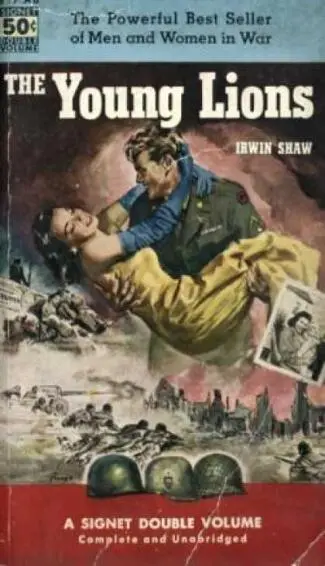
- Название:The Young Lions
- Автор:
- Жанр:
- Год:неизвестен
- ISBN:нет данных
- Рейтинг книги:4 / 5. Голосов: 1
-
Избранное:Добавить в избранное
- Отзывы:
-
Ваша оценка:
The Young Lions: краткое содержание, описание и аннотация
Предлагаем к чтению аннотацию, описание, краткое содержание или предисловие (зависит от того, что написал сам автор книги «The Young Lions»). Если вы не нашли необходимую информацию о книге — напишите в комментариях, мы постараемся отыскать её.
The Young Lions — читать онлайн бесплатно полную книгу (весь текст) целиком
Ниже представлен текст книги, разбитый по страницам. Система сохранения места последней прочитанной страницы, позволяет с удобством читать онлайн бесплатно книгу «The Young Lions», без необходимости каждый раз заново искать на чём Вы остановились. Поставьте закладку, и сможете в любой момент перейти на страницу, на которой закончили чтение.
Интервал:
Закладка:
They watched the bride and bridegroom go off in a car with streamers flying from it, the rice scattered around, the mother weeping softly at the doorstep, the groom grinning, red and self-conscious, at the rear window. Noah looked at Hope and she looked at him, and he knew they were thinking about the same thing.
"Why," he whispered, "don't we…?"
"Sssh." She put her hand over his lips. "You've drunk too much champagne."
They made their goodbyes and started off under the tall trees, between the lawns on which water-sprinklers were whirling, the flashing fountains of water, brilliant and rainbow-like in the sun, making the green smell of the lawns rise into the waning afternoon. They walked slowly, hand in hand.
"Where are they going?" Noah asked.
"California," Hope said. "For a month. Monterey. He has a cousin there with a house."
They walked side by side among the fountains of Flatbush, thinking of the beaches of Monterey in the Pacific Ocean, thinking of the pale Mexican houses in the southern light, thinking of the two young people getting into their compartment on the train at Grand Central and locking the door behind them.
"Oh, God," Noah said. Then he grinned sourly. "I pity them," he said.
"What?"
"On a night like this. The first time. One of the hottest nights of the year."
Hope pulled her hand away. "You're impossible," she said sharply. "What a mean, vulgar thing to say…"
"Hope…" he protested. "It was just a little joke."
"I hate that attitude," Hope said loudly. "Everything's funny!" With surprise, he saw that she was crying.
"Please, darling." He put his arms around her, although two small boys and a large collie dog were watching them interestedly from one of the lawns.
She slipped away. "Keep your hands off me," she said. She walked swiftly on.
"Please." He followed her anxiously. "Please, let me talk to you."
"Write me a letter," she said, through her tears. "You seem to save all your romance for the typewriter."
He caught up with her and walked in troubled silence at her side. He was baffled and lost, adrift on the irrational, endless female sea, and he did not try to save himself, but merely let himself drift with the wind and tide, hoping they would not wreck him.
But Hope would not relent, and all the long way home on the trolley car she sat stubborn and silent, her mouth set in bitter rejection. Oh, God, Noah thought, peering at her timidly as the car rattled on. Oh, God, she is going to leave me.
But she let him follow her into the house when she opened the two doors with her key.
The house was empty. Hope's aunt and uncle had taken their two small children on a three-day holiday to the country, and an almost exotic air of peace hung over the dark rooms.
"You hungry?" Hope asked dourly. She was standing in the middle of the living-room and Noah had thought he would kiss her, until he saw the expression on her face.
"I think I'd better go home," he said.
"You might as well eat," she said. "I left some stuff in the icebox for supper." He followed her meekly into the kitchen and helped as unobtrusively as possible. She got out some cold chicken, a jug full of milk and made a salad. She put everything on a tray and said, curtly, "Outside," like a sergeant commanding a platoon.
He took the tray out to the back garden, a twilit oblong now, that was bounded on two sides by a high board fence, and on the far end by the blank brick wall of a garage that had Virginia creeper growing all over it. There was a graceful acacia tree shading the garden. Hope's uncle had a small rock garden at one end and beds of common flowers, and there was a wood table with shielded candles and a long, sofa-like swing with a canopy. In the hazy blue light of evening, Brooklyn vanished like mist and rumour, and they were in a walled garden in England or France or the mountains of India.
Hope lit the candles and they sat gravely opposite each other, eating hungrily. They hardly spoke while they ate, just polite requests for the salt and the milk. They folded their napkins and stood up on opposite sides of the table.
"We don't need the candles," Hope said. "Will you please blow out the one on your side?"
He leaned over the small glass chimney that guarded the candle and Hope bent over the one on her side of the table. Their heads touched as they blew, together, and in the sudden darkness, Hope said, "Forgive me. I am the meanest female in the whole world."
Then it was all right. They sat side by side, in the swing, looking up at the darkening sky with the summer stars beginning to bloom above them one by one through the single tree. Far off the trolley, far off the trucks, far off the aunt, the uncle and the two children of the house, far off the newsboys crying beyond the garage, far off the world, as they sat there in the walled garden in the evening.
Hope said, "No, we shouldn't" and "I'm afraid, afraid…" and "Darling, darling," and Noah was shy and triumphant and dazzled and humble, and after it was over they lay there crushed and subdued by the wilderness of feeling through which they had blundered, and Noah was afraid that now that it was done she would hate him for it, and every moment of her silence seemed more and more foreboding, and then she said, "See…" and she chuckled. "It wasn't too hot. Not too hot at all."
Much later, when it was time for him to go home, they went inside. They blinked in the light, and didn't quite look at each other. Noah bent over to turn the radio on because it gave him something to do.
They were playing Tchaikovsky, the piano concerto, and the music sounded rich and mournful, as though it had been specially composed and played for them, two people barely out of childhood, who had just loved each other for the first time. Hope came over and kissed the back of his neck as he stood above the radio. He turned to kiss her, when the music stopped, and a matter-of-fact voice said, "Special Bulletin from the Associated Press. The German advance is continuing along the Russian border at all points. Many new armoured divisions have struck on a line extending from Finland to the Black Sea."
"What?" Hope said.
"The Germans," Noah said, thinking how often you say that word, how well known they've made themselves. "They've gone into Russia. That must have been what the newsboys were yelling…"
"Turn it off." Hope reached over and turned the radio off herself. "Tonight."
He held her, feeling her heart beating with sudden fierceness against him. All this afternoon, he thought, while we were at the wedding and walking down that street, and all this evening, in the garden, it was happening, the guns going, the men dying. From Finland to the Black Sea. His mind made no comment on it. It merely recorded the thought, like a poster on the side of the road which you read automatically as you speed by in a car.
They sat down on the worn couch in the quiet room. Outside, it was very dark and the newsboys crying on the distant streets were remote and inconsequential. "What's the day?" Hope asked.
"Sunday." He smiled. "The day of rest."
"I don't mean that," she said. "I know that. The date."
"June," he said, "June 22nd."
"June 22nd," the girl whispered. "I'm going to remember that date. The first time you made love to me."
Roger was still up when Noah got home. Standing outside the doorway, in the dark house, trying to compose his face so that it would show nothing of what had gone on that night, Noah heard the piano being softly played within. It was a sad jazz tune, hesitant and blue, and Roger was improvising on it so that it was difficult to recognize the melody. Noah listened for two or three minutes in the little hallway before he opened the door and went in. Roger waved to him with one hand, without looking round, and continued playing. There was only one lamp lit, in the corner, and the room looked large and mysterious as Noah sank slowly into the battered leather chair near the window. Outside, the city was sleeping. At the open window the curtains moved in the soft wind. Noah closed his eyes, listening to the running, sombre chords. He had a strange impression that he could feel every bone and muscle and pore of his body, alive and weary, in trembling balance under his clothes, reacting to the music.
Читать дальшеИнтервал:
Закладка:
Похожие книги на «The Young Lions»
Представляем Вашему вниманию похожие книги на «The Young Lions» списком для выбора. Мы отобрали схожую по названию и смыслу литературу в надежде предоставить читателям больше вариантов отыскать новые, интересные, ещё непрочитанные произведения.





Обсуждение, отзывы о книге «The Young Lions» и просто собственные мнения читателей. Оставьте ваши комментарии, напишите, что Вы думаете о произведении, его смысле или главных героях. Укажите что конкретно понравилось, а что нет, и почему Вы так считаете.