Irwin Shaw - The Young Lions
Здесь есть возможность читать онлайн «Irwin Shaw - The Young Lions» весь текст электронной книги совершенно бесплатно (целиком полную версию без сокращений). В некоторых случаях можно слушать аудио, скачать через торрент в формате fb2 и присутствует краткое содержание. Жанр: Классическая проза, на английском языке. Описание произведения, (предисловие) а так же отзывы посетителей доступны на портале библиотеки ЛибКат.
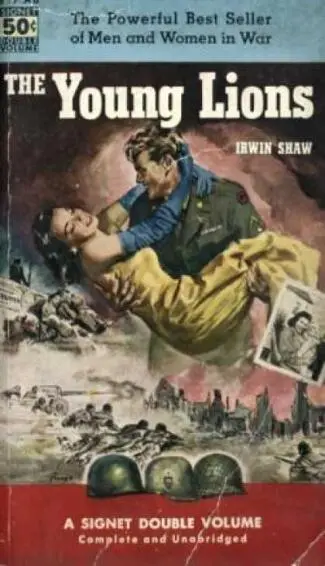
- Название:The Young Lions
- Автор:
- Жанр:
- Год:неизвестен
- ISBN:нет данных
- Рейтинг книги:4 / 5. Голосов: 1
-
Избранное:Добавить в избранное
- Отзывы:
-
Ваша оценка:
The Young Lions: краткое содержание, описание и аннотация
Предлагаем к чтению аннотацию, описание, краткое содержание или предисловие (зависит от того, что написал сам автор книги «The Young Lions»). Если вы не нашли необходимую информацию о книге — напишите в комментариях, мы постараемся отыскать её.
The Young Lions — читать онлайн бесплатно полную книгу (весь текст) целиком
Ниже представлен текст книги, разбитый по страницам. Система сохранения места последней прочитанной страницы, позволяет с удобством читать онлайн бесплатно книгу «The Young Lions», без необходимости каждый раз заново искать на чём Вы остановились. Поставьте закладку, и сможете в любой момент перейти на страницу, на которой закончили чтение.
Интервал:
Закладка:
"Well," Noah said coolly, "let's go on down to the PX. Burnecker," Noah whispered crisply, as he stood up "take hold of my belt with one hand, and Cowley, you hold Burnecker's, and Riker, you hold Cowley's, so we don't get lost."
Obediently, the men stood up and took hold of each other's belts. Then, in single file, with Noah in front, they started out through the darkness towards the long fiery pencil-lines on the horizon.
It was just at dawn that they saw the prisoners. It was light enough so that it was no longer necessary to hold on to each other's belts, and they were lying behind a hedge, getting ready to cross a narrow paved road, when they heard the steady, unmistakable shuffle of feet drawing near.
A moment later the column of about sixty Americans came into view. They were walking slowly, in a shambling careless way, with six Germans with tommy-guns guarding them. They passed within ten feet of Noah. He looked closely at their faces. There was a mixture of shame and relief on the faces, and a kind of numbness, half involuntary, half deliberate. The men did not look at the guards or at each other, or at the surrounding countryside. They shuffled through the wet light in a kind of slow inner reflection, the irregular soft scuffing of their shoes the only sound accompanying them. They walked more easily than other soldiers, because they had no rifles, no packs, no equipment. Even as he watched, so close by, Noah felt the strangeness of seeing sixty Americans walking down a road in a kind of formation, with their hands in their pockets, unarmed and unburdened.
They passed and vanished down the road, the sound of their marching dying slowly among the dewy hedges.
Noah turned and looked at the men beside him. They were still looking, their heads lifted, at the spot where the prisoners had disappeared. There was no expression on Burnecker's face or on Cowley's, just an overlay, a film, of fascination and interest. But Riker looked queer. Noah stared at him, and after a moment he realized that what he saw on Riker's face, in the red, pouched eyes, under the muddy stubble of his beard, was the same mixture of shame and relief that had been on all the faces that had passed.
"I'm going to tell you guys something," Riker said huskily, in a voice that was very different from his normal voice. "We're doing this all wrong." He did not look at Noah or the others, but continued to stare down the road. "We ain't got a chance like this, four of us all together. Only way is to divide up. One by one. One by one." He stopped. Nobody said anything. Riker stared down the road. Faintly, half-heard, half-remembered, there was the shush-shush of the prisoners' marching.
"It's a question of being sensible," Riker said hoarsely. "Four guys together're just a big fat target. One guy alone can really hide. I don't know what you're going to do, but I'm going my separate way." Riker waited for them to say something, but nobody spoke. They lay in the wet grass close to the hedge, no expression on their faces.
"Well," said Riker, "there's no time like the present." He straightened up. He hesitated for a moment. Then he climbed through the hedge. He stood at the edge of the road, still half bent over. He looked large and bear-like, with his thick arms hanging loosely down, his blackened, powerful hands near his knees. Then he started down the road in the direction in which the prisoners had gone.
Noah and the other two men watched him. As he walked, Riker grew more erect. There was something queer about him, Noah thought, and he tried to figure out what it was. Then, when Riker was fifty feet away, and walking more swiftly, more eagerly, Noah realized what it was. Riker was unarmed. Noah glanced down where Riker had been crouched. The Garand was lying on the grass, its muzzle carelessly jammed with dirt.
Noah looked up at Riker again. The big, shambling figure, with the helmet square on the head over the huge shoulders, was moving fast by now, almost running. As Riker reached the first turn in the road, his hands went up, tentatively. Then they froze firmly above his head, and that was the last Noah saw of Riker, trotting around the bend, with his hands high above his head.
"Cross off one rifleman," Burnecker said. He reached down to the Garand and automatically took out the clip and pulled the bolt to eject the cartridge in the chamber. He reached down and picked up the cartridge and put it in his pocket along with the clip.
Noah stood up and Burnecker followed him. Cowley hesitated. Then, with a sigh, he stood up, too.
Noah went through the hedge and crossed the road. The other two men came after him quickly.
From the distance, from the direction of the coast, the sound of the guns was a steady rumbling. At least, Noah thought, as he moved slowly and carefully along the hedge, at least the Army is still in France.
The barn and the house next to it seemed deserted. There were two dead cows lying with their feet up in the barnyard beginning to swell, but the large grey stone building looked peaceful and safe as they peered at it above the rim of the ditch in which they were lying.
They were exhausted by now and moved, in their crawling, creeping, crouched-over progress, in a dull, dope-like stupor. Noah was sure that if they had to run, he could never manage it. They had seen Germans several times, and heard them often, and once Noah was sure two Germans on a motor-cycle had glimpsed them as they hurled themselves down to the ground. But the Germans had merely slowed down a little, glanced their way, and had kept moving. It was hard to know whether it was fear or arrogant indifference on the part of the Germans which had kept them from coming after them.
Cowley was breathing very hard each time he moved, the air snoring into his nostrils, and he had fallen twice climbing fences. He had tried to throw away his rifle, too, and Noah and Burnecker had had to argue with him for ten minutes to make him agree not to leave it behind him. Burnecker had carried the rifle, along with his own, for half an hour, before Cowley had asked for it again.
They had to rest. They hadn't slept for two days and they had had nothing to eat since the day before, and the barn and the house looked promising.
"Take off your helmets and leave them here," Noah said.
"Stand up straight. And walk slowly."
There was about fifty yards of open field to cross to the barn. If anyone happened to see them, they might be taken for Germans if they walked naturally. By now Noah was automatically making the decisions and giving the orders. The others obeyed without question.
They all stood up, and carrying their rifles slung over their shoulders, they walked as normally as possible towards the barn. The air of stillness and emptiness around the buildings was intensified by the sound of firing in the distance. The barn door was open, and they passed the odour of the dead cows and went in. Noah looked around. There was a ladder climbing through the dusty gloom to a hay loft above.
"Go on up," said Noah.
Cowley went first, taking a long time. Then Burnecker silently went after Cowley. Noah grabbed the rungs of the ladder and took a deep breath. He looked up. There were twelve rungs. He shook his head. The twelve rungs looked impossible. He started up, resting on each rung. The wood was splintery and old and the barn smell got heavier and dustier as he neared the top. He sneezed and nearly fell off. At the top he waited a long time, gathering strength to throw himself on to the floor of the loft. Burnecker knelt beside him and put his hands under Noah's armpits. He pulled hard, and Noah threw himself upwards and on to the hay-loft floor, surprised and grateful for Burnecker's strength. He sat up and crawled over to the small window at the end of the loft. He looked out. ›From the height he could see some activity, trucks and small, quickly moving figures about five hundred yards away, but it all looked remote and undangerous. There was a fire burning about half a mile off, too, a farmhouse slowly smouldering, but that, too, seemed normal and of no consequence. He turned away from the window, blinking his eyes. Burnecker and Cowley faced him inquisitively.
Читать дальшеИнтервал:
Закладка:
Похожие книги на «The Young Lions»
Представляем Вашему вниманию похожие книги на «The Young Lions» списком для выбора. Мы отобрали схожую по названию и смыслу литературу в надежде предоставить читателям больше вариантов отыскать новые, интересные, ещё непрочитанные произведения.








Обсуждение, отзывы о книге «The Young Lions» и просто собственные мнения читателей. Оставьте ваши комментарии, напишите, что Вы думаете о произведении, его смысле или главных героях. Укажите что конкретно понравилось, а что нет, и почему Вы так считаете.