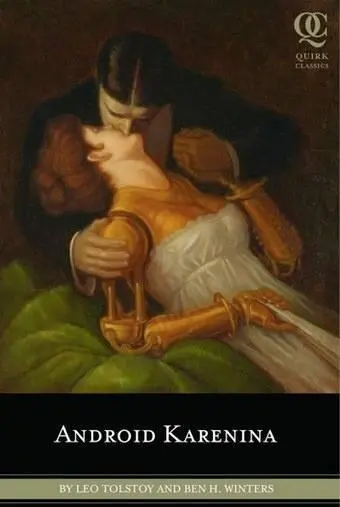
Leo Tolstoy - Android Karenina
Здесь есть возможность читать онлайн «Leo Tolstoy - Android Karenina» весь текст электронной книги совершенно бесплатно (целиком полную версию без сокращений). В некоторых случаях можно слушать аудио, скачать через торрент в формате fb2 и присутствует краткое содержание. Жанр: Классическая проза, Фэнтези, на английском языке. Описание произведения, (предисловие) а так же отзывы посетителей доступны на портале библиотеки ЛибКат.
- Название:Android Karenina
- Автор:
- Жанр:
- Год:неизвестен
- ISBN:нет данных
- Рейтинг книги:5 / 5. Голосов: 1
-
Избранное:Добавить в избранное
- Отзывы:
-
Ваша оценка:
Android Karenina: краткое содержание, описание и аннотация
Предлагаем к чтению аннотацию, описание, краткое содержание или предисловие (зависит от того, что написал сам автор книги «Android Karenina»). Если вы не нашли необходимую информацию о книге — напишите в комментариях, мы постараемся отыскать её.
“Anna’s nightmare, one of the most famous passages in Anna Karenina, clearly anticipates the “steampunk‐inspired” atmosphere of Android Karenina… Tolstoy didn’t know about steampunk or cyborgs, but he did know about the nightmarishness of steam power, unruly machines, and the creepy half‐human status of the Russian peasant classes.” -Elif Batuman, author of The Possessed, via The New Yorker
“Whenever a truly pulpy trend reaches its apotheosis like this, I can’t help but wonder if we’ll get a new classic out of it.” -io9
“No word on whether she’ll [Anna] be bionically rebuilt following the ending, though. It’s good that this series is branching out to other authors…” -Entertainment Weekly
***
Android Karenina – Sense and Sensibility and Sea Monsters co-author Ben H. Winters is back with an all-new collaborator, legendary Russian novelist Leo Tolstoy, and the result is Android Karenina-an enhanced edition of the classic love story set in a dystopian world of robots, cyborgs, and interstellar space travel.
As in the original novel, our story follows two relationships: the tragic adulterous romance of Anna Karenina and Count Alexei Vronsky, and the much more hopeful marriage of Konstantin Levin and Kitty Shcherbatskaya.These four, yearning for true love, live in a steampunk-inspired 19th century of mechanical butlers, extraterrestrial-worshiping cults, and airborne debutante balls. Their passions alone would be enough to consume them-but when a secret cabal of radical scientific revolutionaries launches an attack on Russian high society's high-tech lifestyle, our heroes must fight back with all their courage, all their gadgets, and all the power of a sleek new cyborg model like nothing the world has ever seen.
Filled with the same blend of romance, drama, and fantasy that made the first two Quirk Classics New York Times best sellers, Android Karenina brings this celebrated series into the exciting world of science fiction.
Leo Tolstoy wrote two of the greatest novels in world literature: War and Peace and Anna Karenina.
Ben H. Winters is coauthor of Sense and Sensibility and Sea Monsters, which was hailed by The Onion A.V. Club as a "sheer delight" and by Library Journal as "strangely entertaining, like a Weird Al version of an opera aria." Mr. Winters lives in Brooklyn.
Android Karenina — читать онлайн бесплатно полную книгу (весь текст) целиком
Ниже представлен текст книги, разбитый по страницам. Система сохранения места последней прочитанной страницы, позволяет с удобством читать онлайн бесплатно книгу «Android Karenina», без необходимости каждый раз заново искать на чём Вы остановились. Поставьте закладку, и сможете в любой момент перейти на страницу, на которой закончили чтение.
Интервал:
Закладка:
“I see something has happened. Do you suppose I can be at peace, knowing you have a trouble I am not sharing? Tell me, for God’s sake,” he repeated imploringly.
Abruptly Anna rose and walked to Android Karenina, whom Vronsky had not even noticed, sitting perfectly still on the opposite side of the fountain.
“Yes,” Anna sighed to her Class III. “I shan’t be able to forgive him if he does not realize all the gravity of it. Better not tell; why put him to the test?”
“For God’s sake!” he repeated, circling the fountain and taking her hand.
“Shall I tell you?”
“Yes, yes, yes…”
But Anna could not bring herself to speak, and it was Android Karenina who revealed to him the truth, without saying a word: holding her two end-effectors interlaced in front of her midsection, she slowly brought them outward and upward, miming the appearance of a growing stomach, heavy with child.
As Android Karenina enacted this dumb show, the leaf in Anna’s hand shook more violently, but she did not take her eyes off Vronsky, watching how he would take it. He turned white, would have said something, but stopped; he dropped her hand, and his head sank on his breast. His reaction might have been still more dramatic, had not the Englishman, noting the sudden spiking wildness on his monitor, keyed the right combination of buttons to moderate his heartbeat.
“Yes, he realizes all the gravity of it,” Anna said to Android Karenina.
But Anna was mistaken in thinking he felt the weight of the fact in the same way as she, a woman, felt it. What Vronsky felt was that the turning-point he had been longing for had come now; that it was impossible to go on concealing things from her husband, and it was inevitable in one way or another that they should soon put an end to their unnatural position. But, besides that, her emotion physically affected him in the same way. He looked at her with a look of submissive tenderness, kissed her hand, got up, and, in silence, paced up and down the terrace.
“Yes,” he said, going up to her resolutely. “Neither you nor I have looked on our relations as a passing amusement, and now our fate is sealed. It is absolutely necessary to put an end”-he looked round as he spoke-“to the deception in which we are living.”
“Put an end? How put an end, Alexei?” she said softly.
She was calmer now, and Android Karenina was glowing with an intense but not unpleasant violet, lending a romantic backlight to her mistress’s tender expression.
“Leave your husband and make our life one.”
“It is one as it is,” she answered, scarcely audibly.
“Yes, but altogether, altogether.”
“But how, Alexei, tell me how?” she said in melancholy mockery at the hopelessness of her own position. “Is there any way out of such a position? Am I not the wife of my husband?”
“There is a way out of every position. We must take our line,” he said. “Anything’s better than the position in which you’re living. Of course, I see how you torture yourself over everything-the world and your son and your husband.”
“Oh, not over my husband,” she said, with a quiet smile. “I don’t know him, I don’t think of him. He doesn’t exist.”
“You’re not speaking sincerely. I know you. You worry about him too.”
“Oh, he doesn’t even know,” she said, and suddenly a hot flush came over her face; her cheeks, her brow, her neck crimsoned, and tears of shame came into her eyes. “But we won’t talk of him.”
CHAPTER 12
VRONSKY HAD SEVERAL TIMES ALREADY, though not so resolutely as now, tried to bring her to consider their position, and every time he had been confronted by the same superficiality and triviality with which she met his appeal now. It was as though there were something in this that she could not or would not face, as though the moment she began to speak of this, she, the real Anna, retreated somehow into herself, and another strange and unaccountable woman came out, whom he did not love, and whom he feared, and who was in opposition to him. But today he was resolved to have it out.
“Whether he knows or not,” said Vronsky, in his usual quiet and resolute tone, “that’s nothing to do with us. We cannot… you cannot stay like this, especially now.”
“What’s to be done, according to you?” she asked with the same frivolous irony. She who had so feared he would take her condition too lightly was now vexed with him for deducing from it the necessity of taking some step.
“Tell him everything, and leave him.”
“Very well, let us suppose I do that,” she said. “Do you know what the result of that would be? I can tell you it all beforehand,” and a wicked light gleamed in her eyes, which had been so soft a minute before. “‘Eh, you love another man, and have entered into criminal intrigues with him?’” (Mimicking her husband’s singular appearance, she covered one side of her face with the flat of her hand). “‘I warned you of the results in the religious, the civil, and the domestic relation. You have not listened to me. Now I cannot let you disgrace my name’”- and my son, she had meant to say, but about her son she could not jest-’“disgrace my name, and’-and more in the same style,” she added. “In general terms, he’ll say in his official manner, and with all distinctness and precision, that he cannot let me go, but will take all measures in his power to prevent scandal. And he will calmly and punctually act in accordance with his words. That’s what will happen. He’s not a man, but a machine, and a spiteful machine when he’s angry,” she added, recalling Alexei Alexandrovich as she spoke, with all the peculiarities of his figure and manner of speaking and bifurcated apperance, and reckoning against him every defect she could find in him, softening nothing for the great wrong she herself was doing him.
It was then she sensed that Vronsky was not listening, and saw that his eyes were fixed on some spot behind her head.
“The swirling…,” he said in a low voice, as if hypnotized, and Anna felt irritated by his lack of attention.
“What?”
“The fountain… the swirling…” he repeated, and then with sudden force shouted, “Jump!”
Anna, shocked into action by this sudden urgency, leapt forward from where she sat on the wall of the fountain, landing in a disordered heap at Vronsky’s feet; he scrambled forward to grasp as her forearms and pulled as hard as he could. Directly behind her, hovering like a storm cloud over the fountain’s swirling waters, was what could only be described as a terrible, undulating nothingness: a grey-black hole in the fabric of the atmosphere, wavering in the air above the fountain, and pulling, pulling Anna Karenina in toward itself.
Vronsky gripped her with all his strength, bracing his feet against the wall of the fountain, resisting with all his strength the violent force, ten times stronger than gravity, that was drawing Anna in. Android Karenina joined the struggle, lacing her fingers around Anna’s waist and digging in the base of her heels at the base of the fountain wall.
“What… what is…,” Anna began, and Vronsky answered immediately: “A godmouth!” Anna’s skirts billowed up behind her, rustled by the phantasmagoric wind bellowing from the portal. “UnConSciya creates them… somehow… oof… ”
His fingers slipping a little, Vronsky cursed. “Hold on, Anna. Only hold on, a bit longer… it will not last long.”
“Let me go,” said Anna weakly.
“What?”
“What good is living,” she said, louder now, “if our life is to be under my husband’s control? Let me go!” She directed this last command to Android Karenina, who by virtue of the Iron Laws could not disobey; she turned her faceplate apologetically to Vronsky and released her grasp.
Читать дальшеИнтервал:
Закладка:
Похожие книги на «Android Karenina»
Представляем Вашему вниманию похожие книги на «Android Karenina» списком для выбора. Мы отобрали схожую по названию и смыслу литературу в надежде предоставить читателям больше вариантов отыскать новые, интересные, ещё непрочитанные произведения.











Обсуждение, отзывы о книге «Android Karenina» и просто собственные мнения читателей. Оставьте ваши комментарии, напишите, что Вы думаете о произведении, его смысле или главных героях. Укажите что конкретно понравилось, а что нет, и почему Вы так считаете.