William Thackeray - Vanity Fair (illustrated)
Здесь есть возможность читать онлайн «William Thackeray - Vanity Fair (illustrated)» — ознакомительный отрывок электронной книги совершенно бесплатно, а после прочтения отрывка купить полную версию. В некоторых случаях можно слушать аудио, скачать через торрент в формате fb2 и присутствует краткое содержание. Жанр: Классическая проза, на английском языке. Описание произведения, (предисловие) а так же отзывы посетителей доступны на портале библиотеки ЛибКат.
- Название:Vanity Fair (illustrated)
- Автор:
- Жанр:
- Год:неизвестен
- ISBN:нет данных
- Рейтинг книги:3 / 5. Голосов: 1
-
Избранное:Добавить в избранное
- Отзывы:
-
Ваша оценка:
Vanity Fair (illustrated): краткое содержание, описание и аннотация
Предлагаем к чтению аннотацию, описание, краткое содержание или предисловие (зависит от того, что написал сам автор книги «Vanity Fair (illustrated)»). Если вы не нашли необходимую информацию о книге — напишите в комментариях, мы постараемся отыскать её.
Vanity Fair (illustrated) — читать онлайн ознакомительный отрывок
Ниже представлен текст книги, разбитый по страницам. Система сохранения места последней прочитанной страницы, позволяет с удобством читать онлайн бесплатно книгу «Vanity Fair (illustrated)», без необходимости каждый раз заново искать на чём Вы остановились. Поставьте закладку, и сможете в любой момент перейти на страницу, на которой закончили чтение.
Интервал:
Закладка:
Mr. Osborne’s countenance, when he arrived in the City at his usual time, struck those dependants who were accustomed, for good reasons, to watch its expression, as peculiarly ghastly and worn. At twelve o’clock Mr. Higgs (of the firm of Higgs amp; Blatherwick, solicitors, Bedford Row) called by appointment, and was ushered into the governor’s private room, and closeted there for more than an hour. At about one Mr. Chopper received a note brought by Captain Dobbin’s man, and containing an inclosure for Mr. Osborne, which the clerk went in and delivered. A short time afterwards Mr. Chopper and Mr. Birch, the next clerk, were summoned, and requested to witness a paper. “I’ve been making a new will,” Mr. Osborne said, to which these gentlemen appended their names accordingly. No conversation passed. Mr. Higgs looked exceedingly grave as he came into the outer rooms, and very hard in Mr. Chopper’s face; but there were not any explanations. It was remarked that Mr. Osborne was particularly quiet and gentle all day, to the surprise of those who had augured ill from his darkling demeanour. He called no man names that day, and was not heard to swear once. He left business early; and before going away, summoned his chief clerk once more, and having given him general instructions, asked him, after some seeming hesitation and reluctance to speak, if he knew whether Captain Dobbin was in town?
Chopper said he believed he was. Indeed both of them knew the fact perfectly.
Osborne took a letter directed to that officer, and giving it to the clerk, requested the latter to deliver it into Dobbin’s own hands immediately.
“And now, Chopper,” says he, taking his hat, and with a strange look, “my mind will be easy.” Exactly as the clock struck two (there was no doubt an appointment between the pair) Mr. Frederick Bullock called, and he and Mr. Osborne walked away together.
The Colonel of the -th regiment, in which Messieurs Dobbin and Osborne had companies, was an old General who had made his first campaign under Wolfe at Quebec, and was long since quite too old and feeble for command; but he took some interest in the regiment of which he was the nominal head, and made certain of his young officers welcome at his table, a kind of hospitality which I believe is not now common amongst his brethren. Captain Dobbin was an especial favourite of this old General. Dobbin was versed in the literature of his profession, and could talk about the great Frederick, and the Empress Queen, and their wars, almost as well as the General himself, who was indifferent to the triumphs of the present day, and whose heart was with the tacticians of fifty years back. This officer sent a summons to Dobbin to come and breakfast with him, on the morning when Mr. Osborne altered his will and Mr. Chopper put on his best shirt frill, and then informed his young favourite, a couple of days in advance, of that which they were all expecting — a marching order to go to Belgium. The order for the regiment to hold itself in readiness would leave the Horse Guards in a day or two; and as transports were in plenty, they would get their route before the week was over. Recruits had come in during the stay of the regiment at Chatham; and the old General hoped that the regiment which had helped to beat Montcalm in Canada, and to rout Mr. Washington on Long Island, would prove itself worthy of its historical reputation on the oft-trodden battle-grounds of the Low Countries. “And so, my good friend, if you have any affaire la, said the old General, taking a pinch of snuff with his trembling white old hand, and then pointing to the spot of his robe de chambre under which his heart was still feebly beating, “if you have any Phillis to console, or to bid farewell to papa and mamma, or any will to make, I recommend you to set about your business without delay.” With which the General gave his young friend a finger to shake, and a good-natured nod of his powdered and pigtailed head; and the door being closed upon Dobbin, sate down to pen a poulet (he was exceedingly vain of his French) to Mademoiselle Amenaide of His Majesty’s Theatre.
This news made Dobbin grave, and he thought of our friends at Brighton, and then he was ashamed of himself that Amelia was always the first thing in his thoughts (always before anybody — before father and mother, sisters and duty — always at waking and sleeping indeed, and all day long); and returning to his hotel, he sent off a brief note to Mr. Osborne acquainting him with the information which he had received, and which might tend farther, he hoped, to bring about a reconciliation with George.
This note, despatched by the same messenger who had carried the invitation to Chopper on the previous day, alarmed the worthy clerk not a little. It was inclosed to him, and as he opened the letter he trembled lest the dinner should be put off on which he was calculating. His mind was inexpressibly relieved when he found that the envelope was only a reminder for himself. (“I shall expect you at half-past five,” Captain Dobbin wrote.) He was very much interested about his employer’s family; but, que voulez-vous? a grand dinner was of more concern to him than the affairs of any other mortal.
Dobbin was quite justified in repeating the General’s information to any officers of the regiment whom he should see in the course of his peregrinations; accordingly he imparted it to Ensign Stubble, whom he met at the agent’s, and who — such was his military ardour — went off instantly to purchase a new sword at the accoutrement-maker’s. Here this young fellow, who, though only seventeen years of age, and about sixty-five inches high, with a constitution naturally rickety and much impaired by premature brandy and water, had an undoubted courage and a lion’s heart, poised, tried, bent, and balanced a weapon such as he thought would do execution amongst Frenchmen. Shouting “Ha, ha!” and stamping his little feet with tremendous energy, he delivered the point twice or thrice at Captain Dobbin, who parried the thrust laughingly with his bamboo walking-stick.
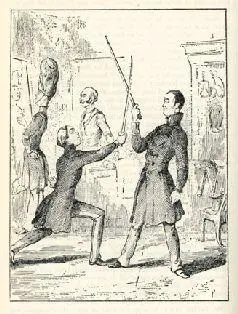
Ensign Stubble practising the art of War
Mr. Stubble, as may be supposed from his size and slenderness, was of the Light Bobs. Ensign Spooney, on the contrary, was a tall youth, and belonged to (Captain Dobbin’s) the Grenadier Company, and he tried on a new bearskin cap, under which he looked savage beyond his years. Then these two lads went off to the Slaughters’, and having ordered a famous dinner, sate down and wrote off letters to the kind anxious parents at home — letters full of love and heartiness, and pluck and bad spelling. Ah! there were many anxious hearts beating through England at that time; and mothers’ prayers and tears flowing in many homesteads.
Seeing young Stubble engaged in composition at one of the coffee-room tables at the Slaughters’, and the tears trickling down his nose on to the paper (for the youngster was thinking of his mamma, and that he might never see her again), Dobbin, who was going to write off a letter to George Osborne, relented, and locked up his desk. “Why should I?” said he. “Let her have this night happy. I’ll go and see my parents early in the morning, and go down to Brighton myself to-morrow.”
So he went up and laid his big hand on young Stubble’s shoulder, and backed up that young champion, and told him if he would leave off brandy and water he would be a good soldier, as he always was a gentlemanly good-hearted fellow. Young Stubble’s eyes brightened up at this, for Dobbin was greatly respected in the regiment, as the best officer and the cleverest man in it.
“Thank you, Dobbin,” he said, rubbing his eyes with his knuckles, “I was just — just telling her I would. And, O Sir, she’s so dam kind to me.” The water pumps were at work again, and I am not sure that the soft-hearted Captain’s eyes did not also twinkle.
Читать дальшеИнтервал:
Закладка:
Похожие книги на «Vanity Fair (illustrated)»
Представляем Вашему вниманию похожие книги на «Vanity Fair (illustrated)» списком для выбора. Мы отобрали схожую по названию и смыслу литературу в надежде предоставить читателям больше вариантов отыскать новые, интересные, ещё непрочитанные произведения.







Обсуждение, отзывы о книге «Vanity Fair (illustrated)» и просто собственные мнения читателей. Оставьте ваши комментарии, напишите, что Вы думаете о произведении, его смысле или главных героях. Укажите что конкретно понравилось, а что нет, и почему Вы так считаете.