William Thackeray - Vanity Fair (illustrated)
Здесь есть возможность читать онлайн «William Thackeray - Vanity Fair (illustrated)» — ознакомительный отрывок электронной книги совершенно бесплатно, а после прочтения отрывка купить полную версию. В некоторых случаях можно слушать аудио, скачать через торрент в формате fb2 и присутствует краткое содержание. Жанр: Классическая проза, на английском языке. Описание произведения, (предисловие) а так же отзывы посетителей доступны на портале библиотеки ЛибКат.
- Название:Vanity Fair (illustrated)
- Автор:
- Жанр:
- Год:неизвестен
- ISBN:нет данных
- Рейтинг книги:3 / 5. Голосов: 1
-
Избранное:Добавить в избранное
- Отзывы:
-
Ваша оценка:
Vanity Fair (illustrated): краткое содержание, описание и аннотация
Предлагаем к чтению аннотацию, описание, краткое содержание или предисловие (зависит от того, что написал сам автор книги «Vanity Fair (illustrated)»). Если вы не нашли необходимую информацию о книге — напишите в комментариях, мы постараемся отыскать её.
Vanity Fair (illustrated) — читать онлайн ознакомительный отрывок
Ниже представлен текст книги, разбитый по страницам. Система сохранения места последней прочитанной страницы, позволяет с удобством читать онлайн бесплатно книгу «Vanity Fair (illustrated)», без необходимости каждый раз заново искать на чём Вы остановились. Поставьте закладку, и сможете в любой момент перейти на страницу, на которой закончили чтение.
Интервал:
Закладка:
Our young bride and bridegroom had chosen Brighton as the place where they would pass the first few days after their marriage; and having engaged apartments at the Ship Inn, enjoyed themselves there in great comfort and quietude, until Jos presently joined them. Nor was he the only companion they found there. As they were coming into the hotel from a sea-side walk one afternoon, on whom should they light but Rebecca and her husband. The recognition was immediate. Rebecca flew into the arms of her dearest friend. Crawley and Osborne shook hands together cordially enough: and Becky, in the course of a very few hours, found means to make the latter forget that little unpleasant passage of words which had happened between them. “Do you remember the last time we met at Miss Crawley’s, when I was so rude to you, dear Captain Osborne? I thought you seemed careless about dear Amelia. It was that made me angry: and so pert: and so unkind: and so ungrateful. Do forgive me!” Rebecca said, and she held out her hand with so frank and winning a grace, that Osborne could not but take it. By humbly and frankly acknowledging yourself to be in the wrong, there is no knowing, my son, what good you may do. I knew once a gentleman and very worthy practitioner in Vanity Fair, who used to do little wrongs to his neighbours on purpose, and in order to apologise for them in an open and manly way afterwards — and what ensued? My friend Crocky Doyle was liked everywhere, and deemed to be rather impetuous — but the honestest fellow. Becky’s humility passed for sincerity with George Osborne.
These two young couples had plenty of tales to relate to each other. The marriages of either were discussed; and their prospects in life canvassed with the greatest frankness and interest on both sides. George’s marriage was to be made known to his father by his friend Captain Dobbin; and young Osborne trembled rather for the result of that communication. Miss Crawley, on whom all Rawdon’s hopes depended, still held out. Unable to make an entry into her house in Park Lane, her affectionate nephew and niece had followed her to Brighton, where they had emissaries continually planted at her door.
“I wish you could see some of Rawdon’s friends who are always about our door,” Rebecca said, laughing. “Did you ever see a dun, my dear; or a bailiff and his man? Two of the abominable wretches watched all last week at the greengrocer’s opposite, and we could not get away until Sunday. If Aunty does not relent, what shall we do?”
Rawdon, with roars of laughter, related a dozen amusing anecdotes of his duns, and Rebecca’s adroit treatment of them. He vowed with a great oath that there was no woman in Europe who could talk a creditor over as she could. Almost immediately after their marriage, her practice had begun, and her husband found the immense value of such a wife. They had credit in plenty, but they had bills also in abundance, and laboured under a scarcity of ready money. Did these debt-difficulties affect Rawdon’s good spirits? No. Everybody in Vanity Fair must have remarked how well those live who are comfortably and thoroughly in debt: how they deny themselves nothing; how jolly and easy they are in their minds. Rawdon and his wife had the very best apartments at the inn at Brighton; the landlord, as he brought in the first dish, bowed before them as to his greatest customers: and Rawdon abused the dinners and wine with an audacity which no grandee in the land could surpass. Long custom, a manly appearance, faultless boots and clothes, and a happy fierceness of manner, will often help a man as much as a great balance at the banker’s.
The two wedding parties met constantly in each other’s apartments. After two or three nights the gentlemen of an evening had a little piquet, as their wives sate and chatted apart. This pastime, and the arrival of Jos Sedley, who made his appearance in his grand open carriage, and who played a few games at billiards with Captain Crawley, replenished Rawdon’s purse somewhat, and gave him the benefit of that ready money for which the greatest spirits are sometimes at a stand-still.
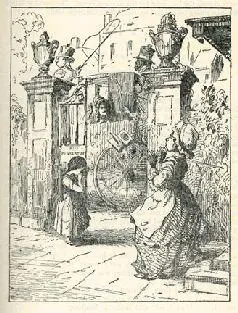
So the three gentlemen walked down to see the Lightning coach come in. Punctual to the minute, the coach crowded inside and out, the guard blowing his accustomed tune on the horn — the Lightning came tearing down the street, and pulled up at the coach-office.
“Hullo! there’s old Dobbin,” George cried, quite delighted to see his old friend perched on the roof; and whose promised visit to Brighton had been delayed until now. “How are you, old fellow? Glad you’re come down. Emmy’ll be delighted to see you,” Osborne said, shaking his comrade warmly by the hand as soon as his descent from the vehicle was effected — and then he added, in a lower and agitated voice, “What’s the news? Have you been in Russell Square? What does the governor say? Tell me everything.”
Dobbin looked very pale and grave. “I’ve seen your father,” said he. “How’s Amelia — Mrs. George? I’ll tell you all the news presently: but I’ve brought the great news of all: and that is — ”
“Out with it, old fellow,” George said.
“We’re ordered to Belgium. All the army goes — guards and all. Heavytop’s got the gout, and is mad at not being able to move. O’Dowd goes in command, and we embark from Chatham next week.” This news of war could not but come with a shock upon our lovers, and caused all these gentlemen to look very serious.
CHAPTER XXIII
What is the secret mesmerism which friendship possesses, and under the operation of which a person ordinarily sluggish, or cold, or timid, becomes wise, active, and resolute, in another’s behalf? As Alexis, after a few passes from Dr. Elliotson, despises pain, reads with the back of his head, sees miles off, looks into next week, and performs other wonders, of which, in his own private normal condition, he is quite incapable; so you see, in the affairs of the world and under the magnetism of friendships, the modest man becomes bold, the shy confident, the lazy active, or the impetuous prudent and peaceful. What is it, on the other hand, that makes the lawyer eschew his own cause, and call in his learned brother as an adviser? And what causes the doctor, when ailing, to send for his rival, and not sit down and examine his own tongue in the chimney Bass, or write his own prescription at his study-table? I throw out these queries for intelligent readers to answer, who know, at once, how credulous we are, and how sceptical, how soft and how obstinate, how firm for others and how diffident about ourselves: meanwhile, it is certain that our friend William Dobbin, who was personally of so complying a disposition that if his parents had pressed him much, it is probable he would have stepped down into the kitchen and married the cook, and who, to further his own interests, would have found the most insuperable difficulty in walking across the street, found himself as busy and eager in the conduct of George Osborne’s affairs, as the most selfish tactician could be in the pursuit of his own.
Whilst our friend George and his young wife were enjoying the first blushing days of the honeymoon at Brighton, honest William was left as George’s plenipotentiary in London, to transact all the business part of the marriage. His duty it was to call upon old Sedley and his wife, and to keep the former in good humour: to draw Jos and his brother-in-law nearer together, so that Jos’s position and dignity, as collector of Boggley Wollah, might compensate for his father’s loss of station, and tend to reconcile old Osborne to the alliance: and finally, to communicate it to the latter in such a way as should least irritate the old gentleman.
Now, before he faced the head of the Osborne house with the news which it was his duty to tell, Dobbin bethought him that it would be politic to make friends of the rest of the family, and, if possible, have the ladies on his side. They can’t be angry in their hearts, thought he. No woman ever was really angry at a romantic marriage. A little crying out, and they must come round to their brother; when the three of us will lay siege to old Mr. Osborne. So this Machiavellian captain of infantry cast about him for some happy means or stratagem by which he could gently and gradually bring the Misses Osborne to a knowledge of their brother’s secret.
Читать дальшеИнтервал:
Закладка:
Похожие книги на «Vanity Fair (illustrated)»
Представляем Вашему вниманию похожие книги на «Vanity Fair (illustrated)» списком для выбора. Мы отобрали схожую по названию и смыслу литературу в надежде предоставить читателям больше вариантов отыскать новые, интересные, ещё непрочитанные произведения.










Обсуждение, отзывы о книге «Vanity Fair (illustrated)» и просто собственные мнения читателей. Оставьте ваши комментарии, напишите, что Вы думаете о произведении, его смысле или главных героях. Укажите что конкретно понравилось, а что нет, и почему Вы так считаете.