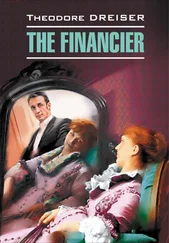
Theodore Dreiser - The Financier
Здесь есть возможность читать онлайн «Theodore Dreiser - The Financier» весь текст электронной книги совершенно бесплатно (целиком полную версию без сокращений). В некоторых случаях можно слушать аудио, скачать через торрент в формате fb2 и присутствует краткое содержание. Жанр: Классическая проза, на английском языке. Описание произведения, (предисловие) а так же отзывы посетителей доступны на портале библиотеки ЛибКат.
- Название:The Financier
- Автор:
- Жанр:
- Год:неизвестен
- ISBN:нет данных
- Рейтинг книги:5 / 5. Голосов: 1
-
Избранное:Добавить в избранное
- Отзывы:
-
Ваша оценка:
The Financier: краткое содержание, описание и аннотация
Предлагаем к чтению аннотацию, описание, краткое содержание или предисловие (зависит от того, что написал сам автор книги «The Financier»). Если вы не нашли необходимую информацию о книге — напишите в комментариях, мы постараемся отыскать её.
The Financier — читать онлайн бесплатно полную книгу (весь текст) целиком
Ниже представлен текст книги, разбитый по страницам. Система сохранения места последней прочитанной страницы, позволяет с удобством читать онлайн бесплатно книгу «The Financier», без необходимости каждый раз заново искать на чём Вы остановились. Поставьте закладку, и сможете в любой момент перейти на страницу, на которой закончили чтение.
Интервал:
Закладка:
The project which fascinated him most was one that related to the development of the territory then lying almost unexplored between the extreme western shore of Lake Superior, where Duluth now stands, and that portion of the Pacific Ocean into which the Columbia River empties—the extreme northern one-third of the United States. Here, if a railroad were built, would spring up great cities and prosperous towns. There were, it was suspected, mines of various metals in the region of the Rockies which this railroad would traverse, and untold wealth to be reaped from the fertile corn and wheat lands. Products brought only so far east as Duluth could then be shipped to the Atlantic, via the Great Lakes and the Erie Canal, at a greatly reduced cost. It was a vision of empire, not unlike the Panama Canal project of the same period, and one that bade fair apparently to be as useful to humanity. It had aroused the interest and enthusiasm of Cooke. Because of the fact that the government had made a grant of vast areas of land on either side of the proposed track to the corporation that should seriously undertake it and complete it within a reasonable number of years, and because of the opportunity it gave him of remaining a distinguished public figure, he had eventually shouldered the project. It was open to many objections and criticisms; but the genius which had been sufficient to finance the Civil War was considered sufficient to finance the Northern Pacific Railroad. Cooke undertook it with the idea of being able to put the merits of the proposition before the people direct—not through the agency of any great financial corporation—and of selling to the butcher, the baker, and the candlestick-maker the stock or shares that he wished to dispose of.
It was a brilliant chance. His genius had worked out the sale of great government loans during the Civil War to the people direct in this fashion. Why not Northern Pacific certificates? For several years he conducted a pyrotechnic campaign, surveying the territory in question, organizing great railway-construction corps, building hundreds of miles of track under most trying conditions, and selling great blocks of his stock, on which interest of a certain percentage was guaranteed. If it had not been that he knew little of railroad-building, personally, and that the project was so vast that it could not well be encompassed by one man, even so great a man it might have proved successful, as under subsequent management it did. However, hard times, the war between France and Germany, which tied up European capital for the time being and made it indifferent to American projects, envy, calumny, a certain percentage of mismanagement, all conspired to wreck it. On September 18, 1873, at twelve-fifteen noon, Jay Cooke & Co. failed for approximately eight million dollars and the Northern Pacific for all that had been invested in it—some fifty million dollars more.
One can imagine what the result was—the most important financier and the most distinguished railway enterprise collapsing at one and the same time. “A financial thunderclap in a clear sky,” said the Philadelphia Press. “No one could have been more surprised,” said the Philadelphia Inquirer, “if snow had fallen amid the sunshine of a summer noon.” The public, which by Cooke’s previous tremendous success had been lulled into believing him invincible, could not understand it. It was beyond belief. Jay Cooke fail? Impossible, or anything connected with him. Nevertheless, he had failed; and the New York Stock Exchange, after witnessing a number of crashes immediately afterward, closed for eight days. The Lake Shore Railroad failed to pay a call-loan of one million seven hundred and fifty thousand dollars; and the Union Trust Company, allied to the Vanderbilt interests, closed its doors after withstanding a prolonged run. The National Trust Company of New York had eight hundred thousand dollars of government securities in its vaults, but not a dollar could be borrowed upon them; and it suspended. Suspicion was universal, rumor affected every one.
In Philadelphia, when the news reached the stock exchange, it came first in the form of a brief despatch addressed to the stock board from the New York Stock Exchange—“Rumor on street of failure of Jay Cooke & Co. Answer.” It was not believed, and so not replied to. Nothing was thought of it. The world of brokers paid scarcely any attention to it. Cowperwood, who had followed the fortunes of Jay Cooke & Co. with considerable suspicion of its president’s brilliant theory of vending his wares direct to the people—was perhaps the only one who had suspicions. He had once written a brilliant criticism to some inquirer, in which he had said that no enterprise of such magnitude as the Northern Pacific had ever before been entirely dependent upon one house, or rather upon one man, and that he did not like it. “I am not sure that the lands through which the road runs are so unparalleled in climate, soil, timber, minerals, etc., as Mr. Cooke and his friends would have us believe. Neither do I think that the road can at present, or for many years to come, earn the interest which its great issues of stock call for. There is great danger and risk there.” So when the notice was posted, he looked at it, wondering what the effect would be if by any chance Jay Cooke & Co. should fail.
He was not long in wonder. A second despatch posted on ’change read: “New York, September 18th. Jay Cooke & Co. have suspended.”
Cowperwood could not believe it. He was beside himself with the thought of a great opportunity. In company with every other broker, he hurried into Third Street and up to Number 114, where the famous old banking house was located, in order to be sure. Despite his natural dignity and reserve, he did not hesitate to run. If this were true, a great hour had struck. There would be wide-spread panic and disaster. There would be a terrific slump in prices of all stocks. He must be in the thick of it. Wingate must be on hand, and his two brothers. He must tell them how to sell and when and what to buy. His great hour had come!
Chapter LIX
The banking house of Jay Cooke & Co., in spite of its tremendous significance as a banking and promoting concern, was a most unpretentious affair, four stories and a half in height of gray stone and red brick. It had never been deemed a handsome or comfortable banking house. Cowperwood had been there often. Wharf-rats as long as the forearm of a man crept up the culverted channels of Dock Street to run through the apartments at will. Scores of clerks worked under gas-jets, where light and air were not any too abundant, keeping track of the firm’s vast accounts. It was next door to the Girard National Bank, where Cowperwood’s friend Davison still flourished, and where the principal financial business of the street converged. As Cowperwood ran he met his brother Edward, who was coming to the stock exchange with some word for him from Wingate.
“Run and get Wingate and Joe,” he said. “There’s something big on this afternoon. Jay Cooke has failed.”
Edward waited for no other word, but hurried off as directed.
Cowperwood reached Cooke & Co. among the earliest. To his utter astonishment, the solid brown-oak doors, with which he was familiar, were shut, and a notice posted on them, which he quickly read, ran:
September 18, 1873. To the Public—
We regret to be obliged to announce that, owing to unexpected demands on us, our firm has been obliged to suspend payment. In a few days we will be able to present a statement to our creditors. Until which time we must ask their patient consideration. We believe our assets to be largely in excess of our liabilities.
Jay Cooke & Co.
A magnificent gleam of triumph sprang into Cowperwood’s eye. In company with many others he turned and ran back toward the exchange, while a reporter, who had come for information knocked at the massive doors of the banking house, and was told by a porter, who peered out of a diamond-shaped aperture, that Jay Cooke had gone home for the day and was not to be seen.
Читать дальшеИнтервал:
Закладка:
Похожие книги на «The Financier»
Представляем Вашему вниманию похожие книги на «The Financier» списком для выбора. Мы отобрали схожую по названию и смыслу литературу в надежде предоставить читателям больше вариантов отыскать новые, интересные, ещё непрочитанные произведения.








Обсуждение, отзывы о книге «The Financier» и просто собственные мнения читателей. Оставьте ваши комментарии, напишите, что Вы думаете о произведении, его смысле или главных героях. Укажите что конкретно понравилось, а что нет, и почему Вы так считаете.