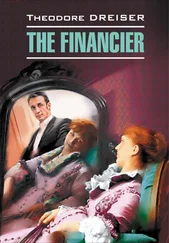
Theodore Dreiser - The Financier
Здесь есть возможность читать онлайн «Theodore Dreiser - The Financier» весь текст электронной книги совершенно бесплатно (целиком полную версию без сокращений). В некоторых случаях можно слушать аудио, скачать через торрент в формате fb2 и присутствует краткое содержание. Жанр: Классическая проза, на английском языке. Описание произведения, (предисловие) а так же отзывы посетителей доступны на портале библиотеки ЛибКат.
- Название:The Financier
- Автор:
- Жанр:
- Год:неизвестен
- ISBN:нет данных
- Рейтинг книги:5 / 5. Голосов: 1
-
Избранное:Добавить в избранное
- Отзывы:
-
Ваша оценка:
The Financier: краткое содержание, описание и аннотация
Предлагаем к чтению аннотацию, описание, краткое содержание или предисловие (зависит от того, что написал сам автор книги «The Financier»). Если вы не нашли необходимую информацию о книге — напишите в комментариях, мы постараемся отыскать её.
The Financier — читать онлайн бесплатно полную книгу (весь текст) целиком
Ниже представлен текст книги, разбитый по страницам. Система сохранения места последней прочитанной страницы, позволяет с удобством читать онлайн бесплатно книгу «The Financier», без необходимости каждый раз заново искать на чём Вы остановились. Поставьте закладку, и сможете в любой момент перейти на страницу, на которой закончили чтение.
Интервал:
Закладка:
“That’s all right,” he said, looking around him in an uncertain way. “I’m ready.”
He stepped out into the hall, with scarcely a farewell glance, and to Bonhag, who was grieving greatly over the loss of so profitable a customer, he said: “I wish you would see that some of these things are sent over to my house, Walter. You’re welcome to the chair, that clock, this mirror, those pictures—all of these things in fact, except my linen, razors, and so forth.”
The last little act of beneficence soothed Bonhag’s lacerated soul a little. They went out into the receiving overseer’s office, where Cowperwood laid aside his prison suit and the soft shirt with a considerable sense of relief. The clog shoes had long since been replaced by a better pair of his own. He put on the derby hat and gray overcoat he had worn the year before, on entering, and expressed himself as ready. At the entrance of the prison he turned and looked back—one last glance—at the iron door leading into the garden.
“You don’t regret leaving that, do you, Frank?” asked Steger, curiously.
“I do not,” replied Cowperwood. “It wasn’t that I was thinking of. It was just the appearance of it, that’s all.”
In another minute they were at the outer gate, where Cowperwood shook the warden finally by the hand. Then entering a carriage outside the large, impressive, Gothic entrance, the gates were locked behind them and they were driven away.
“Well, there’s an end of that, Frank,” observed Steger, gayly; “that will never bother you any more.”
“Yes,” replied Cowperwood. “It’s worse to see it coming than going.”
“It seems to me we ought to celebrate this occasion in some way,” observed Walter Leigh. “It won’t do just to take Frank home. Why don’t we all go down to Green’s? That’s a good idea.”
“I’d rather not, if you don’t mind,” replied Cowperwood, feelingly. “I’ll get together with you all, later. Just now I’d like to go home and change these clothes.”
He was thinking of Aileen and his children and his mother and father and of his whole future. Life was going to broaden out for him considerably from now on, he was sure of it. He had learned so much about taking care of himself in those thirteen months. He was going to see Aileen, and find how she felt about things in general, and then he was going to resume some such duties as he had had in his own concern, with Wingate & Co. He was going to secure a seat on ’change again, through his friends; and, to escape the effect of the prejudice of those who might not care to do business with an ex-convict, he was going to act as general outside man, and floor man on ’change, for Wingate & Co. His practical control of that could not be publicly proved. Now for some important development in the market—some slump or something. He would show the world whether he was a failure or not.
They let him down in front of his wife’s little cottage, and he entered briskly in the gathering gloom.
On September 18, 1873, at twelve-fifteen of a brilliant autumn day, in the city of Philadelphia, one of the most startling financial tragedies that the world has ever seen had its commencement. The banking house of Jay Cooke & Co., the foremost financial organization of America, doing business at Number 114 South Third Street in Philadelphia, and with branches in New York, Washington, and London, closed its doors. Those who know anything about the financial crises of the United States know well the significance of the panic which followed. It is spoken of in all histories as the panic of 1873, and the widespread ruin and disaster which followed was practically unprecedented in American history.
At this time Cowperwood, once more a broker—ostensibly a broker’s agent—was doing business in South Third Street, and representing Wingate & Co. on ’change. During the six months which had elapsed since he had emerged from the Eastern Penitentiary he had been quietly resuming financial, if not social, relations with those who had known him before.
Furthermore, Wingate & Co. were prospering, and had been for some time, a fact which redounded to his credit with those who knew. Ostensibly he lived with his wife in a small house on North Twenty-first Street. In reality he occupied a bachelor apartment on North Fifteenth Street, to which Aileen occasionally repaired. The difference between himself and his wife had now become a matter of common knowledge in the family, and, although there were some faint efforts made to smooth the matter over, no good resulted. The difficulties of the past two years had so inured his parents to expect the untoward and exceptional that, astonishing as this was, it did not shock them so much as it would have years before. They were too much frightened by life to quarrel with its weird developments. They could only hope and pray for the best.
The Butler family, on the other hand, what there was of it, had become indifferent to Aileen’s conduct. She was ignored by her brothers and Norah, who now knew all; and her mother was so taken up with religious devotions and brooding contemplation of her loss that she was not as active in her observation of Aileen’s life as she might have been. Besides, Cowperwood and his mistress were more circumspect in their conduct than they had ever been before. Their movements were more carefully guarded, though the result was the same. Cowperwood was thinking of the West—of reaching some slight local standing here in Philadelphia, and then, with perhaps one hundred thousand dollars in capital, removing to the boundless prairies of which he had heard so much—Chicago, Fargo, Duluth, Sioux City, places then heralded in Philadelphia and the East as coming centers of great life—and taking Aileen with him. Although the problem of marriage with her was insoluble unless Mrs. Cowperwood should formally agree to give him up—a possibility which was not manifest at this time, neither he nor Aileen were deterred by that thought. They were going to build a future together—or so they thought, marriage or no marriage. The only thing which Cowperwood could see to do was to take Aileen away with him, and to trust to time and absence to modify his wife’s point of view.
This particular panic, which was destined to mark a notable change in Cowperwood’s career, was one of those peculiar things which spring naturally out of the optimism of the American people and the irrepressible progress of the country. It was the result, to be accurate, of the prestige and ambition of Jay Cooke, whose early training and subsequent success had all been acquired in Philadelphia, and who had since become the foremost financial figure of his day. It would be useless to attempt to trace here the rise of this man to distinction; it need only be said that by suggestions which he made and methods which he devised the Union government, in its darkest hours, was able to raise the money wherewith to continue the struggle against the South. After the Civil War this man, who had built up a tremendous banking business in Philadelphia, with great branches in New York and Washington, was at a loss for some time for some significant thing to do, some constructive work which would be worthy of his genius. The war was over; the only thing which remained was the finances of peace, and the greatest things in American financial enterprise were those related to the construction of transcontinental railway lines. The Union Pacific, authorized in 1860, was already building; the Northern Pacific and the Southern Pacific were already dreams in various pioneer minds. The great thing was to connect the Atlantic and the Pacific by steel, to bind up the territorially perfected and newly solidified Union, or to enter upon some vast project of mining, of which gold and silver were the most important. Actually railway-building was the most significant of all, and railroad stocks were far and away the most valuable and important on every exchange in America. Here in Philadelphia, New York Central, Rock Island, Wabash, Central Pacific, St. Paul, Hannibal & St. Joseph, Union Pacific, and Ohio & Mississippi were freely traded in. There were men who were getting rich and famous out of handling these things; and such towering figures as Cornelius Vanderbilt, Jay Gould, Daniel Drew, James Fish, and others in the East, and Fair, Crocker, W. R. Hearst, and Collis P. Huntington, in the West, were already raising their heads like vast mountains in connection with these enterprises. Among those who dreamed most ardently on this score was Jay Cooke, who without the wolfish cunning of a Gould or the practical knowledge of a Vanderbilt, was ambitious to thread the northern reaches of America with a band of steel which should be a permanent memorial to his name.
Читать дальшеИнтервал:
Закладка:
Похожие книги на «The Financier»
Представляем Вашему вниманию похожие книги на «The Financier» списком для выбора. Мы отобрали схожую по названию и смыслу литературу в надежде предоставить читателям больше вариантов отыскать новые, интересные, ещё непрочитанные произведения.









Обсуждение, отзывы о книге «The Financier» и просто собственные мнения читателей. Оставьте ваши комментарии, напишите, что Вы думаете о произведении, его смысле или главных героях. Укажите что конкретно понравилось, а что нет, и почему Вы так считаете.