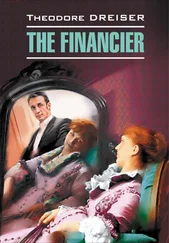
Theodore Dreiser - The Financier
Здесь есть возможность читать онлайн «Theodore Dreiser - The Financier» весь текст электронной книги совершенно бесплатно (целиком полную версию без сокращений). В некоторых случаях можно слушать аудио, скачать через торрент в формате fb2 и присутствует краткое содержание. Жанр: Классическая проза, на английском языке. Описание произведения, (предисловие) а так же отзывы посетителей доступны на портале библиотеки ЛибКат.
- Название:The Financier
- Автор:
- Жанр:
- Год:неизвестен
- ISBN:нет данных
- Рейтинг книги:5 / 5. Голосов: 1
-
Избранное:Добавить в избранное
- Отзывы:
-
Ваша оценка:
The Financier: краткое содержание, описание и аннотация
Предлагаем к чтению аннотацию, описание, краткое содержание или предисловие (зависит от того, что написал сам автор книги «The Financier»). Если вы не нашли необходимую информацию о книге — напишите в комментариях, мы постараемся отыскать её.
The Financier — читать онлайн бесплатно полную книгу (весь текст) целиком
Ниже представлен текст книги, разбитый по страницам. Система сохранения места последней прочитанной страницы, позволяет с удобством читать онлайн бесплатно книгу «The Financier», без необходимости каждый раз заново искать на чём Вы остановились. Поставьте закладку, и сможете в любой момент перейти на страницу, на которой закончили чтение.
Интервал:
Закладка:
“Yes, Mr. Chapin explained that to me,” replied Cowperwood. “I think I know what most of the rules are now. I’ll try not to break any of them.”
The days which followed brought a number of modifications of his prison lot, but not sufficient by any means to make it acceptable to him. Bonhag, during the first few days in which he trained Cowperwood in the art of caning chairs, managed to make it perfectly clear that there were a number of things he would be willing to do for him. One of the things that moved him to this, was that already he had been impressed by the fact that Stener’s friends were coming to see him in larger numbers than Cowperwood’s, sending him an occasional basket of fruit, which he gave to the overseers, and that his wife and children had been already permitted to visit him outside the regular visiting-day. This was a cause for jealousy on Bonhag’s part. His fellow-overseer was lording it over him—telling him, as it were, of the high jinks in Block 4. Bonhag really wanted Cowperwood to spruce up and show what he could do, socially or otherwise.
And so now he began with: “I see you have your lawyer and your partner here every day. There ain’t anybody else you’d like to have visit you, is there? Of course, it’s against the rules to have your wife or sister or anybody like that, except on visiting days—” And here he paused and rolled a large and informing eye on Cowperwood—such an eye as was supposed to convey dark and mysterious things. “But all the rules ain’t kept around here by a long shot.”
Cowperwood was not the man to lose a chance of this kind. He smiled a little—enough to relieve himself, and to convey to Bonhag that he was gratified by the information, but vocally he observed: “I’ll tell you how it is, Mr. Bonhag. I believe you understand my position better than most men would, and that I can talk to you. There are people who would like to come here, but I have been afraid to let them come. I did not know that it could be arranged. If it could be, I would be very grateful. You and I are practical men—I know that if any favors are extended some of those who help to bring them about must be looked after. If you can do anything to make it a little more comfortable for me here I will show you that I appreciate it. I haven’t any money on my person, but I can always get it, and I will see that you are properly looked after.”
Bonhag’s short, thick ears tingled. This was the kind of talk he liked to hear. “I can fix anything like that, Mr. Cowperwood,” he replied, servilely. “You leave it to me. If there’s any one you want to see at any time, just let me know. Of course I have to be very careful, and so do you, but that’s all right, too. If you want to stay out in that yard a little longer in the mornings or get out there afternoons or evenings, from now on, why, go ahead. It’s all right. I’ll just leave the door open. If the warden or anybody else should be around, I’ll just scratch on your door with my key, and you come in and shut it. If there’s anything you want from the outside I can get it for you—jelly or eggs or butter or any little thing like that. You might like to fix up your meals a little that way.”
“I’m certainly most grateful, Mr. Bonhag,” returned Cowperwood in his grandest manner, and with a desire to smile, but he kept a straight face.
“In regard to that other matter,” went on Bonhag, referring to the matter of extra visitors, “I can fix that any time you want to. I know the men out at the gate. If you want anybody to come here, just write ’em a note and give it to me, and tell ’em to ask for me when they come. That’ll get ’em in all right. When they get here you can talk to ’em in your cell. See! Only when I tap they have to come out. You want to remember that. So just you let me know.”
Cowperwood was exceedingly grateful. He said so in direct, choice language. It occurred to him at once that this was Aileen’s opportunity, and that he could now notify her to come. If she veiled herself sufficiently she would probably be safe enough. He decided to write her, and when Wingate came he gave him a letter to mail.
Two days later, at three o’clock in the afternoon—the time appointed by him—Aileen came to see him. She was dressed in gray broadcloth with white-velvet trimmings and cut-steel buttons which glistened like silver, and wore, as additional ornaments, as well as a protection against the cold, a cap, stole, and muff of snow-white ermine. Over this rather striking costume she had slipped a long dark circular cloak, which she meant to lay off immediately upon her arrival. She had made a very careful toilet as to her shoes, gloves, hair, and the gold ornaments which she wore. Her face was concealed by a thick green veil, as Cowperwood had suggested; and she arrived at an hour when, as near as he had been able to prearrange, he would be alone. Wingate usually came at four, after business, and Steger in the morning, when he came at all. She was very nervous over this strange adventure, leaving the street-car in which she had chosen to travel some distance away and walking up a side street. The cold weather and the gray walls under a gray sky gave her a sense of defeat, but she had worked very hard to look nice in order to cheer her lover up. She knew how readily he responded to the influence of her beauty when properly displayed.
Cowperwood, in view of her coming, had made his cell as acceptable as possible. It was clean, because he had swept it himself and made his own bed; and besides he had shaved and combed his hair, and otherwise put himself to rights. The caned chairs on which he was working had been put in the corner at the end of the bed. His few dishes were washed and hung up, and his clogs brushed with a brush which he now kept for the purpose. Never before, he thought to himself, with a peculiar feeling of artistic degradation, had Aileen seen him like this. She had always admired his good taste in clothes, and the way he carried himself in them; and now she was to see him in garments which no dignity of body could make presentable. Only a stoic sense of his own soul-dignity aided him here. After all, as he now thought, he was Frank A. Cowperwood, and that was something, whatever he wore. And Aileen knew it. Again, he might be free and rich some day, and he knew that she believed that. Best of all, his looks under these or any other circumstances, as he knew, would make no difference to Aileen. She would only love him the more. It was her ardent sympathy that he was afraid of. He was so glad that Bonhag had suggested that she might enter the cell, for it would be a grim procedure talking to her through a barred door.
When Aileen arrived she asked for Mr. Bonhag, and was permitted to go to the central rotunda, where he was sent for. When he came she murmured: “I wish to see Mr. Cowperwood, if you please”; and he exclaimed, “Oh, yes, just come with me.” As he came across the rotunda floor from his corridor he was struck by the evident youth of Aileen, even though he could not see her face. This now was something in accordance with what he had expected of Cowperwood. A man who could steal five hundred thousand dollars and set a whole city by the ears must have wonderful adventures of all kinds, and Aileen looked like a true adventure. He led her to the little room where he kept his desk and detained visitors, and then bustled down to Cowperwood’s cell, where the financier was working on one of his chairs and scratching on the door with his key, called: “There’s a young lady here to see you. Do you want to let her come inside?”
“Thank you, yes,” replied Cowperwood; and Bonhag hurried away, unintentionally forgetting, in his boorish incivility, to unlock the cell door, so that he had to open it in Aileen’s presence. The long corridor, with its thick doors, mathematically spaced gratings and gray-stone pavement, caused Aileen to feel faint at heart. A prison, iron cells! And he was in one of them. It chilled her usually courageous spirit. What a terrible place for her Frank to be! What a horrible thing to have put him here! Judges, juries, courts, laws, jails seemed like so many foaming ogres ranged about the world, glaring down upon her and her love-affair. The clank of the key in the lock, and the heavy outward swinging of the door, completed her sense of the untoward. And then she saw Cowperwood.
Читать дальшеИнтервал:
Закладка:
Похожие книги на «The Financier»
Представляем Вашему вниманию похожие книги на «The Financier» списком для выбора. Мы отобрали схожую по названию и смыслу литературу в надежде предоставить читателям больше вариантов отыскать новые, интересные, ещё непрочитанные произведения.










Обсуждение, отзывы о книге «The Financier» и просто собственные мнения читателей. Оставьте ваши комментарии, напишите, что Вы думаете о произведении, его смысле или главных героях. Укажите что конкретно понравилось, а что нет, и почему Вы так считаете.