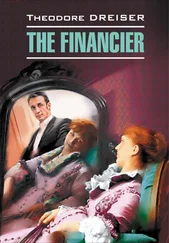
Theodore Dreiser - The Financier
Здесь есть возможность читать онлайн «Theodore Dreiser - The Financier» весь текст электронной книги совершенно бесплатно (целиком полную версию без сокращений). В некоторых случаях можно слушать аудио, скачать через торрент в формате fb2 и присутствует краткое содержание. Жанр: Классическая проза, на английском языке. Описание произведения, (предисловие) а так же отзывы посетителей доступны на портале библиотеки ЛибКат.
- Название:The Financier
- Автор:
- Жанр:
- Год:неизвестен
- ISBN:нет данных
- Рейтинг книги:5 / 5. Голосов: 1
-
Избранное:Добавить в избранное
- Отзывы:
-
Ваша оценка:
The Financier: краткое содержание, описание и аннотация
Предлагаем к чтению аннотацию, описание, краткое содержание или предисловие (зависит от того, что написал сам автор книги «The Financier»). Если вы не нашли необходимую информацию о книге — напишите в комментариях, мы постараемся отыскать её.
The Financier — читать онлайн бесплатно полную книгу (весь текст) целиком
Ниже представлен текст книги, разбитый по страницам. Система сохранения места последней прочитанной страницы, позволяет с удобством читать онлайн бесплатно книгу «The Financier», без необходимости каждый раз заново искать на чём Вы остановились. Поставьте закладку, и сможете в любой момент перейти на страницу, на которой закончили чтение.
Интервал:
Закладка:
Instinctively Cowperwood knew that he was the warden. “This is Mr. Desmas, isn’t it?” he asked, courteously and pleasantly.
“Yes, sir, I’m the man,” replied Desmas interestedly. “These rooms are not as comfortable as they might be, are they?” The warden’s even teeth showed in a friendly, yet wolfish, way.
“They certainly are not, Mr. Desmas,” replied Cowperwood, standing very erect and soldier-like. “I didn’t imagine I was coming to a hotel, however.” He smiled.
“There isn’t anything special I can do for you, is there, Mr. Cowperwood?” began Desmas curiously, for he was moved by a thought that at some time or other a man such as this might be of service to him. “I’ve been talking to your lawyer.” Cowperwood was intensely gratified by the Mr. So that was the way the wind was blowing. Well, then, within reason, things might not prove so bad here. He would see. He would sound this man out.
“I don’t want to be asking anything, Warden, which you cannot reasonably give,” he now returned politely. “But there are a few things, of course, that I would change if I could. I wish I might have sheets for my bed, and I could afford better underwear if you would let me wear it. This that I have on annoys me a great deal.”
“They’re not the best wool, that’s true enough,” replied Desmas, solemnly. “They’re made for the State out here in Pennsylvania somewhere. I suppose there’s no objection to your wearing your own underwear if you want to. I’ll see about that. And the sheets, too. We might let you use them if you have them. We’ll have to go a little slow about this. There are a lot of people that take a special interest in showing the warden how to tend to his business.”
“I can readily understand that, Warden,” went on Cowperwood briskly, “and I’m certainly very much obliged to you. You may be sure that anything you do for me here will be appreciated, and not misused, and that I have friends on the outside who can reciprocate for me in the course of time.” He talked slowly and emphatically, looking Desmas directly in the eye all of the time. Desmas was very much impressed.
“That’s all right,” he said, now that he had gone so far as to be friendly. “I can’t promise much. Prison rules are prison rules. But there are some things that can be done, because it’s the rule to do them for other men when they behave themselves. You can have a better chair than that, if you want it, and something to read too. If you’re in business yet, I wouldn’t want to do anything to stop that. We can’t have people running in and out of here every fifteen minutes, and you can’t turn a cell into a business office—that’s not possible. It would break up the order of the place. Still, there’s no reason why you shouldn’t see some of your friends now and then. As for your mail—well, that will have to be opened in the ordinary way for the time being, anyhow. I’ll have to see about that. I can’t promise too much. You’ll have to wait until you come out of this block and down-stairs. Some of the cells have a yard there; if there are any empty—” The warden cocked his eye wisely, and Cowperwood saw that his tot was not to be as bad as he had anticipated—though bad enough. The warden spoke to him about the different trades he might follow, and asked him to think about the one he would prefer. “You want to have something to keep your hands busy, whatever else you want. You’ll find you’ll need that. Everybody here wants to work after a time. I notice that.”
Cowperwood understood and thanked Desmas profusely. The horror of idleness in silence and in a cell scarcely large enough to turn around in comfortably had already begun to creep over him, and the thought of being able to see Wingate and Steger frequently, and to have his mail reach him, after a time, untampered with, was a great relief. He was to have his own underwear, silk and wool—thank God!—and perhaps they would let him take off these shoes after a while. With these modifications and a trade, and perhaps the little yard which Desmas had referred to, his life would be, if not ideal, at least tolerable. The prison was still a prison, but it looked as though it might not be so much of a terror to him as obviously it must be to many.
During the two weeks in which Cowperwood was in the “manners squad,” in care of Chapin, he learned nearly as much as he ever learned of the general nature of prison life; for this was not an ordinary penitentiary in the sense that the prison yard, the prison squad, the prison lock-step, the prison dining-room, and prison associated labor make the ordinary penitentiary. There was, for him and for most of those confined there, no general prison life whatsoever. The large majority were supposed to work silently in their cells at the particular tasks assigned them, and not to know anything of the remainder of the life which went on around them, the rule of this prison being solitary confinement, and few being permitted to work at the limited number of outside menial tasks provided. Indeed, as he sensed and as old Chapin soon informed him, not more than seventy-five of the four hundred prisoners confined here were so employed, and not all of these regularly—cooking, gardening in season, milling, and general cleaning being the only avenues of escape from solitude. Even those who so worked were strictly forbidden to talk, and although they did not have to wear the objectionable hood when actually employed, they were supposed to wear it in going to and from their work. Cowperwood saw them occasionally tramping by his cell door, and it struck him as strange, uncanny, grim. He wished sincerely at times since old Chapin was so genial and talkative that he were to be under him permanently; but it was not to be.
His two weeks soon passed—drearily enough in all conscience but they passed, interlaced with his few commonplace tasks of bed-making, floor-sweeping, dressing, eating, undressing, rising at five-thirty, and retiring at nine, washing his several dishes after each meal, etc. He thought he would never get used to the food. Breakfast, as has been said, was at six-thirty, and consisted of coarse black bread made of bran and some white flour, and served with black coffee. Dinner was at eleven-thirty, and consisted of bean or vegetable soup, with some coarse meat in it, and the same bread. Supper was at six, of tea and bread, very strong tea and the same bread—no butter, no milk, no sugar. Cowperwood did not smoke, so the small allowance of tobacco which was permitted was without value to him. Steger called in every day for two or three weeks, and after the second day, Stephen Wingate, as his new business associate, was permitted to see him also—once every day, if he wished, Desmas stated, though the latter felt he was stretching a point in permitting this so soon. Both of these visits rarely occupied more than an hour, or an hour and a half, and after that the day was long. He was taken out on several days on a court order, between nine and five, to testify in the bankruptcy proceedings against him, which caused the time in the beginning to pass quickly.
It was curious, once he was in prison, safely shut from the world for a period of years apparently, how quickly all thought of assisting him departed from the minds of those who had been most friendly. He was done, so most of them thought. The only thing they could do now would be to use their influence to get him out some time; how soon, they could not guess. Beyond that there was nothing. He would really never be of any great importance to any one any more, or so they thought. It was very sad, very tragic, but he was gone—his place knew him not.
“A bright young man, that,” observed President Davison of the Girard National, on reading of Cowperwood’s sentence and incarceration. “Too bad! Too bad! He made a great mistake.”
Читать дальшеИнтервал:
Закладка:
Похожие книги на «The Financier»
Представляем Вашему вниманию похожие книги на «The Financier» списком для выбора. Мы отобрали схожую по названию и смыслу литературу в надежде предоставить читателям больше вариантов отыскать новые, интересные, ещё непрочитанные произведения.










Обсуждение, отзывы о книге «The Financier» и просто собственные мнения читателей. Оставьте ваши комментарии, напишите, что Вы думаете о произведении, его смысле или главных героях. Укажите что конкретно понравилось, а что нет, и почему Вы так считаете.