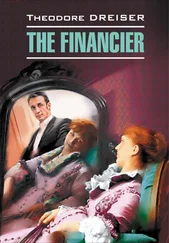
Theodore Dreiser - The Financier
Здесь есть возможность читать онлайн «Theodore Dreiser - The Financier» весь текст электронной книги совершенно бесплатно (целиком полную версию без сокращений). В некоторых случаях можно слушать аудио, скачать через торрент в формате fb2 и присутствует краткое содержание. Жанр: Классическая проза, на английском языке. Описание произведения, (предисловие) а так же отзывы посетителей доступны на портале библиотеки ЛибКат.
- Название:The Financier
- Автор:
- Жанр:
- Год:неизвестен
- ISBN:нет данных
- Рейтинг книги:5 / 5. Голосов: 1
-
Избранное:Добавить в избранное
- Отзывы:
-
Ваша оценка:
The Financier: краткое содержание, описание и аннотация
Предлагаем к чтению аннотацию, описание, краткое содержание или предисловие (зависит от того, что написал сам автор книги «The Financier»). Если вы не нашли необходимую информацию о книге — напишите в комментариях, мы постараемся отыскать её.
The Financier — читать онлайн бесплатно полную книгу (весь текст) целиком
Ниже представлен текст книги, разбитый по страницам. Система сохранения места последней прочитанной страницы, позволяет с удобством читать онлайн бесплатно книгу «The Financier», без необходимости каждый раз заново искать на чём Вы остановились. Поставьте закладку, и сможете в любой момент перейти на страницу, на которой закончили чтение.
Интервал:
Закладка:
When they reached the court the same little pen in which Cowperwood had awaited the verdict of his jury several months before was waiting to receive him.
Cowperwood, senior, and his other sons sought places in the courtroom proper. Eddie Zanders remained with his charge. Stener and a deputy by the name of Wilkerson were in the room; but he and Cowperwood pretended now not to see each other. Frank had no objection to talking to his former associate, but he could see that Stener was diffident and ashamed. So he let the situation pass without look or word of any kind. After some three-quarters of an hour of dreary waiting the door leading into the courtroom proper opened and a bailiff stepped in.
“All prisoners up for sentence,” he called.
There were six, all told, including Cowperwood and Stener. Two of them were confederate housebreakers who had been caught red-handed at their midnight task.
Another prisoner was no more and no less than a plain horse-thief, a young man of twenty-six, who had been convicted by a jury of stealing a grocer’s horse and selling it. The last man was a negro, a tall, shambling, illiterate, nebulous-minded black, who had walked off with an apparently discarded section of lead pipe which he had found in a lumber-yard. His idea was to sell or trade it for a drink. He really did not belong in this court at all; but, having been caught by an undersized American watchman charged with the care of the property, and having at first refused to plead guilty, not quite understanding what was to be done with him, he had been perforce bound over to this court for trial. Afterward he had changed his mind and admitted his guilt, so he now had to come before Judge Payderson for sentence or dismissal. The lower court before which he had originally been brought had lost jurisdiction by binding him over to to higher court for trial. Eddie Zanders, in his self-appointed position as guide and mentor to Cowperwood, had confided nearly all of this data to him as he stood waiting.
The courtroom was crowded. It was very humiliating to Cowperwood to have to file in this way along the side aisle with these others, followed by Stener, well dressed but sickly looking and disconsolate.
The negro, Charles Ackerman, was the first on the list.
“How is it this man comes before me?” asked Payderson, peevishly, when he noted the value of the property Ackerman was supposed to have stolen.
“Your honor,” the assistant district attorney explained, promptly, “this man was before a lower court and refused, because he was drunk, or something, to plead guilty. The lower court, because the complainant would not forego the charge, was compelled to bind him over to this court for trial. Since then he has changed his mind and has admitted his guilt to the district attorney. He would not be brought before you except we have no alternative. He has to be brought here now in order to clear the calendar.”
Judge Payderson stared quizzically at the negro, who, obviously not very much disturbed by this examination, was leaning comfortably on the gate or bar before which the average criminal stood erect and terrified. He had been before police-court magistrates before on one charge and another—drunkenness, disorderly conduct, and the like—but his whole attitude was one of shambling, lackadaisical, amusing innocence.
“Well, Ackerman,” inquired his honor, severely, “did you or did you not steal this piece of lead pipe as charged here—four dollars and eighty cents’ worth?”
“Yassah, I did,” he began. “I tell you how it was, jedge. I was a-comin’ along past dat lumber-yard one Saturday afternoon, and I hadn’t been wuckin’, an’ I saw dat piece o’ pipe thoo de fence, lyin’ inside, and I jes’ reached thoo with a piece o’ boad I found dey and pulled it over to me an’ tuck it. An’ aftahwahd dis Mistah Watchman man”—he waved his hand oratorically toward the witness-chair, where, in case the judge might wish to ask him some questions, the complainant had taken his stand—“come around tuh where I live an’ accused me of done takin’ it.”
“But you did take it, didn’t you?”
“Yassah, I done tuck it.”
“What did you do with it?”
“I traded it foh twenty-five cents.”
“You mean you sold it,” corrected his honor.
“Yassah, I done sold it.”
“Well, don’t you know it’s wrong to do anything like that? Didn’t you know when you reached through that fence and pulled that pipe over to you that you were stealing? Didn’t you?”
“Yassah, I knowed it was wrong,” replied Ackerman, sheepishly. “I didn’ think ’twuz stealin’ like zackly, but I done knowed it was wrong. I done knowed I oughtn’ take it, I guess.”
“Of course you did. Of course you did. That’s just it. You knew you were stealing, and still you took it. Has the man to whom this negro sold the lead pipe been apprehended yet?” the judge inquired sharply of the district attorney. “He should be, for he’s more guilty than this negro, a receiver of stolen goods.”
“Yes, sir,” replied the assistant. “His case is before Judge Yawger.”
“Quite right. It should be,” replied Payderson, severely. “This matter of receiving stolen property is one of the worst offenses, in my judgment.”
He then turned his attention to Ackerman again. “Now, look here, Ackerman,” he exclaimed, irritated at having to bother with such a pretty case, “I want to say something to you, and I want you to pay strict attention to me. Straighten up, there! Don’t lean on that gate! You are in the presence of the law now.” Ackerman had sprawled himself comfortably down on his elbows as he would have if he had been leaning over a back-fence gate talking to some one, but he immediately drew himself straight, still grinning foolishly and apologetically, when he heard this. “You are not so dull but that you can understand what I am going to say to you. The offense you have committed—stealing a piece of lead pipe—is a crime. Do you hear me? A criminal offense—one that I could punish you very severely for. I could send you to the penitentiary for one year if I chose—the law says I may—one year at hard labor for stealing a piece of lead pipe. Now, if you have any sense you will pay strict attention to what I am going to tell you. I am not going to send you to the penitentiary right now. I’m going to wait a little while. I am going to sentence you to one year in the penitentiary—one year. Do you understand?” Ackerman blanched a little and licked his lips nervously. “And then I am going to suspend that sentence—hold it over your head, so that if you are ever caught taking anything else you will be punished for this offense and the next one also at one and the same time. Do you understand that? Do you know what I mean? Tell me. Do you?”
“Yessah! I does, sir,” replied the negro. “You’se gwine to let me go now—tha’s it.”
The audience grinned, and his honor made a wry face to prevent his own grim grin.
“I’m going to let you go only so long as you don’t steal anything else,” he thundered. “The moment you steal anything else, back you come to this court, and then you go to the penitentiary for a year and whatever more time you deserve. Do you understand that? Now, I want you to walk straight out of this court and behave yourself. Don’t ever steal anything. Get something to do! Don’t steal, do you hear? Don’t touch anything that doesn’t belong to you! Don’t come back here! If you do, I’ll send you to the penitentiary, sure.”
“Yassah! No, sah, I won’t,” replied Ackerman, nervously. “I won’t take nothin’ more that don’t belong tuh me.”
He shuffled away, after a moment, urged along by the guiding hand of a bailiff, and was put safely outside the court, amid a mixture of smiles and laughter over his simplicity and Payderson’s undue severity of manner. But the next case was called and soon engrossed the interest of the audience.
Читать дальшеИнтервал:
Закладка:
Похожие книги на «The Financier»
Представляем Вашему вниманию похожие книги на «The Financier» списком для выбора. Мы отобрали схожую по названию и смыслу литературу в надежде предоставить читателям больше вариантов отыскать новые, интересные, ещё непрочитанные произведения.










Обсуждение, отзывы о книге «The Financier» и просто собственные мнения читателей. Оставьте ваши комментарии, напишите, что Вы думаете о произведении, его смысле или главных героях. Укажите что конкретно понравилось, а что нет, и почему Вы так считаете.