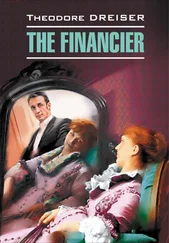
Theodore Dreiser - The Financier
Здесь есть возможность читать онлайн «Theodore Dreiser - The Financier» весь текст электронной книги совершенно бесплатно (целиком полную версию без сокращений). В некоторых случаях можно слушать аудио, скачать через торрент в формате fb2 и присутствует краткое содержание. Жанр: Классическая проза, на английском языке. Описание произведения, (предисловие) а так же отзывы посетителей доступны на портале библиотеки ЛибКат.
- Название:The Financier
- Автор:
- Жанр:
- Год:неизвестен
- ISBN:нет данных
- Рейтинг книги:5 / 5. Голосов: 1
-
Избранное:Добавить в избранное
- Отзывы:
-
Ваша оценка:
The Financier: краткое содержание, описание и аннотация
Предлагаем к чтению аннотацию, описание, краткое содержание или предисловие (зависит от того, что написал сам автор книги «The Financier»). Если вы не нашли необходимую информацию о книге — напишите в комментариях, мы постараемся отыскать её.
The Financier — читать онлайн бесплатно полную книгу (весь текст) целиком
Ниже представлен текст книги, разбитый по страницам. Система сохранения места последней прочитанной страницы, позволяет с удобством читать онлайн бесплатно книгу «The Financier», без необходимости каждый раз заново искать на чём Вы остановились. Поставьте закладку, и сможете в любой момент перейти на страницу, на которой закончили чтение.
Интервал:
Закладка:
“Will you have to go soon, if you do have to go?” she ventured, wearily.
“I can’t tell yet. Possibly to-night. Possibly Friday. Possibly not until Monday. I’m waiting to hear from Steger. I expect him here any minute.”
To prison! To prison! Her Frank Cowperwood, her husband—the substance of their home here—and all their soul destruction going to prison. And even now she scarcely grasped why! She stood there wondering what she could do.
“Is there anything I can get for you?” she asked, starting forward as if out of a dream. “Do you want me to do anything? Don’t you think perhaps you had better leave Philadelphia, Frank? You needn’t go to prison unless you want to.”
She was a little beside herself, for the first time in her life shocked out of a deadly calm.
He paused and looked at her for a moment in his direct, examining way, his hard commercial business judgment restored on the instant.
“That would be a confession of guilt, Lillian, and I’m not guilty,” he replied, almost coldly. “I haven’t done anything that warrants my running away or going to prison, either. I’m merely going there to save time at present. I can’t be litigating this thing forever. I’ll get out—be pardoned out or sued out in a reasonable length of time. Just now it’s better to go, I think. I wouldn’t think of running away from Philadelphia. Two of five judges found for me in the decision. That’s pretty fair evidence that the State has no case against me.”
His wife saw she had made a mistake. It clarified her judgment on the instant. “I didn’t mean in that way, Frank,” she replied, apologetically. “You know I didn’t. Of course I know you’re not guilty. Why should I think you were, of all people?”
She paused, expecting some retort, some further argument—a kind word maybe. A trace of the older, baffling love, but he had quietly turned to his desk and was thinking of other things.
At this point the anomaly of her own state came over her again. It was all so sad and so hopeless. And what was she to do in the future? And what was he likely to do? She paused half trembling and yet decided, because of her peculiarly nonresisting nature—why trespass on his time? Why bother? No good would really come of it. He really did not care for her any more—that was it. Nothing could make him, nothing could bring them together again, not even this tragedy. He was interested in another woman—Aileen—and so her foolish thoughts and explanations, her fear, sorrow, distress, were not important to him. He could take her agonized wish for his freedom as a comment on his probable guilt, a doubt of his innocence, a criticism of him! She turned away for a minute, and he started to leave the room.
“I’ll be back again in a few moments,” he volunteered. “Are the children here?”
“Yes, they’re up in the play-room,” she answered, sadly, utterly nonplussed and distraught.
“Oh, Frank!” she had it on her lips to cry, but before she could utter it he had bustled down the steps and was gone. She turned back to the table, her left hand to her mouth, her eyes in a queer, hazy, melancholy mist. Could it be, she thought, that life could really come to this—that love could so utterly, so thoroughly die? Ten years before—but, oh, why go back to that? Obviously it could, and thoughts concerning that would not help now. Twice now in her life her affairs had seemed to go to pieces—once when her first husband had died, and now when her second had failed her, had fallen in love with another and was going to be sent off to prison. What was it about her that caused such things? Was there anything wrong with her? What was she going to do? Where go? She had no idea, of course, for how long a term of years he would be sent away. It might be one year or it might be five years, as the papers had said. Good heavens! The children could almost come to forget him in five years. She put her other hand to her mouth, also, and then to her forehead, where there was a dull ache. She tried to think further than this, but somehow, just now, there was no further thought. Suddenly quite outside of her own volition, with no thought that she was going to do such a thing, her bosom began to heave, her throat contracted in four or five short, sharp, aching spasms, her eyes burned, and she shook in a vigorous, anguished, desperate, almost one might have said dry-eyed, cry, so hot and few were the tears. She could not stop for the moment, just stood there and shook, and then after a while a dull ache succeeded, and she was quite as she had been before.
“Why cry?” she suddenly asked herself, fiercely—for her. “Why break down in this stormy, useless way? Would it help?”
But, in spite of her speculative, philosophic observations to herself, she still felt the echo, the distant rumble, as it were, of the storm in her own soul. “Why cry? Why not cry?” She might have said—but wouldn’t, and in spite of herself and all her logic, she knew that this tempest which had so recently raged over her was now merely circling around her soul’s horizon and would return to break again.
Chapter L
The arrival of Steger with the information that no move of any kind would be made by the sheriff until Monday morning, when Cowperwood could present himself, eased matters. This gave him time to think—to adjust home details at his leisure. He broke the news to his father and mother in a consoling way and talked with his brothers and father about getting matters immediately adjusted in connection with the smaller houses to which they were now shortly to be compelled to move. There was much conferring among the different members of this collapsing organization in regard to the minor details; and what with his conferences with Steger, his seeing personally Davison, Leigh, Avery Stone, of Jay Cooke & Co., George Waterman (his old-time employer Henry was dead), ex-State Treasurer Van Nostrand, who had gone out with the last State administration, and others, he was very busy. Now that he was really going into prison, he wanted his financial friends to get together and see if they could get him out by appealing to the Governor. The division of opinion among the judges of the State Supreme Court was his excuse and strong point. He wanted Steger to follow this up, and he spared no pains in trying to see all and sundry who might be of use to him—Edward Tighe, of Tighe & Co., who was still in business in Third Street; Newton Targool; Arthur Rivers; Joseph Zimmerman, the dry-goods prince, now a millionaire; Judge Kitchen; Terrence Relihan, the former representative of the money element at Harrisburg; and many others.
Cowperwood wanted Relihan to approach the newspapers and see if he could not readjust their attitude so as to work to get him out, and he wanted Walter Leigh to head the movement of getting up a signed petition which should contain all the important names of moneyed people and others, asking the Governor to release him. Leigh agreed to this heartily, as did Relihan, and many others.
And, afterwards there was really nothing else to do, unless it was to see Aileen once more, and this, in the midst of his other complications and obligations, seemed all but impossible at times—and yet he did achieve that, too—so eager was he to be soothed and comforted by the ignorant and yet all embracing volume of her love. Her eyes these days! The eager, burning quest of him and his happiness that blazed in them. To think that he should be tortured so—her Frank! Oh, she knew—whatever he said, and however bravely and jauntily he talked. To think that her love for him should have been the principal cause of his being sent to jail, as she now believed. And the cruelty of her father! And the smallness of his enemies—that fool Stener, for instance, whose pictures she had seen in the papers. Actually, whenever in the presence of her Frank, she fairly seethed in a chemic agony for him—her strong, handsome lover—the strongest, bravest, wisest, kindest, handsomest man in the world. Oh, didn’t she know! And Cowperwood, looking in her eyes and realizing this reasonless, if so comforting fever for him, smiled and was touched. Such love! That of a dog for a master; that of a mother for a child. And how had he come to evoke it? He could not say, but it was beautiful.
Читать дальшеИнтервал:
Закладка:
Похожие книги на «The Financier»
Представляем Вашему вниманию похожие книги на «The Financier» списком для выбора. Мы отобрали схожую по названию и смыслу литературу в надежде предоставить читателям больше вариантов отыскать новые, интересные, ещё непрочитанные произведения.










Обсуждение, отзывы о книге «The Financier» и просто собственные мнения читателей. Оставьте ваши комментарии, напишите, что Вы думаете о произведении, его смысле или главных героях. Укажите что конкретно понравилось, а что нет, и почему Вы так считаете.