Mark Twain - A Tramp Abroad
Здесь есть возможность читать онлайн «Mark Twain - A Tramp Abroad» весь текст электронной книги совершенно бесплатно (целиком полную версию без сокращений). В некоторых случаях можно слушать аудио, скачать через торрент в формате fb2 и присутствует краткое содержание. Жанр: Классическая проза, Юмористическая проза, на английском языке. Описание произведения, (предисловие) а так же отзывы посетителей доступны на портале библиотеки ЛибКат.
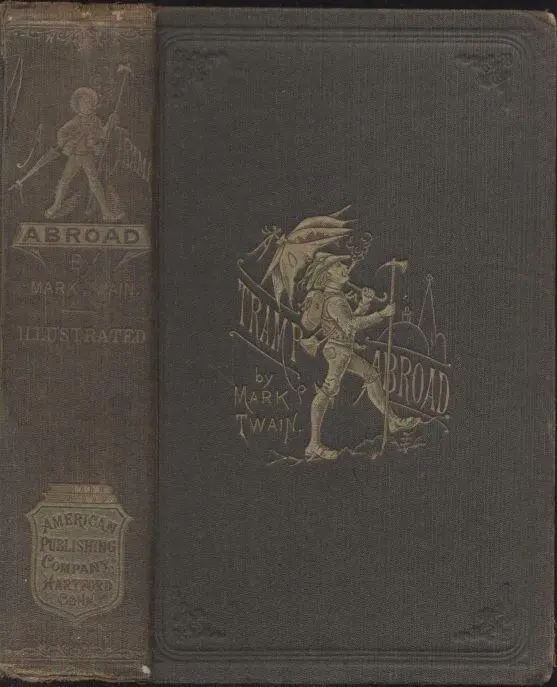
- Название:A Tramp Abroad
- Автор:
- Жанр:
- Год:неизвестен
- ISBN:нет данных
- Рейтинг книги:5 / 5. Голосов: 1
-
Избранное:Добавить в избранное
- Отзывы:
-
Ваша оценка:
A Tramp Abroad: краткое содержание, описание и аннотация
Предлагаем к чтению аннотацию, описание, краткое содержание или предисловие (зависит от того, что написал сам автор книги «A Tramp Abroad»). Если вы не нашли необходимую информацию о книге — напишите в комментариях, мы постараемся отыскать её.
A Tramp Abroad — читать онлайн бесплатно полную книгу (весь текст) целиком
Ниже представлен текст книги, разбитый по страницам. Система сохранения места последней прочитанной страницы, позволяет с удобством читать онлайн бесплатно книгу «A Tramp Abroad», без необходимости каждый раз заново искать на чём Вы остановились. Поставьте закладку, и сможете в любой момент перейти на страницу, на которой закончили чтение.
Интервал:
Закладка:
The village smarties recognized a treasure in Nicodemus, right away—a butt to play jokes on. It was easy to see that he was inconceivably green and confiding. George Jones had the glory of perpetrating the first joke on him; he gave him a cigar with a firecracker in it and winked to the crowd to come; the thing exploded presently and swept away the bulk of Nicodemus's eyebrows and eyelashes. He simply said:
"I consider them kind of seeg'yars dangersome,"—and seemed to suspect nothing. The next evening Nicodemus waylaid George and poured a bucket of ice-water over him.
One day, while Nicodemus was in swimming, Tom McElroy "tied" his clothes. Nicodemus made a bonfire of Tom's by way of retaliation.
A third joke was played upon Nicodemus a day or two later—he walked up the middle aisle of the village church, Sunday night, with a staring handbill pinned between his shoulders. The joker spent the remainder of the night, after church, in the cellar of a deserted house, and Nicodemus sat on the cellar door till toward breakfast-time to make sure that the prisoner remembered that if any noise was made, some rough treatment would be the consequence. The cellar had two feet of stagnant water in it, and was bottomed with six inches of soft mud.
But I wander from the point. It was the subject of skeletons that brought this boy back to my recollection. Before a very long time had elapsed, the village smarties began to feel an uncomfortable consciousness of not having made a very shining success out of their attempts on the simpleton from "old Shelby." Experimenters grew scarce and chary. Now the young doctor came to the rescue. There was delight and applause when he proposed to scare Nicodemus to death, and explained how he was going to do it. He had a noble new skeleton—the skeleton of the late and only local celebrity, Jimmy Finn, the village drunkard—a grisly piece of property which he had bought of Jimmy Finn himself, at auction, for fifty dollars, under great competition, when Jimmy lay very sick in the tan-yard a fortnight before his death. The fifty dollars had gone promptly for whiskey and had considerably hurried up the change of ownership in the skeleton. The doctor would put Jimmy Finn's skeleton in Nicodemus's bed!
This was done—about half past ten in the evening. About Nicodemus's usual bedtime—midnight—the village jokers came creeping stealthily through the jimpson weeds and sunflowers toward the lonely frame den. They reached the window and peeped in. There sat the long-legged pauper, on his bed, in a very short shirt, and nothing more; he was dangling his legs contentedly back and forth, and wheezing the music of "Camptown Races" out of a paper-overlaid comb which he was pressing against his mouth; by him lay a new jewsharp, a new top, and solid india-rubber ball, a handful of painted marbles, five pounds of "store" candy, and a well-gnawed slab of gingerbread as big and as thick as a volume of sheet-music. He had sold the skeleton to a traveling quack for three dollars and was enjoying the result!
Just as we had finished talking about skeletons and were drifting into the subject of fossils, Harris and I heard a shout, and glanced up the steep hillside. We saw men and women standing away up there looking frightened, and there was a bulky object tumbling and floundering down the steep slope toward us. We got out of the way, and when the object landed in the road it proved to be a boy. He had tripped and fallen, and there was nothing for him to do but trust to luck and take what might come.
When one starts to roll down a place like that, there is no stopping till the bottom is reached. Think of people FARMING on a slant which is so steep that the best you can say of it—if you want to be fastidiously accurate—is, that it is a little steeper than a ladder and not quite so steep as a mansard roof. But that is what they do. Some of the little farms on the hillside opposite Heidelberg were stood up "edgeways." The boy was wonderfully jolted up, and his head was bleeding, from cuts which it had got from small stones on the way.
Harris and I gathered him up and set him on a stone, and by that time the men and women had scampered down and brought his cap.
Men, women, and children flocked out from neighboring cottages and joined the crowd; the pale boy was petted, and stared at, and commiserated, and water was brought for him to drink and bathe his bruises in. And such another clatter of tongues! All who had seen the catastrophe were describing it at once, and each trying to talk louder than his neighbor; and one youth of a superior genius ran a little way up the hill, called attention, tripped, fell, rolled down among us, and thus triumphantly showed exactly how the thing had been done.
Harris and I were included in all the descriptions; how we were coming along; how Hans Gross shouted; how we looked up startled; how we saw Peter coming like a cannon-shot; how judiciously we got out of the way, and let him come; and with what presence of mind we picked him up and brushed him off and set him on a rock when the performance was over. We were as much heroes as anybody else, except Peter, and were so recognized; we were taken with Peter and the populace to Peter's mother's cottage, and there we ate bread and cheese, and drank milk and beer with everybody, and had a most sociable good time; and when we left we had a handshake all around, and were receiving and shouting back LEB' WOHL's until a turn in the road separated us from our cordial and kindly new friends forever.
We accomplished our undertaking. At half past eight in the evening we stepped into Oppenau, just eleven hours and a half out of Allerheiligen—one hundred and forty-six miles. This is the distance by pedometer; the guide-book and the Imperial Ordinance maps make it only ten and a quarter—a surprising blunder, for these two authorities are usually singularly accurate in the matter of distances.
CHAPTER XXIV
I Protect the Empress of Germany
Sunday on the Continent—A Day of Rest—An Incident at Church—An Object of Sympathy—Royalty at Church—Public Grounds Concert—Power and Grades of Music—Hiring a Courier
That was a thoroughly satisfactory walk—and the only one we were ever to have which was all the way downhill. We took the train next morning and returned to Baden-Baden through fearful fogs of dust. Every seat was crowded, too; for it was Sunday, and consequently everybody was taking a "pleasure" excursion. Hot! the sky was an oven—and a sound one, too, with no cracks in it to let in any air. An odd time for a pleasure excursion, certainly!
Sunday is the great day on the continent—the free day, the happy day. One can break the Sabbath in a hundred ways without committing any sin.
We do not work on Sunday, because the commandment forbids it; the Germans do not work on Sunday, because the commandment forbids it. We rest on Sunday, because the commandment requires it; the Germans rest on Sunday because the commandment requires it. But in the definition of the word "rest" lies all the difference. With us, its Sunday meaning is, stay in the house and keep still; with the Germans its Sunday and week-day meanings seem to be the same—rest the TIRED PART, and never mind the other parts of the frame; rest the tired part, and use the means best calculated to rest that particular part. Thus: If one's duties have kept him in the house all the week, it will rest him to be out on Sunday; if his duties have required him to read weighty and serious matter all the week, it will rest him to read light matter on Sunday; if his occupation has busied him with death and funerals all the week, it will rest him to go to the theater Sunday night and put in two or three hours laughing at a comedy; if he is tired with digging ditches or felling trees all the week, it will rest him to lie quiet in the house on Sunday; if the hand, the arm, the brain, the tongue, or any other member, is fatigued with inanition, it is not to be rested by addeding a day's inanition; but if a member is fatigued with exertion, inanition is the right rest for it. Such is the way in which the Germans seem to define the word "rest"; that is to say, they rest a member by recreating, recuperating, restoring its forces. But our definition is less broad. We all rest alike on Sunday—by secluding ourselves and keeping still, whether that is the surest way to rest the most of us or not. The Germans make the actors, the preachers, etc., work on Sunday. We encourage the preachers, the editors, the printers, etc., to work on Sunday, and imagine that none of the sin of it falls upon us; but I do not know how we are going to get around the fact that if it is wrong for the printer to work at his trade on Sunday it must be equally wrong for the preacher to work at his, since the commandment has made no exception in his favor. We buy Monday morning's paper and read it, and thus encourage Sunday printing. But I shall never do it again.
Читать дальшеИнтервал:
Закладка:
Похожие книги на «A Tramp Abroad»
Представляем Вашему вниманию похожие книги на «A Tramp Abroad» списком для выбора. Мы отобрали схожую по названию и смыслу литературу в надежде предоставить читателям больше вариантов отыскать новые, интересные, ещё непрочитанные произведения.











Обсуждение, отзывы о книге «A Tramp Abroad» и просто собственные мнения читателей. Оставьте ваши комментарии, напишите, что Вы думаете о произведении, его смысле или главных героях. Укажите что конкретно понравилось, а что нет, и почему Вы так считаете.