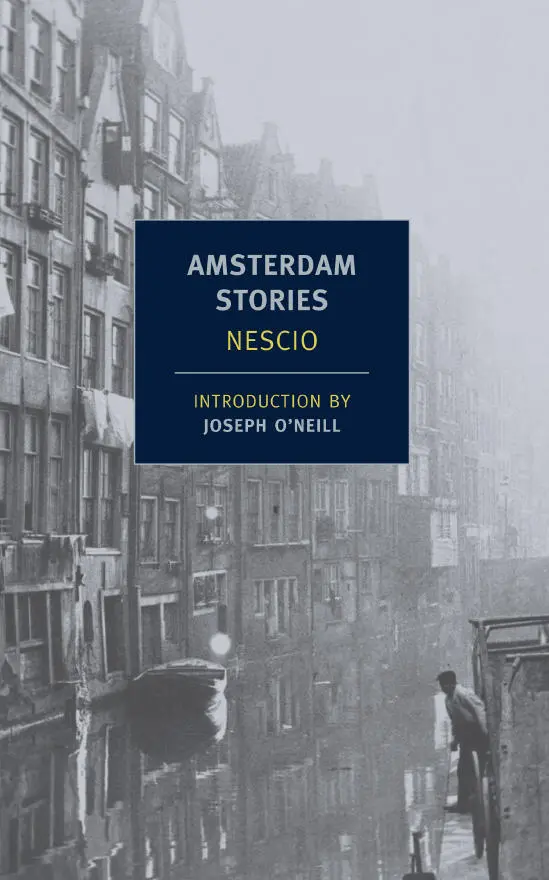
Nescio - Amsterdam Stories
Здесь есть возможность читать онлайн «Nescio - Amsterdam Stories» весь текст электронной книги совершенно бесплатно (целиком полную версию без сокращений). В некоторых случаях можно слушать аудио, скачать через торрент в формате fb2 и присутствует краткое содержание. Год выпуска: 2012, Издательство: NYRB Classics, Жанр: Классическая проза, на английском языке. Описание произведения, (предисловие) а так же отзывы посетителей доступны на портале библиотеки ЛибКат.
- Название:Amsterdam Stories
- Автор:
- Издательство:NYRB Classics
- Жанр:
- Год:2012
- ISBN:нет данных
- Рейтинг книги:5 / 5. Голосов: 1
-
Избранное:Добавить в избранное
- Отзывы:
-
Ваша оценка:
Amsterdam Stories: краткое содержание, описание и аннотация
Предлагаем к чтению аннотацию, описание, краткое содержание или предисловие (зависит от того, что написал сам автор книги «Amsterdam Stories»). Если вы не нашли необходимую информацию о книге — напишите в комментариях, мы постараемся отыскать её.
Who was Nescio? Nescio — Latin for “I don’t know”—was the pen name of J.H.F. Grönloh, the highly successful director of the Holland — Bombay Trading Company and a father of four — someone who knew more than enough about respectable maturity. Only in his spare time and under the cover of a pseudonym, as if commemorating a lost self, did he let himself go, producing over the course of his lifetime a handful of utterly original stories that contain some of the most luminous pages in modern literature.
This is the first English translation of Nescio’s stories.
Amsterdam Stories — читать онлайн бесплатно полную книгу (весь текст) целиком
Ниже представлен текст книги, разбитый по страницам. Система сохранения места последней прочитанной страницы, позволяет с удобством читать онлайн бесплатно книгу «Amsterdam Stories», без необходимости каждый раз заново искать на чём Вы остановились. Поставьте закладку, и сможете в любой момент перейти на страницу, на которой закончили чтение.
Интервал:
Закладка:
“Do you understand what the sun wants from me? I have thirty-four setting suns leaning against the wall, one on top of the other, all facing the wall. But every evening it’s there again.”
“Unless it’s cloudy,” I said. But he wouldn’t let himself be distracted.
“Koekebakker, you’ve always been my best friend. I’ve known you since — how long has it been?”
“About thirteen years, Bavink.”
“Thirteen years. That’s a long time. You know what you need to do? Do me a favor. You have a hatbox?”
I didn’t say anything.
“Put it in a hatbox, Koekebakker. In a hatbox. I want to be left alone. Put it in a hatbox, a plain old hatbox. That’s all it’s worth.”
Bavink blubbered drunkard’s tears. I looked around helplessly. A man in a uniform with a yellow stripe on his cap came up to us and spoke to me.
“I think it would be better, sir, if you took the gentleman home.” I saluted and held out my arm for Bavink. He came willingly. He fell asleep in the taxi and woke up for a minute on Nieuwezijds Voorburgwal when we drove over a pothole, and he wanted to start in on the hatbox again. But he fell right back asleep.
One morning he sat staring blankly in front of his last sunset. I arrived at his place with Hoyer. He didn’t recognize us. He just looked at the sun, a big cold red sun setting behind the clouds.
“It just looks at me, neither of us knows what to do with each other.” He didn’t say anything else.
Now he’s in an institution. It’s very peaceful there and he’s calm. He just looks up at the sky, or gazes at the horizon, or sits staring into the sun until his eyes hurt. He’s not supposed to do that but they can’t get anywhere with him. They can’t get him to talk. His paintings fetch a high price nowadays.
And old Koekebakker has turned into a sedate and sensible man. He just writes, receives his humble wages, and doesn’t cause trouble.
God’s throne is still unshaken. His world just takes its course. Now and then God smiles for a moment about the important gentlemen who think they’re really something. A new batch of little Titans are still busy piling up little boulders so that they can topple him down off his heights and arrange the world the way they think it should be. He only laughs, and thinks: “That’s good, boys. You may be crazy but I still like you better than the proper, sensible gentlemen. I’m sorry you have to break your necks and I have to let the gentlemen thrive, but I’m only God.”
And so everything takes its little course, and woe to those who ask: Why?
Finished January 1914
THE WRITING ON THE WALL
AGAIN the longest day was past. The days were getting shorter — it was still barely noticeable but we knew it was happening, this summer too would pass. Again the day came to an end, again the bright red above the horizon grew pale, the water in the distance kept its color, but barely, darkness crept up everywhere, out of the earth, now the canal in the distance had vanished in the night. We were gloomy about all the things that had passed, and about our lives, which would end while all these things continued to exist. We would see the days get longer a few more times, then we wouldn’t be young anymore. And after that, when the chestnut trees had blossomed red or white a few more times, we would die, in the prime of our lives or maybe as old men, which would be even worse. And the sky would be red again and the canal would still be there too, most likely, gold in the twilight, and they wouldn’t notice any difference.
Then Bavink said “I’m going to be famous” the way someone else would say “They overcharged me ten cents,” and we all felt we had gotten the short end of the stick, all three of us, Bavink and Bekker and me.
Then Bavink told us about a visit he had received from a gentleman he’d never met, a short, well-fed man in a suit jacket. Bavink remembered his name and it turned out I knew him, we went to school together, back when he was still a scheming kid.
He’d come on assignment from a magazine founded by another ambitious gentleman who had poured a ton of money into it and gone around collecting original opinions and slogans and ideas from all sorts of people and presented them as his own, and still didn’t get famous, and then later he gave up too.
“So,” I said, “he came ‘on assignment’?” And all three of us had to laugh, we laughed our heads off, though Bekker was a little subdued because he sometimes wore a suit coat himself, and a top hat and white tie too not long ago, to help bury a client, and he had almost said a few words by the grave and had come home with a cold.
“What was he really there for?” “To make my acquaintance.” “How did it go?” “It started well,” Bavink said, “but I think the guy couldn’t really make heads or tails of me.”
Bavink had started by saying that he was incapable of talking seriously — a funny thing to say right off the bat to a man like that, who in the first place is a serious person and secondly is there on assignment. The man had done his best to laugh and then said, “You must be joking, Mister Bavink.”
Then even Bekker had to laugh and call himself an idiot and say he was going to quit his job and sell his suit and smoke cigars with the money. Which of course he didn’t do.
And Bavink had answered that he wasn’t joking and the man was completely flummoxed. He couldn’t sneer at Bavink because he had heard from well-known persons that Bavink “was doing remarkably fine work.”
“So I presume,” he’d said, and paused for a second and peered at Bavink through his pince-nez and then said again, “So I presume that you put all of your seriousness into your work?”
“What would you have done then, Koekebakker, if it was you there?” The fellow had spoken with so much respect that Bavink had thought “What an absolute ass he is” but didn’t dare to say anything.
“You know what I would have done, Bavink? I would’ve asked if he wanted a smoke.” “That’s exactly what I did too, and he said, ‘No thank you, I don’t smoke.’”
The fellow talked like he was reading out loud from a newspaper. He understood perfectly well that Bavink did not want to talk about himself, he himself felt the same way, it is always rather unpleasant, but you simply can’t always avoid it, you understand, life carries with it certain obligations and an artist (the guy really emphasized that word) more or less belongs among those who … Then Bavink thought that he might as well say something that sounded like it was straight out of a speech too, so he said: “Indubitably.” The guy was taken aback. He was happy to hear that Mister Bavink shared his opinion with respect to this point — guys like that always call these things “points”—and as a result he took the liberty of asking Mister Bavink in all candor whether it was true what certain newspapers (he called them “journals”) had printed, namely that he was, to a great degree, a great degree, indifferent to fame?
“Jesus,” said Bavink, “there I was, I thought if Hoyer was here he’d know what to say to him.”
“And what did you say?”
“I asked him: Is that what it said in the paper?”
“Don’t you read the newspapers?” he said then, just like a normal person.
“I’ll be damned,” Bekker said, “so he wasn’t going to leave empty-handed after all. Now he can write in his little rag that Johannes Bavink never reads the newspaper.”
“That’s what I thought too,” Bavink said. “Now he’s got his hands on something, now I’ll never get rid of him. He was already starting in with his notebook.”
“What a mess,” I said. “Mess? You have no idea. What was I supposed to do then? How could I get rid of him? The longer he sat there the more room he took up. I saw him growing and spreading, he filled my whole studio and the whole street was full of the little men, everyone the three of us, Hoyer too, have seen for all these years on the street, everywhere, they were standing out on the street and I knew they were standing there. My studio looked at me like it didn’t know me anymore, I wasn’t Bavink anymore, I felt like I was Bekker with some factory owner on the phone.” “Hey,” Bekker said. “That can happen,” I said. “You hear that, Bekker? I said that can happen. It’s a lousy feeling. You know I feel sorry for you.” “Hey,” Bekker said. We fell silent.
Читать дальшеИнтервал:
Закладка:
Похожие книги на «Amsterdam Stories»
Представляем Вашему вниманию похожие книги на «Amsterdam Stories» списком для выбора. Мы отобрали схожую по названию и смыслу литературу в надежде предоставить читателям больше вариантов отыскать новые, интересные, ещё непрочитанные произведения.

![Олеся Проглядова - Nomen nescio. Имя неизвестно [litres]](/books/391740/olesya-proglyadova-nomen-nescio-imya-neizvestno-lit-thumb.webp)








Обсуждение, отзывы о книге «Amsterdam Stories» и просто собственные мнения читателей. Оставьте ваши комментарии, напишите, что Вы думаете о произведении, его смысле или главных героях. Укажите что конкретно понравилось, а что нет, и почему Вы так считаете.