Louis Couperus - The Hidden Force
Здесь есть возможность читать онлайн «Louis Couperus - The Hidden Force» весь текст электронной книги совершенно бесплатно (целиком полную версию без сокращений). В некоторых случаях можно слушать аудио, скачать через торрент в формате fb2 и присутствует краткое содержание. Год выпуска: 2012, ISBN: 2012, Издательство: Pushkin Press, Жанр: Классическая проза, на английском языке. Описание произведения, (предисловие) а так же отзывы посетителей доступны на портале библиотеки ЛибКат.
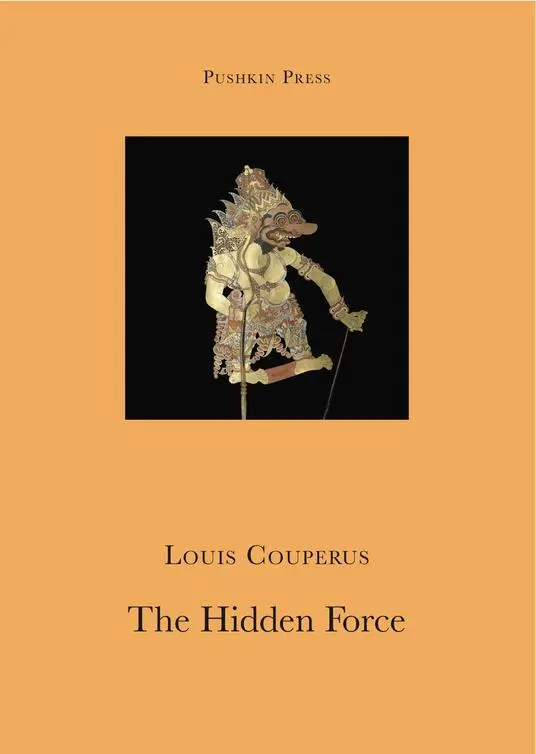
- Название:The Hidden Force
- Автор:
- Издательство:Pushkin Press
- Жанр:
- Год:2012
- ISBN:9781908968227
- Рейтинг книги:4 / 5. Голосов: 1
-
Избранное:Добавить в избранное
- Отзывы:
-
Ваша оценка:
The Hidden Force: краткое содержание, описание и аннотация
Предлагаем к чтению аннотацию, описание, краткое содержание или предисловие (зависит от того, что написал сам автор книги «The Hidden Force»). Если вы не нашли необходимую информацию о книге — напишите в комментариях, мы постараемся отыскать её.
The Hidden Force — читать онлайн бесплатно полную книгу (весь текст) целиком
Ниже представлен текст книги, разбитый по страницам. Система сохранения места последней прочитанной страницы, позволяет с удобством читать онлайн бесплатно книгу «The Hidden Force», без необходимости каждый раз заново искать на чём Вы остановились. Поставьте закладку, и сможете в любой момент перейти на страницу, на которой закончили чтение.
Интервал:
Закладка:
“A devil…”
“Perhaps. Un bon diable .”
“Are you starting to speak French?”
“Yes. With my departure to Paris in view… Something that protects me. I firmly believe that life has no hold on me, that I am invulnerable, to anything.”
“You’re getting superstitious.”
“Oh, I already was. Perhaps I’ve become worse. Tell me, have I changed recently?”
“You’re more nervous…”
“Not so indifferent any more?”
“You’re more cheerful, more amusing.”
“Was I boring before?”
“You were quiet. You were always beautiful, wonderful, divine… but rather quiet.”
“Perhaps I cared more about people then.”
“Don’t you care any more?”
“No, not any more. They gossip anyway… But tell me, haven’t I changed in more ways?
“Oh yes… more jealous, more superstitious, more nervous… What more do you want?…”
“Physically… haven’t I changed physically?…”
“No.”
“Haven’t I aged… Aren’t I getting wrinkles?”
“You? Never.”
“Do you know… I think I’ve got a whole future ahead of me… Something completely different…”
“In Paris?”
“Perhaps… Tell me, aren’t I too old?”
“For what?”
“For Paris… How old do you think I am?
“Twenty-five.”
“You’re fibbing: you know perfectly well that I’m thirty-two… Do I look thirty-two?”
“No, no…”
“Tell me, don’t you think the Indies is a rotten country… You’ve never been to Europe, have you?”
“No…”
“I only between the ages of ten and fifteen… Actually you’re a brown colonial and I’m white colonial…”
“I love my country.”
“Yes, because you think you’re some kind of Solo prince. That’s your absurd delusion in Pajaram… I, I hate the Indies… I spit on Labuwangi. I want to get out. I have to go to Paris. Will you come with me?”
“I’d never want to…”
“Not even if you consider that there are hundreds of women in Europe that you’ve never had?…”
He looked at her: something in her words, in her voice made him look up, a deranged, hysterical note, that had never struck him in the past, when she had always been the silently passionate lover, eyes half-closed, who immediately afterwards wanted to forget and become propriety itself. Something in her repelled him: he liked the supple, soft yielding of her embrace, with something indolent and smiling — as she used to be — not these half-crazed eyes and purple mouth, ready to bite. It was as if she could feel it, because she suddenly pushed him away, and said brusquely: “You bore me… I know you inside out. Go away…”
But he didn’t want to; he didn’t like a rendezvous that led nowhere, and he embraced her and asked…
“No,” she said abruptly. “You bore me. Everyone bores me here. Everything bores me…”
On his knees, he grasped her waist and pulled her towards him. She, laughing slightly, gave way a little, running her hand nervously through his hair. A carriage pulled up outside.
“Listen,” she said.
“It’s Mrs Van Does…”
“She’s back very early…”
“I don’t suppose she’s sold anything.”
“Then it’ll cost you ten guilders…”
“I expect so…”
“Do you pay her a lot? For our rendezvous?”
“Oh, what does it matter?…”
“Listen,” he said again, more attentively.
“That’s not Mrs Van Does…”
“No…”
“It’s a man’s footstep…”
“It wasn’t a dos-à-dos either: it rattled far too much.”
“It’s probably nothing…” she said. “Someone who’s got the wrong address. No one will come in here.”
“The man is coming round the back,” she said, listening.
They both listened for a moment. Then suddenly, with two or three steps through the narrow garden and on to the small back veranda, his , Van Oudijck’s figure loomed at the closed glass door, visible through the curtain. He had wrenched the door open before Léonie and Addy could change position, so that Van Oudijck saw the two of them: her, sitting on the divan, him kneeling in front of her with her hand, as if forgotten, still resting on his hair.
“Léonie!” thundered her husband.
The blood coursed and seethed through her veins with the shock of surprise, and in a single moment she saw a whole future: his fury, a divorce, a court case, the money that he would give her, everything jumbled together. But, as if through the force of will-power, the rush of blood immediately subsided and evened out, and she sat calmly, with terror visible in her eyes for only a further moment, until she could direct her steely gaze at Van Oudijck. And pressing Addy’s head with her fingers she signalled to him to stay as he was, kneeling at her feet, and as if in a state of self-hypnosis, listening in astonishment at the sound of her own, slightly hoarse voice:
“Otto… Adrien de Luce is asking me to put in a good word with you… for him… He is asking… for Doddy’s hand…”
She was still the only one speaking. She continued: “He knows that you have some objections. He knows that you are not very fond of his family, because they have Javanese blood… in their veins.”
She spoke as if some other voice were speaking inside her, and she had to smile at the phrase “in their veins”. She did not know why; perhaps it was because it was the first time in her life that she had used it in conversation.
“But,” she went on, “there are no financial objections, if Doddy wants to live at Pajaram… And the young things have known each other… for so long. They were afraid of you…”
Still no one else spoke.
“Doddy’s nerves have been bad for so long, she’s been almost ill. It would be a crime not to give your consent, Otto…”
Gradually her voice became melodious, and the smile appeared around her lips, but her eyes were still steely, as if she were threatening some mysterious wrath if Van Oudijck did not believe her.
“Come…” she said very softly, very sweetly, tapping Addy gently on the head with her still trembling fingers. “Get up… Addy… and… go… to… Papa…”
He got up mechanically.
“Léonie,” said Van Oudijck, hoarsely. “Why were you here?”
She looked up in complete astonishment and gentle sincerity.
“Here? I came to see Mrs Van Does…”
“And him?” said Van Oudijck pointing.
“Him?… He came to see her too… Mrs Van Does had to go out… Then he asked to speak to me… and then he asked me… for Doddy’s hand…”
All three of them were again silent.
“And you, Otto?” she asked, more harshly this time. “What brings you here?”
He looked at her sharply.
“Do you want to buy something from Mrs Van Does?”
“Theo said you were here…”
“Theo was right…”
“Léonie…”
She got up, and with her steely eyes indicated to him that he had to believe, that all she wanted was for him to believe.
“Anyway, Otto,” she said, once more gentle, calm and sweet, “don’t keep Addy waiting for an answer any longer. And you, Addy, don’t be afraid, and ask for Doddy’s hand from Papa… I have… nothing to say about Doddy: I’ve already said it.”
They now stood facing each other in the cramped central gallery, stuffy with their breath and bottled-up feelings.
“Commissioner,” said Addy at that point, “I wish to ask you… for your daughter’s hand…”
A dos-à-dos drew up outside.
“That’s Mrs Van Does,” said Léonie hurriedly. “Otto, say something, before she comes…”
“Very well,” said Van Oudijck gloomily.
Читать дальшеИнтервал:
Закладка:
Похожие книги на «The Hidden Force»
Представляем Вашему вниманию похожие книги на «The Hidden Force» списком для выбора. Мы отобрали схожую по названию и смыслу литературу в надежде предоставить читателям больше вариантов отыскать новые, интересные, ещё непрочитанные произведения.









Обсуждение, отзывы о книге «The Hidden Force» и просто собственные мнения читателей. Оставьте ваши комментарии, напишите, что Вы думаете о произведении, его смысле или главных героях. Укажите что конкретно понравилось, а что нет, и почему Вы так считаете.