Louis Couperus - The Hidden Force
Здесь есть возможность читать онлайн «Louis Couperus - The Hidden Force» весь текст электронной книги совершенно бесплатно (целиком полную версию без сокращений). В некоторых случаях можно слушать аудио, скачать через торрент в формате fb2 и присутствует краткое содержание. Год выпуска: 2012, ISBN: 2012, Издательство: Pushkin Press, Жанр: Классическая проза, на английском языке. Описание произведения, (предисловие) а так же отзывы посетителей доступны на портале библиотеки ЛибКат.
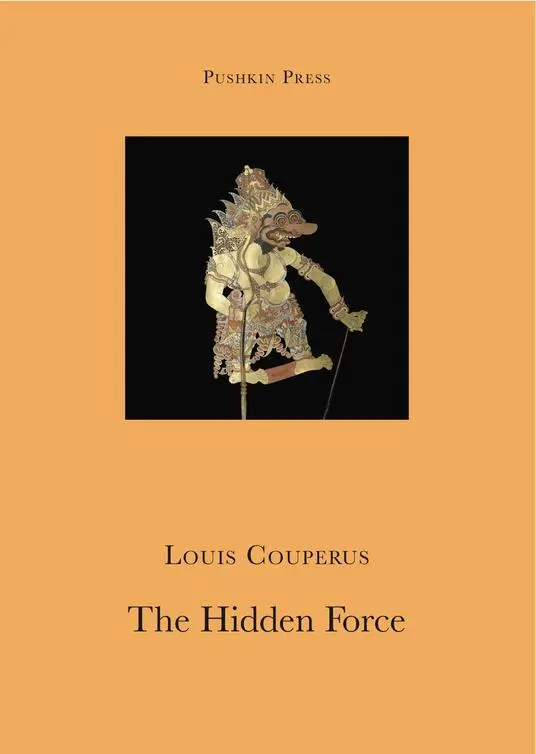
- Название:The Hidden Force
- Автор:
- Издательство:Pushkin Press
- Жанр:
- Год:2012
- ISBN:9781908968227
- Рейтинг книги:4 / 5. Голосов: 1
-
Избранное:Добавить в избранное
- Отзывы:
-
Ваша оценка:
The Hidden Force: краткое содержание, описание и аннотация
Предлагаем к чтению аннотацию, описание, краткое содержание или предисловие (зависит от того, что написал сам автор книги «The Hidden Force»). Если вы не нашли необходимую информацию о книге — напишите в комментариях, мы постараемся отыскать её.
The Hidden Force — читать онлайн бесплатно полную книгу (весь текст) целиком
Ниже представлен текст книги, разбитый по страницам. Система сохранения места последней прочитанной страницы, позволяет с удобством читать онлайн бесплатно книгу «The Hidden Force», без необходимости каждый раз заново искать на чём Вы остановились. Поставьте закладку, и сможете в любой момент перейти на страницу, на которой закончили чтение.
Интервал:
Закладка:
His passion for her began to turn to hate. He hated her now, with all the instinct of a Eurasian, which — for all his white skin — is what he was. He was more his mother’s son than his father’s. Oh, he hated her now, because he had felt his fear of punishment for an instant, and now he had forgotten everything. And his aim was to do her harm. How, he did not yet know, but he wanted to do her harm, so that she felt pain and sorrow. Pondering on this gave his small, murky soul a satanic sombreness. Although he didn’t think about it, he felt unconsciously that she was virtually invulnerable, and even that she secretly revelled in that invulnerability, and it made her more shameless and more indifferent every day. She was off to stay at Pajaram at every moment, on any pretext. The anonymous letters, which Van Oudijck still frequently gave her to read, no longer upset her; she became used to them. She returned them to him without a word: occasionally she even forgot about them and left them lying about on the back veranda. Once Theo read them there. He didn’t know in what sudden burst of lucidity, but he suddenly thought he recognized certain letters, certain strokes. He remembered the cottage in the native quarter in Pajaram — made half of bamboo and half of paraffin crates — where he had visited si-Oudijck with Addy de Luce, and the papers that he had hastily gathered together with an Arab. He vaguely remembered those same letters and strokes on a slip of paper on the floor. The blurred image flashed through his mind. But it was no more than a lightning bolt. His small, gloomy soul contained nothing but dull hate and murky calculation, but he was not clever enough to develop that calculation. He hated his father, from instinct and antipathy; his mother because she was a Eurasian; his stepmother because she no longer wanted him; he hated Addy, and for good measure he hated Doddy; he hated the world, because he had to work in it. He hated every job now that he had his office in Surabaya. But he was too lazy and insufficiently lucid to do any harm. He could not think of a way, however hard he tried, of harming his father, Addy and Léonie. Everything in him was vague, murky, discontented, unclear. What he wanted was money and a beautiful wife. Apart from that, there was nothing in him but his dull gloom and the malaise of a fat, blond colonial. And his thoughts rambled dimly and impotently on.
Up to now Doddy had always been very fond of Léonie, instinctively. But now she could deny it no longer: what at first she had thought was coincidence — her mama and Addy always seeking each other out in the same smile of attraction, one of them tugging at the other from one end of the room to the other, as if irresistibly — was not coincidence at all! And she too now hated Mama; Mama with her beautiful calm, her sovereign indifference. Doddy’s own passionate nature clashed with that other nature of milky-white Creole lethargy, which only now at this late stage, simply because of the propitiousness of fate, dared let itself be carried away, unconditionally. She hated Mama and that hate resulted in scenes, scenes of nervous anger, the screaming anger of Doddy at the taunting calm of Mama’s indifference, on all kinds of petty differences of opinion: about a visit, a ride on horseback, a hot sauce, a dress that one of them liked and the other did not. Léonie enjoyed teasing Doddy, just for the sake of it. Doddy would try to cry on her daddy’s shoulder, but Van Oudijck refused to take her side, and said that she should have more respect for Mama. But once, when she came to him for consolation, and he admonished her for her walks with Addy, she screamed that Mama herself was in love with Addy. Van Oudijck was angry and shooed her out of the room. But it all fitted together too well — the anonymous letters, his wife’s new flirtatiousness, Doddy’s accusation and what he had observed for himself at the recent parties — for him not to ponder and even brood on it. And now, once he started brooding and pondering about it, sudden memories flashed through his mind like bursts of lightning: of an unexpected visit; of a locked door; of a moving curtain; of a whispered word and a timidly averted glance. He combined all that and suddenly recalled those same subtle memories, linked to others from the past. It suddenly roused his jealousy, a man’s jealousy of his wife, whom he cherishes as his dearest possession. Jealousy rose in him like a gust of wind and blew through his concentration at work, confusing his thoughts as he sat working, making him suddenly leave his office while he was dealing with the court cases, to search Léonie’s room, lift up a curtain, even look under the bed. Now he no longer allowed her to stay at Pajaram, ostensibly because he did not wish to raise the hopes of the De Luces that Addy would ever marry Doddy. Because he did not dare to talk to Léonie about his jealousy… He could not contemplate Addy ever marrying Doddy. Though his daughter had Indies blood in her veins, he wanted a full-blooded European as a son-in-law. He hated anything to do with mixed race. He hated the De Luces, and the whole native Indies’ quasi-royal tradition of their Pajaram. He hated their gambling, their consorting with all kinds of Javanese chiefs: people whom as an official he gave their due, but apart from that regarded as necessary tools of government policy. He hated all their pretensions to be an old Indies family, and he hated Addy: a young man, supposedly employed in the factory, but who did nothing except chase after anything in skirts. As an older, industrious man, he found such a life insufferable. So Léonie would have to forgo Pajaram, but in the mornings she simply went to Mrs Van Does, and in her little house she met Addy, while Mrs Van Does herself went shopping in a cart, with two jars of diamonds and a bundle of batik bedspreads. In the evenings Addy went walking with Doddy and listened to her passionate reproaches. He laughed at her anger and took her in his arms until she clung to him gasping for breath: he kissed the accusations from her lips until, mad with love, she melted in his arms. They went no further, being afraid, especially Doddy. They walked beyond the compounds along the embankments through the rice fields, while swarms of fireflies in the darkness around them twinkled like tiny lamps; they walked arm in arm, hand in hand, enervated by physical desire that they never dared take to its logical conclusion. They explored each other all over with their hands, they made love with their hands. When she got home she was beside herself, furious with Mama, envying her calm, smiling fulfilment as she sat musing on a cane chair in her white peignoir, with a dusting of powder.
In the house, redecorated and whitewashed after the strange events — which were now over — there was a hatred that seemed to put out shoots everywhere like a diabolical flower, a hatred that surrounded the smiling woman who was too lethargic to hate and whose only pleasure was silent teasing: a jealous hatred now of father for son when he saw him sitting too often with his stepmother, despite Theo’s own hatred begging for something his father could not fathom; a hatred of a son for his father; a hatred of a daughter for her mother; a hatred that spelt disaster for all family life. Van Oudijck did not know how it had gradually come to this. Sadly, he regretted the time when he had been blind, when he had seen his wife and children only in the light in which he wanted to see them. That was over now. Just as the strange events had once risen into their life, so hatred rose like a pestilential miasma from the ground. Van Oudijck, who had never been superstitious, who had worked coolly and calmly in his deserted house, where incomprehensible spectral activity continued around him, who had read reports with hammering going on over his head and his whisky and soda turning yellow in his glass — Van Oudijck, for the first time in his life, now saw the dark looks of Theo and Doddy; he now suddenly found his wife becoming more brazen every day, hand in hand with young De Luce, knees almost interlocked; he saw himself changed, aged, gloomily spying; became superstitious, insurmountably superstitious, believing in a hidden force, hidden he knew not where in the Indies, in the soil of the Indies, in a deep mystery, somewhere, somewhere — a force that meant him no good, because he was a European, a ruler, a stranger on this mysterious, sacred shore. When he saw this superstition in himself, so new for him as a practical man, so utterly incredible in him — a man of simple, masculine sobriety — he was alarmed, as if at a latent madness he began to sense in himself.
Читать дальшеИнтервал:
Закладка:
Похожие книги на «The Hidden Force»
Представляем Вашему вниманию похожие книги на «The Hidden Force» списком для выбора. Мы отобрали схожую по названию и смыслу литературу в надежде предоставить читателям больше вариантов отыскать новые, интересные, ещё непрочитанные произведения.









Обсуждение, отзывы о книге «The Hidden Force» и просто собственные мнения читателей. Оставьте ваши комментарии, напишите, что Вы думаете о произведении, его смысле или главных героях. Укажите что конкретно понравилось, а что нет, и почему Вы так считаете.