Louis Couperus - The Hidden Force
Здесь есть возможность читать онлайн «Louis Couperus - The Hidden Force» весь текст электронной книги совершенно бесплатно (целиком полную версию без сокращений). В некоторых случаях можно слушать аудио, скачать через торрент в формате fb2 и присутствует краткое содержание. Год выпуска: 2012, ISBN: 2012, Издательство: Pushkin Press, Жанр: Классическая проза, на английском языке. Описание произведения, (предисловие) а так же отзывы посетителей доступны на портале библиотеки ЛибКат.
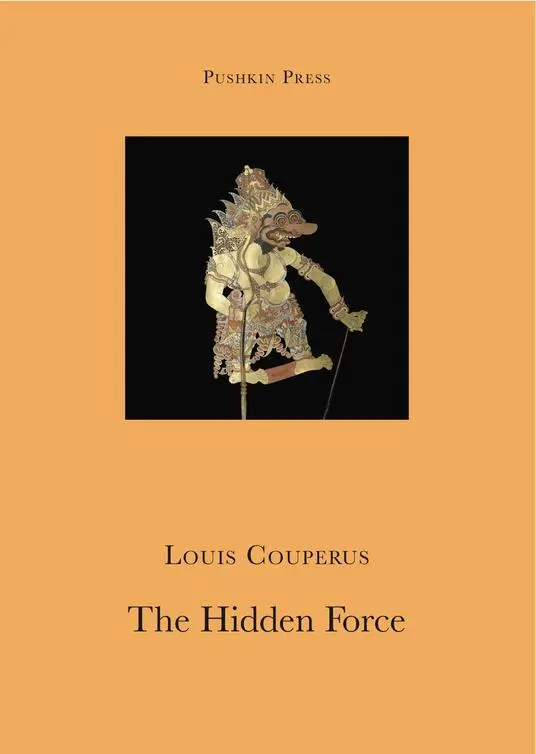
- Название:The Hidden Force
- Автор:
- Издательство:Pushkin Press
- Жанр:
- Год:2012
- ISBN:9781908968227
- Рейтинг книги:4 / 5. Голосов: 1
-
Избранное:Добавить в избранное
- Отзывы:
-
Ваша оценка:
The Hidden Force: краткое содержание, описание и аннотация
Предлагаем к чтению аннотацию, описание, краткое содержание или предисловие (зависит от того, что написал сам автор книги «The Hidden Force»). Если вы не нашли необходимую информацию о книге — напишите в комментариях, мы постараемся отыскать её.
The Hidden Force — читать онлайн бесплатно полную книгу (весь текст) целиком
Ниже представлен текст книги, разбитый по страницам. Система сохранения места последней прочитанной страницы, позволяет с удобством читать онлайн бесплатно книгу «The Hidden Force», без необходимости каждый раз заново искать на чём Вы остановились. Поставьте закладку, и сможете в любой момент перейти на страницу, на которой закончили чтение.
Интервал:
Закладка:
Strong as he had been during the strange events, which he had been able to ward off with a single threat of force, this superstition — the aftermath of those events — found a weakness, a vulnerable spot in him. He was so surprised at not understanding himself that he was frightened of going mad, and yet he went on fretting. His health had been undermined by the beginnings of liver disease and he studied his yellow complexion. Suddenly he thought of poisoning. The kitchen was investigated and the cook was questioned, but nothing was found. He realized he was worrying about nothing, but the doctor diagnosed a swollen liver and prescribed the usual diet. What in other circumstances he would have considered quite normal — a very common illness — he now suddenly found odd, a strange phenomenon, about which he fretted. It affected his nerves. He now suffered from sudden bouts of tiredness while working, and from pounding headaches. His jealousy made him agitated; he was seized by tremors of restlessness. He suddenly realized that if there had been hammering above his head now, if betel juice had been spewed around him, he wouldn’t be able to stay in the house. And he believed in a hatred that rose in clouds out of the resentful earth like a pestilence. He believed in a force, deeply hidden in things in the Indies, in nature in Java, the climate of Labuwangi, in the mumbo-jumbo — that was what he still called it — that sometimes enables the Javanese to outsmart the Westerner, and gives him power, mysterious power, not enough to free himself from the yoke, but sufficient to make people ill, make them languish, to taunt and torment them, to haunt them incomprehensibly and horribly — a hidden force, a hidden power, hostile to our Western temperament, our blood, our body, our soul, our civilization, to everything we see fit to be and to think. He had been illuminated as if by a sudden single light, not as a consequence of thinking. He had been illuminated as if with a single jolt of revelation, completely at odds with the logic of his everyday life, his everyday train of thought. He suddenly saw it before him in a single vision of terror, like the light of his approaching old age, just as the very old sometimes suddenly see the truth. Yet he was still young, he was strong… And he felt that unless he could divert his crazy thoughts they might make him ill, weak and miserable, for ever, for ever…
For him especially, as a simple practical man, this sudden reversal was almost unbearable. What someone with a morbid cast of mind would have contemplated calmly, left him thunderstruck. He had never thought that there might be things in life somewhere deep down, mysterious, stronger than will-power, intellectual power. Now — after the night-mare, which he had bravely overcome — it appeared that the nightmare had exhausted him after all and infected him with all kinds of weakness. It was unbelievable, but now, in the evenings when he was working, he listened to night falling in the garden, or the rat stumbling around above his head. And then he would suddenly get up, go into Léonie’s room and look under her bed. When he finally discovered that many of the anonymous letters by which he was pursued were the work of a half-blood claiming to be his son, and even known in the compound by Van Oudijck’s own surname, he felt too hesitant to investigate the matter, because of what might come to light that he had forgotten, from his time as a controller long ago in Ngajiwa. Now he wavered, where in the past he had been resolute. Now he was no longer able to order his memories with such certainty that he could swear he had no son, sired at that time almost without knowing it. He did not have a clear memory of the housekeeper he’d had before his first marriage. He preferred to let the whole business of the anonymous letters go on smouldering in their dark recess, rather than investigate and stir things up. He even had money sent to the half-caste who claimed to be his son, so that he would not abuse the name that he had appropriated, by asking for gifts of chicken, rice and clothes all over the compound. These were things that si-Oudijck asked of ignorant village folk, whom he threatened with the vague displeasure of his father, the master over in Labuwangi. So to avoid the villagers being threatened any longer with his wrath, Van Oudijck sent him money. That was a sign of weakness, and in the past he would never have done it, but now he developed a tendency to pour oil in troubled waters, to make excuses, no longer to be so unbending and severe, and to blur and tone down everything that was black and white. Eldersma was sometimes amazed when he now saw the Commissioner — who had once been so resolute — in two minds, saw him giving way in administrative matters, disputes with tenants, in a way he never would have done in the past. A laxness in the operation of the office would have crept in, had not Eldersma taken the work off Van Oudijck’s hands, and made himself even busier than he already was. It was widely rumoured that the District Commissioner was a sick man. And it was true that his complexion was jaundiced, and his liver painful; the slightest thing set off his palpitations. The atmosphere in the household was neurotic, with Doddy’s tantrums and outbursts, the jealousy and hatred of Theo, who was back home after having abandoned Surabaya. Only Léonie remained triumphant, always beautiful, white, calm, smiling, content, exulting in the enduring passion of Addy, whom she was able to enchant as a sorceress of love, a mistress of passion. Fate had warned her, and she kept Theo at arm’s length, but apart from that she was happy, content.
Then there was suddenly a vacancy in Batavia. The names of two or three commissioners were mentioned, but Van Oudijck had the best chance. He fretted about it, he was apprehensive: he didn’t like Batavia as a district. He would not be able to work there as he had worked here, devoting himself assiduously to promoting so many different interests, both cultural and social. He would have preferred an appointment in Surabaya, where there was a lot happening, or in one of the Principalities, where his tact in dealing with the Javanese nobility would have stood him in good stead. But Batavia! For a commissioner, the least interesting district as an official: for the position of district commissioner the least flattering aspect was the arrogance of the place, close to the governor general, right in the midst of the most senior officials, so that the commissioner, virtually all-powerful elsewhere, was no more than another senior official among members of the Council of the Indies, and too close to Buitenzorg, with its conceited secretariat, whose bureaucracy and red tape were in conflict with administrative practice and the actual work of the commissioners themselves.
The possibility of his appointment threw him into complete confusion, and made him jumpier than ever, now that he would have to leave Labuwangi at a month’s notice, and sell his household effects. It would be a real wrench to leave Labuwangi. Despite what he had suffered there, he loved the town and especially his district. Throughout his territory in all those years he had left traces of his industry, his concentration, his ambition, his love. Now, in less than a month, he might have to hand it all over to a successor, tear himself away from everything he had lovingly provided and promoted. And the successor might change everything, and totally disagree with him. It provoked a melancholy gloom in him. The fact that a promotion would also take him closer to retirement, meant nothing to him. That future of idleness and boredom as old age approached was a nightmare to him.
Then his possible promotion suddenly became such a pathological obsession that the improbable happened and he wrote to the Director of the Colonial Service and the Governor General requesting that he be left at Labuwangi. Little of these letters leaked out; he himself said nothing about them either in the family circle or among his officials, so that when a younger commissioner, second class was appointed as commissioner of Batavia, people talked about Van Oudijck having been passed over, without knowing that it had been at his own instigation. Searching for a reason, people raked up the dismissal of the Prince of Ngajiwa, and the ensuing strange happenings, but it was felt that neither was really reason enough for the government to pass over Van Oudijck.
Читать дальшеИнтервал:
Закладка:
Похожие книги на «The Hidden Force»
Представляем Вашему вниманию похожие книги на «The Hidden Force» списком для выбора. Мы отобрали схожую по названию и смыслу литературу в надежде предоставить читателям больше вариантов отыскать новые, интересные, ещё непрочитанные произведения.









Обсуждение, отзывы о книге «The Hidden Force» и просто собственные мнения читателей. Оставьте ваши комментарии, напишите, что Вы думаете о произведении, его смысле или главных героях. Укажите что конкретно понравилось, а что нет, и почему Вы так считаете.