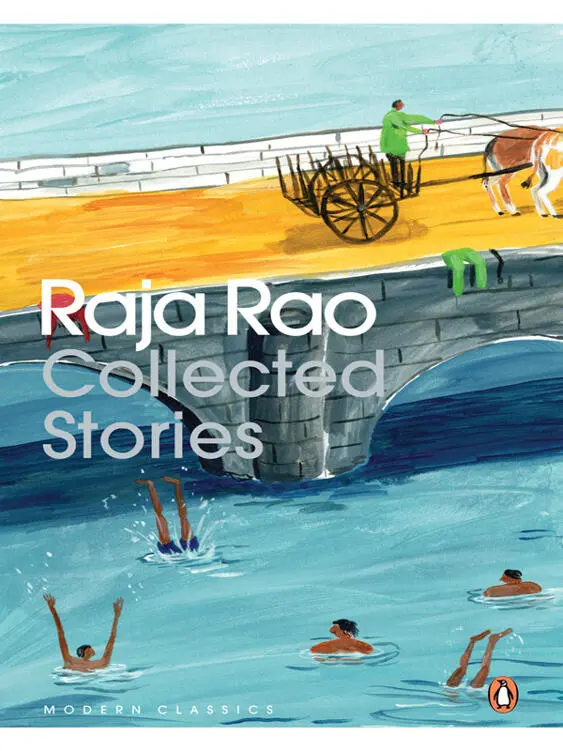
Raja Rao - Collected Stories
Здесь есть возможность читать онлайн «Raja Rao - Collected Stories» весь текст электронной книги совершенно бесплатно (целиком полную версию без сокращений). В некоторых случаях можно слушать аудио, скачать через торрент в формате fb2 и присутствует краткое содержание. Год выпуска: 2014, Издательство: Penguin, Жанр: Классическая проза, на английском языке. Описание произведения, (предисловие) а так же отзывы посетителей доступны на портале библиотеки ЛибКат.
- Название:Collected Stories
- Автор:
- Издательство:Penguin
- Жанр:
- Год:2014
- ISBN:нет данных
- Рейтинг книги:5 / 5. Голосов: 1
-
Избранное:Добавить в избранное
- Отзывы:
-
Ваша оценка:
Collected Stories: краткое содержание, описание и аннотация
Предлагаем к чтению аннотацию, описание, краткое содержание или предисловие (зависит от того, что написал сам автор книги «Collected Stories»). Если вы не нашли необходимую информацию о книге — напишите в комментариях, мы постараемся отыскать её.
Collected Stories — читать онлайн бесплатно полную книгу (весь текст) целиком
Ниже представлен текст книги, разбитый по страницам. Система сохранения места последней прочитанной страницы, позволяет с удобством читать онлайн бесплатно книгу «Collected Stories», без необходимости каждый раз заново искать на чём Вы остановились. Поставьте закладку, и сможете в любой момент перейти на страницу, на которой закончили чтение.
Интервал:
Закладка:
He had tears in his eyes.
‘No, no, do not weep, brother. As you say we will go far, far, as far as you like. . to Hyderpur. You say there one can become rich in the twinkling of an eye. Well then, I’ll go with you, I will.’
‘What an angel for a wife!’ beamed Motilal, ‘how blessed! We shall go to Hyderpur and become rich in a day, fabulously rich in the twinkling of an eye. And when we go back to our own town they will treat us like veritable gods. They will say, ‘Look! look at them, sister, look at Bhata Motilal! His father died before he was born and his mother died but two months after he saw light, and yet look how rich he has become! The gods have helped him, surely. He lived, sister, like a sacred bull of the street which wanders far and wild and eats whatever it finds. He lived by begging, and now he is rich, so wealthy.’ They will envy and fear me, Beti.’ Beti could not help weeping. She was so subdued to happiness.
‘Yes! When we go and tell Mother we are wealthy, how splendid it all will be! She shall toil no more. And she shall live with us.’
‘We shall see. . ’ Motilal looked towards the town, which was sinking away into the vast darkness. Here and there a light shone, and he lay down beside Beti and slept.
‘So, after many hungry months,’ continued Narasimha, ‘still begging and still wandering, sick or lame, they reached Hyderpur. They found that dirty hovel they now live in. It had neither roof nor walls. They went to the owner and asked him for an honest deal. He was but too happy to get rid of it. And with the necessary hagglings he was willing to part with it for— how much do you think? — fifty rupees, a damned pittance of five times ten rupees. They bought it, and while they were trying to put up the wall, and lay the roof, they still sang and begged. Once a dog begins to eat filth,’ said Narasimha contemptuously, ‘you cannot ask him to stop. So, after a month’s work — still begging— they were able to have a thatch over their heads. Then with the rest of the money they went to the Sunday Fair at Bolarum and bought a few seer s of gram, sugar and sesame and thus started their shop. Now, as everybody knows, they are overflowing with money, and yet how they live, these dogs, these curs, they live like pariah’s pigs. . ’
Ananda said nothing. He listened to the story with real interest; but to join the other in his abuse was beyond his inmost feelings. He had just come to Motilal’s shop. His stepmother wanted sugar for the evening dinner. Bidding a distant goodbye to Narasimha, he ran out. He ran to Motilal’s gram shop.
The shop could not have changed much in its appearance since they had settled down there. The roof was of zinc sheets, with a few beams that had, at least half a century of life. The only addition to the house was a little wooden byre, which they had put up for the cow they had newly bought. The fodder was carefully piled upon the roof, and nobody seemed to remember if ever it had been pulled down these two years or more. The cow wandered all day from one dustbin to another, eating chips of vegetables that were thrown away, or, as it was rumoured, actually entered latrines and cleared them. Anyway she gave the seer of milk she had to, which with a little generosity under the tap became a seer and a half, and Beti Bai always had helpless clients to buy the milky liquid. Ananda himself had once paid eight pice for a quarter of a seer —half water and half God knows what! But it was a good thing to have some sort of milk. If not, what a shame! What would the guests think!
To come back to the shop itself: it consisted of a small verandah, some ten feet by fifteen, which opened directly on the road. In one corner was the grocery. Small drawers, some fifty or so, were fixed into the wall, each filled with pepper, ginger, or sesame seeds. Just by it, between four open boxes of rice, wheat, salt and tamarind, was an oily seat where Motilal usually sat. When people had to wait, they generally squatted down by one of the boxes and thus swept away the dust that had been gathering for some considerable time. On the other side, projected into the road, was a wooden platform — an old bedstead perhaps, with a few planks on either side — which contained the various grams in bamboo baskets. There was the sugared gram, the fried gram, the Bombay gram cakes, and occasionally perfumed gram balls, and sticks of sugar; and almonds. It was Beti Bai who usually sat in the gram shop. She had made a duster out of an old cloth, and she kept off the flies by flicking it now here, now there. But, in spite of this unfailing care, the dust that came from the road gently settled down upon the gram. It did not matter much, as Beti once half seriously confessed to a friend from the bazaar; it added to the weight.
Behind Beti, by the kitchen door on the left, was a small platform on which lay almost all the things they possessed. A bedding roll, tightly folded and carefully tucked in, used to lie prominently on it. From the many holes in the carpet, one could easily guess what the bedding may have contained. Perhaps a blanket, a sheet, and an old mattress, thin like the skin of a cow. Beside the bedding were a few big, bell-metal vessels that were used for frying and baking the gram. Nobody had as yet seen where the safe was. There were rumours that they kept it in a hole in the earth, discreetly covered by the gunny-bag seat of Motilal in the grocery.
Between the gram platform and the platform where the bedding lay was a narrow space that served now for eating, now for grinding and now for sleeping. It opened on the kitchen — a small tin shed that had protruded, much against the Municipal Inspector’s warnings, into the little lane. One of these days, the Inspector was going to come again. But his servants were clever fellows. They had been given more than an anna’s worth of grams some three or four times, and they had informed the boss that it was all perfectly in order. Well, if he came, if he actually came, a rupee or two in his hands and everything would go smoothly. Motilal had known ten such inspectors, and had sweet well silenced them.
The one happy element in the shop was the little green parrot in the cage, which cried out ‘Ram, Ram’ to all the clients who entered. Everybody who came in offered a few grams to her, and thus she had always more than enough to eat. Beti Bai loved her as though she were her own child. Especially since their son Chota had run away with that woman, they had found the little parrot to be their only living solace. She cost nothing, and was always so active and affectionate. When Beti quarrelled with Motilal, which happened almost every day, she had only to turn to the parrot and call ‘Mithu, Mithu’, and little Mithu would reply, hopping round and stretching her feathers, ‘Ram, Ram, Mai. . Ram,’ ‘Pyari, Mithu,’ ‘Ram, Ram, Mai. . Ram.’
Motilal must now have been over fifty. He was tall, thin, and rather wrinkled in the face. His steel-black eyes had something wanting in lustre. They seemed seated in their sockets like rats in a hole. And, too, like rats in a hole they were shrewd when you least observed them. His wiry hands, with bulging blue veins, shivered at every shake or touch. For ages asthma had kept him awake night after night, and but for his hookah, life would have been intolerable. The hookah was comforting for the moment. But in the long run, it had almost totally ruined his health. In spite of Beti Bai’s constant nagging, he smoked almost every minute of the day. In fact he had sometimes smoked so much that the very water of the hookah had begun to stink. But he coughed away, spat away, and smoked on, careless of all but the warm caress of the smoke in his throat. It was so delicious to have a friend like that. When he had to weigh things, he reluctantly put it aside for a moment. And no sooner had he folded the balance down than he would snatch back the hookah with the eagerness of a miser, and begin his ‘gud. . gud. . gud . . ’ It made such a queer gurgling noise. Children who came to buy a few peppermints or sugar-candy would usually sit and listen to the gurgle. And when they went out they would clap their hands, gurgle deeply in their throats and laugh. Behind them Motilal would still be at his hookah and it would still be gurgling, ‘gud. . gud. . gud. . ’
Читать дальшеИнтервал:
Закладка:
Похожие книги на «Collected Stories»
Представляем Вашему вниманию похожие книги на «Collected Stories» списком для выбора. Мы отобрали схожую по названию и смыслу литературу в надежде предоставить читателям больше вариантов отыскать новые, интересные, ещё непрочитанные произведения.










Обсуждение, отзывы о книге «Collected Stories» и просто собственные мнения читателей. Оставьте ваши комментарии, напишите, что Вы думаете о произведении, его смысле или главных героях. Укажите что конкретно понравилось, а что нет, и почему Вы так считаете.