Raja Rao - Collected Stories
Здесь есть возможность читать онлайн «Raja Rao - Collected Stories» весь текст электронной книги совершенно бесплатно (целиком полную версию без сокращений). В некоторых случаях можно слушать аудио, скачать через торрент в формате fb2 и присутствует краткое содержание. Год выпуска: 2014, Издательство: Penguin, Жанр: Классическая проза, на английском языке. Описание произведения, (предисловие) а так же отзывы посетителей доступны на портале библиотеки ЛибКат.
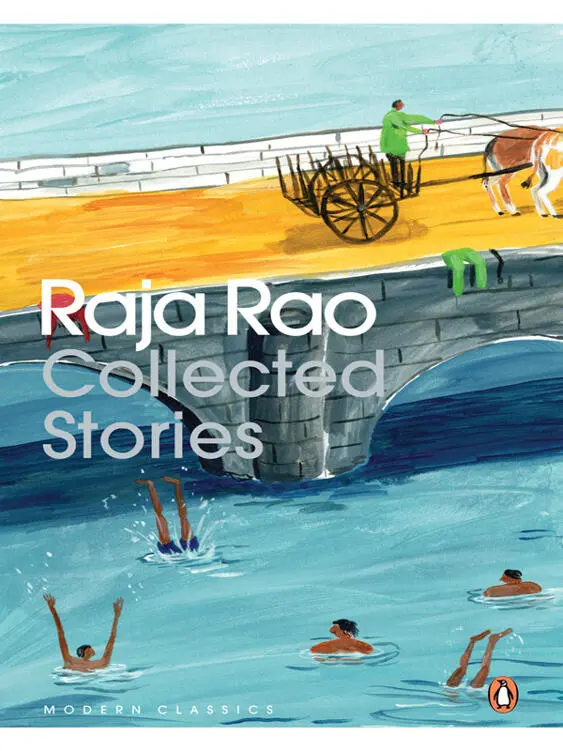
- Название:Collected Stories
- Автор:
- Издательство:Penguin
- Жанр:
- Год:2014
- ISBN:нет данных
- Рейтинг книги:5 / 5. Голосов: 1
-
Избранное:Добавить в избранное
- Отзывы:
-
Ваша оценка:
Collected Stories: краткое содержание, описание и аннотация
Предлагаем к чтению аннотацию, описание, краткое содержание или предисловие (зависит от того, что написал сам автор книги «Collected Stories»). Если вы не нашли необходимую информацию о книге — напишите в комментариях, мы постараемся отыскать её.
Collected Stories — читать онлайн бесплатно полную книгу (весь текст) целиком
Ниже представлен текст книги, разбитый по страницам. Система сохранения места последней прочитанной страницы, позволяет с удобством читать онлайн бесплатно книгу «Collected Stories», без необходимости каждый раз заново искать на чём Вы остановились. Поставьте закладку, и сможете в любой момент перейти на страницу, на которой закончили чтение.
Интервал:
Закладка:
‘When did they come here?’ I asked.
‘Over a month ago. Soon after Sata’s death. . ’ It made me sad to think of aunt Sata. She was the dearest of women; she had died in childbirth.
‘How is She?’ I managed to say, trembling.
‘Who?’
‘She. . ’ I pointed towards one of the doors that seemed, I cannot say why, to be Akkayya’s room.
‘You mean Akkayya?’ she said, pained.
‘Yes!’
‘Well!’ here my grandmother had tears in her eyes. ‘Well, my son, she is between life and death. I wish she would die soon.’ It sent a sharp shiver through my back. For a brief moment we did not say a word to each other.
‘Anyhow,’ she began, trying to change the subject, ‘tell me, how is everybody at home. Your father? Your sisters?’
‘They’re all well,’ I said casually. My eyes were strangely drawn towards that door — Akkayya’s door. Was she there?
In the meanwhile the milk-woman came and my grandmother went into the kitchen to get a vessel. I looked around. The morning was breaking. The sun was spreading his feathers like an amorous peacock. But it was still very cold. And somehow even the mango tree I loved so much was sad and sickly. The bullock-carts were creaking along, and the dust of the morning was rising. I was not going to stay with my grandmother. I had decided to go to my uncle’s and had dropped in here only to pay my respects to her and to inquire after Akkayya. Now I must be going. . Somehow I felt breathless and worm-eaten. Even my grandmother’s face, which was always lively and young, looked as though she were being strangled. No, I must be going. But my grandmother insisted that I should stay and have a cup of coffee. I could not refuse it. But I could not stay there any longer. Telling my grandmother I would go and wash my face at the well, I walked out into the courtyard. The raw air, the pomegranates and the sky above seemed to give the sense of a fresher reality. I sat on the wall of the well, thinking of my grandfather, aunt Sata, Akkayya, and all those whom I had loved and lived with, and who were slowly disappearing one by one.
The children came out. Naga was a little girl of nine, pale, anaemic and quiet. Ramu was about four, plump, wild and mischievous. I tried to talk to them and told them I was their cousin. But that did not seem to interest them. ‘One more of us,’ they seemed to say and walked away to wash their faces. Even in their countenance there was something heavy, sad, decaying. Death had entered the house like a cobra. When would He leave it?
The coffee was ready. Naga came to call me. I had not yet washed and so I simply threw a little water on my face, dried it and went in. Nobody was to speak loudly. Everything was hushed and uneasy.
‘Do you want to see her?’ my grandmother asked. I felt as though I were going to spit in my cup.
‘No,’ I said, nodding my head uncomfortably.
‘She calls you a thousand times a day, and says she will not die without seeing you. . ’ She was in tears. I coughed.
‘She wants badly to see you, my child. She says everybody in Talassana hates her, only you, your father and your own mother ever cared for her. . Oh, to see her weep! She weeps like a mad woman. And when she shrieks the tiles seem to fly to the skies! Suppose you see her?’
‘No. I do not want to bother her.’ I lied.
‘It’s no bother. She would weep to see you. My child, you must!’
‘Yes, it is true,’ added Naga. ‘She always calls you and tells us you were born like a prince and you would be one. She tells us so many stories about you.’ She laughed, and hid her face between her knees.
‘No,’ I said, ‘I will not see her now. As I stay in town for another two or three days — we shall see.’ My grandmother understood me and didn’t insist any more.
‘My child,’ she exclaimed, sorrowful and breathless, ‘my life here is really dreadful. Oh! to be living thus. . ’ She wept. ‘These children are already a burden, and with them, Akkayya. . No. Not a moment to breathe and not a moment to call my own. And then—’ Here I heard from a neighbouring room Akkayya’s shrieking voice.
‘Naga! Naga! You dirty widow, you daughter of a prostitute, you donkey-whore! Come, or I’ll flay you alive!’
Naga squirmed in her place. Her day was beginning. I must confess it sent a chill through me as though rising from a rotting well.
‘Naga! Naga! hè, hè Naga! you dirty donkey-whore!’
My grandmother nodded her head and asked Naga to answer.
‘You see, my child, that is how it is twenty-four hours in the day. I do not know where she learnt these filthy words of abuse, but not even a pariah would use them before his wife, such are her curses. “Naga, Naga.” Always “Naga”. This poor child, beaten and skinned to her last bone by her father, has come to live here, and her life as you see is worse than a dog’s life. She has to take food to her, put it into her mouth, clean her bed, sweep the floor, and for absolution sit listening to her mad, mad stories. But you see, my child,’ continued my grandmother, trying to be a little kinder to her sister, ‘you see, sometimes she folds these two children in her arms and weeps over them for their unhappiness. She calls them by all sorts of endearing names — my parrot, my calf, my diamond. .c.’
‘That’s true! She is sometimes very good,’ agreed Naga.
‘Naga, you concubine, Naga, you wretch, Naga, you donkey. . ’ recommenced Akkayya. There was a painful silence for a moment. We all stopped breathing. Naga sipped at her coffee.
‘Does she ever get up?’ I ventured.
‘Never. We carry her to the bath and bring her back. All the morning I do nothing but wash her dirty clothes, we have two beds for her which we change from day to day, then wash her saris, take her to the bath, wash her myself, then taking her back we put her in her new bed.’ Here she seemed to draw back her hands and wipe them with her sari to feel sure the foul smell was not sticking to them. ‘She is never silent even for a moment, and we can never have anybody here or go to anybody.’
‘But,’ I said, ‘why not?’
‘Why? The moment she hears me going down the steps she begins to shriek for me and weep and roll in her bed till I go to her. And when I go she asks me to sit, and when I sit, she laughs at me and tells me a story I have heard a million times before.
‘You see, my son, that is my life. At this age — I am sixty-two now — I cannot say I shall go on pilgrimage and lead a pious life. Nothing but curses in my ears, instead of Rama, Rama, and nothing but washing filth the whole day instead of sacred baths in the Ganges and the Jumna. . ’ She began to sob. What could I do? Again it started:
‘Naga, you wretch, Naga, Naga. . Naga. I will burn you today if you do not come,’ Akkayya shrieked.
‘Go, Naga, go,’ said my grandmother, and the little girl limped out of the room mechanically.
‘Listen! Listen and hear what she will tell her.’ I went nearer the wall.
‘You dirty whore, you dog-born, you donkey’s wife, this is how you come when I call you! I have been shouting for you for hours. Oh, I wish I could get up and tear your skin like my sari. You dirty donkey-whore! Why don’t you all let me die? Leave me, throw me into the well and drink a good, hot seer of milk?
You would, wouldn’t you? You cur, dirty cur. Why don’t you go and sleep with the servant, you concubine?’
‘Tell me, what do you want?’ said Naga. Her voice was firm and indifferent.
‘What do I want? What do I want? I want some coffee to drink, some hot water to wash with. And you are a dear, a darling. Come and kiss me.’
Naga came back and sat with us as though nothing had happened. Hardly had she sipped her coffee once than Akkayya again called out:
Читать дальшеИнтервал:
Закладка:
Похожие книги на «Collected Stories»
Представляем Вашему вниманию похожие книги на «Collected Stories» списком для выбора. Мы отобрали схожую по названию и смыслу литературу в надежде предоставить читателям больше вариантов отыскать новые, интересные, ещё непрочитанные произведения.







Обсуждение, отзывы о книге «Collected Stories» и просто собственные мнения читателей. Оставьте ваши комментарии, напишите, что Вы думаете о произведении, его смысле или главных героях. Укажите что конкретно понравилось, а что нет, и почему Вы так считаете.