Raja Rao - Collected Stories
Здесь есть возможность читать онлайн «Raja Rao - Collected Stories» весь текст электронной книги совершенно бесплатно (целиком полную версию без сокращений). В некоторых случаях можно слушать аудио, скачать через торрент в формате fb2 и присутствует краткое содержание. Год выпуска: 2014, Издательство: Penguin, Жанр: Классическая проза, на английском языке. Описание произведения, (предисловие) а так же отзывы посетителей доступны на портале библиотеки ЛибКат.
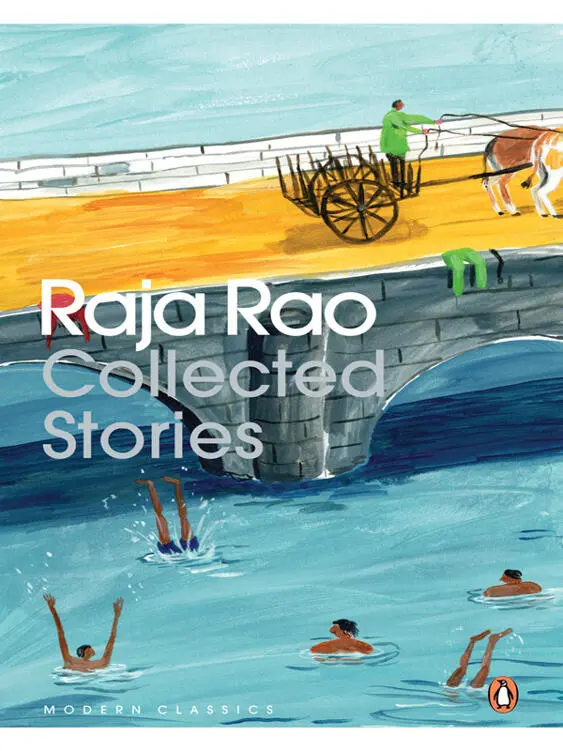
- Название:Collected Stories
- Автор:
- Издательство:Penguin
- Жанр:
- Год:2014
- ISBN:нет данных
- Рейтинг книги:5 / 5. Голосов: 1
-
Избранное:Добавить в избранное
- Отзывы:
-
Ваша оценка:
Collected Stories: краткое содержание, описание и аннотация
Предлагаем к чтению аннотацию, описание, краткое содержание или предисловие (зависит от того, что написал сам автор книги «Collected Stories»). Если вы не нашли необходимую информацию о книге — напишите в комментариях, мы постараемся отыскать её.
Collected Stories — читать онлайн бесплатно полную книгу (весь текст) целиком
Ниже представлен текст книги, разбитый по страницам. Система сохранения места последней прочитанной страницы, позволяет с удобством читать онлайн бесплатно книгу «Collected Stories», без необходимости каждый раз заново искать на чём Вы остановились. Поставьте закладку, и сможете в любой момент перейти на страницу, на которой закончили чтение.
Интервал:
Закладка:
During one of these holiday visits to my grandfather — I was about ten or eleven years old then — somehow it struck me that I should know more about Akkayya. I wanted to ask somebody, but going to one of my aunts or cousins I would be so overcome with fear that I would excuse myself and run away awkwardly. At last one day I got a very good chance. Uncle Shama loved me and he often called me to go and lie by him. That evening aunt Nagamma was busy in the kitchen, and being alone I took courage to ask who Akkayya was and why she lived with us. What uncle Shama told me I cannot quite remember, but it is something like what I am going to relate to you.
She was a sister of my grandmother, and was the eldest of eight children, three girls and five boys. Her parents were very rich people and my great-grandfather had even been a Prime Minister once. That was, as you must remember, over a hundred years ago. Akkayya was a pretty little girl, full of charm and intelligence. When she was five she had already begun to discuss the holy scriptures with her father, and her horoscope foretold a most brilliant marriage. Her father, when a Prime Minister, had known the Ministers of many neighbouring states. I do not know if you have ever heard of the Gagana State, on the banks of the Cauvery, just where she falls down the precipice into the frothy abysm below. It was a small state but it had a good king and his Minister Ramakrishnayya was an intelligent and able administrator. Ramakrishnayya had often come and stayed with Akkayya’s father, that is my great-grandfather, and having lately lost his second wife, Ramakrishnayya was intending to marry again. When Akkayya’s father heard of it he straightway sent a Brahmin to negotiate for his daughter’s marriage. Ramakrishnayya had never expected to be able to marry the daughter of a former Prime Minister of Mysore State; and he was so flattered with the proposal that he came running and accepted the hand of Akkayya with becoming humility and grace. Akkayya must have been about eight or nine years of age then, and Ramakrishnayya, I cannot well remember, but his son had already three children of his own. The whole of Mysore was invited for the marriage week, and if uncle Shama is to be believed — he had, I must say, a very rich imagination— the Maharaja himself came to grace the holy occasion. The marriage over, the bridegroom’s party left for Gagana, amidst hymns and holy music, leaving the little wife to come of age. Not very long after, Akkayya’s father received a letter to say that Ramakrishnayya had died of ‘some fever’, and they wept and they moaned for a few days, and after that everything went on as usual. Akkayya did not understand anything of what had happened and she perfectly enjoyed the doll-show — for it was Dassera then. They only asked her not to put on the kumkum mark and she did not mind that in the very least.
Years passed. Akkayya came of age, and as was meet for a Brahmin widow, she was taken to Rameshwaram, shaven and was then duly sent to her husband’s family in Gagana where she was received with appropriate respect and affection. Her stepson, now about forty-five years of age, treated her as one of his own daughters, some of whom were married and had children of their own. Akkayya soon became the mistress of the kitchen — she was the only widow there — and she did the cleaning of the vessels and the sweeping of the floors, as though she were born with a vessel at her waist and a broom in her hand. For four or five years she lived on thus and she was more than happy in that ‘full house’; there were always children to play with, girls to talk to, cows to milk, and the temple to go to; oh, it was altogether such an easy, quiet life. Her daughterin-law, that is her stepson’s wife, was a good woman, and as she was three months in the year in confinement, three other months in pregnancy, and nearly half the rest of the time in bed due to a fever or a cough, she did not bother Akkayya at all, and everything was perfect. When she went to the temple everybody stepped aside saying, ‘The Minister’s wife,’ ‘The Minister’s wife,’ and she felt so proud of being thus addressed that she went there more than ever before. Akkayya herself had told me a story, which I had completely forgotten and would never have remembered had not uncle Shama referred to it again. One day she wanted to see the waterfall. She had heard the bhus-bhus of the waters but had never once gone anywhere near it. So a trip was duly arranged, and one of the police officers led the family of the Minister to the place where the Cauvery gallops forth into the narrow gorge, gurgling and swishing and rising majestically into the air like a seven-headed cobra. What do you think Akkayya saw? Would you believe me, she actually saw with those very eyes she had — and they were sharp I assure you — she actually saw miles and miles of thick, strong jute rope swallowed by the abysm and yet it went deeper and deeper still. . and God only knew how much deeper the cataracts were. They told the Minister’s family that the deeps communicated with the centre of the earth. Oh, how wonderful!
Akkayya was now about eighteen. She had always loved children and she began to ask why she could not have some. Uncle Shama added his own opinion about it by saying — and I hardly understood it then — that women want children above all and they are jealous of those who have any. Whatever it be, Akkayya began to quarrel with her step-granddaughter and in a year things had grown so difficult that her stepson wrote to her brothers, my great-grandfather was dead by that time, to take her away, which they soon did. But it is a pity that her stepson should have been so mean as to say that she wanted to poison one of his daughters or that she wanted to sleep with him. I assure you, Akkayya was as pure a thing as the jasmine in the temple garden. When people hate others they always mix milk and salt. . Anyway Akkayya was back in her family, and everybody was happy about it.
But that could not go on very long either, as her brothers did not agree between themselves and they quarrelled so violently with one another that the family had to break up, the five brothers taking their own share of the patrimony. But nobody wanted to take Akkayya, for even here she had begun to be jealous of her sisters-in-law, all of whom had many, many children. It was then my grandmother asked her to come and stay with her in Talassana, and for fifty years or more she lived in our family without quarrels or complaints. My grandmother was a sharp woman — God give her peace at least in her next life! — and she knew how to treat people, the chamberlain or the elephant guard, according to his station and shawl, she was the image and pet of the Prime Minister, her father. She let Akkayya have all the children to herself and Akkayya was as happy as a deer. She cooked for the family, sometimes discussed philosophy with my grandfather, and during the rest of the time she played with us. And, especially when by some strange misfortune three of my aunts successively died, leaving three, eight and five children, she had always enough children to take care of, and she treated them all alike, kind when they were good and severe when they were mischievous. And when these children left her, she forgot them as the cow forgets her young ones. But God always supplied her with orphan children, and as you will soon see it was these who stood around her as she breathed her last. That was her karma!
When uncle Shama told me the story I could not help weeping. And thinking of Akkayya I had a sudden vision of the black, moss-grown rock that hung over the Nandi precipice, firm, but insecure; it would fall now or it would never; and when the winds would rise and the tempests toss it over into the great mouth below, it would be no more, no more and all its stony hardships spent and lost. . The sky was gathering clouds.
Читать дальшеИнтервал:
Закладка:
Похожие книги на «Collected Stories»
Представляем Вашему вниманию похожие книги на «Collected Stories» списком для выбора. Мы отобрали схожую по названию и смыслу литературу в надежде предоставить читателям больше вариантов отыскать новые, интересные, ещё непрочитанные произведения.









Обсуждение, отзывы о книге «Collected Stories» и просто собственные мнения читателей. Оставьте ваши комментарии, напишите, что Вы думаете о произведении, его смысле или главных героях. Укажите что конкретно понравилось, а что нет, и почему Вы так считаете.