Raja Rao - Collected Stories
Здесь есть возможность читать онлайн «Raja Rao - Collected Stories» весь текст электронной книги совершенно бесплатно (целиком полную версию без сокращений). В некоторых случаях можно слушать аудио, скачать через торрент в формате fb2 и присутствует краткое содержание. Год выпуска: 2014, Издательство: Penguin, Жанр: Классическая проза, на английском языке. Описание произведения, (предисловие) а так же отзывы посетителей доступны на портале библиотеки ЛибКат.
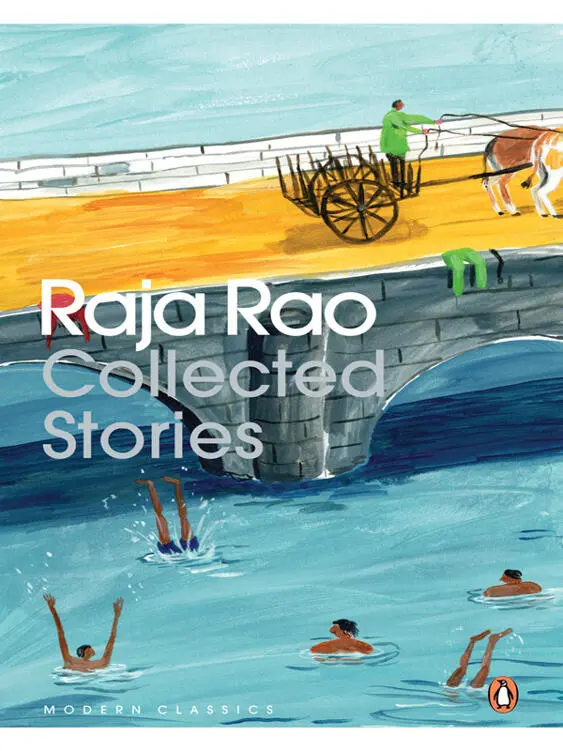
- Название:Collected Stories
- Автор:
- Издательство:Penguin
- Жанр:
- Год:2014
- ISBN:нет данных
- Рейтинг книги:5 / 5. Голосов: 1
-
Избранное:Добавить в избранное
- Отзывы:
-
Ваша оценка:
Collected Stories: краткое содержание, описание и аннотация
Предлагаем к чтению аннотацию, описание, краткое содержание или предисловие (зависит от того, что написал сам автор книги «Collected Stories»). Если вы не нашли необходимую информацию о книге — напишите в комментариях, мы постараемся отыскать её.
Collected Stories — читать онлайн бесплатно полную книгу (весь текст) целиком
Ниже представлен текст книги, разбитый по страницам. Система сохранения места последней прочитанной страницы, позволяет с удобством читать онлайн бесплатно книгу «Collected Stories», без необходимости каждый раз заново искать на чём Вы остановились. Поставьте закладку, и сможете в любой момент перейти на страницу, на которой закончили чтение.
Интервал:
Закладка:
But the Red-men’s Government was no fool’s government. It sent for men from Peshawar and Pindi, while heavy cars were stationed at the City Gates, with guns to the left and guns to the right, and soldiers stood beside them, for the town would be taken, and cost what it might the Red-men’s Government would govern.
And, though Gauri had neither the blue card nor the red card she now came every evening to the Master; she looked very sad, and somebody had even seen a tear, clear as a drop of the Ganges, run down her cheeks, for she was of compassion infinite and true.
And people were much affrighted, and they took the women and the children to the fields beyond and they cooked food beneath the trees and lived there — for the army of the Government was going to take the town and no woman or child would be spared. And doors were closed and clothes and vessels and jewels were hidden away, and only the workmen and the men ruled the city, and the Master was the head of them all, and they called him President. Patrols of young men in khadi and Gandhi-cap would go through the streets, and when they saw the old or the miserly peeping from behind the doors they called them and talked to them and led them to the camp by the fields, for the Master said there was danger and nobody could stay but the strong and the young. Grass grew beneath the eaves and the dust of monsoon swept along the streets while the Red-men’s trains brought armies after armies, and everybody could see them, for the station was down below and the town upon a hill. Barricades lay on the streets like corpse-heaps after the last plague, but the biggest of them all was in the Suryanarayana Street. It was as big as a chariot.
Men were hid behind it and waited for the battle. But the Master said, ‘No, there shall be no battle, brothers.’ But the workmen said again, ‘It is not with, “I love you, I love you,” that you can change the grinding heart of this Government,’ and they brought picks and scythes and crowbars, and a few Mohammedans brought their swords and one or two stole rifles from the mansions, and there was a regular fighting army ready to fall on the Red-man’s men. And the Master went and said this and the Master went and said that, but the workmen said, ‘We’ll fight,’ and fight they would. So deep in despair the Master said, ‘I resign from the Presidentship,’ and he went and sat in meditation and rose into the worlds from which come light and love, in order that the city might be saved from bloodshed. And when people heard this they were greatly angered against the workmen, but they knew the workmen were right and the Master was right, and they did not know which way the eye should turn. Owls hovered about even in midday light, and when dusk fell, all the stars hung so low that people knew that that night would see the fight.
But everybody looked at the empty street-corners and said, ‘Where is she — Gauri?’
At ten that night the first war-chariots were heard to move up, and cannons and bayonets and lifted swords rushed in assault.
And what happened afterwards people remember to this very day. There she was, Gauri, striding out of the Oil Lane and turning round Copper Seenayya’s house towards the Suryanarayana Street, her head held gently bent and her ears pressed back like plaits of hair, and staggering like one going to the temple with fruits and flowers to offer to the Goddess. And she walked fast, fast, and when people saw her they ran behind her, and crowds after crowds gathered round her, and torch and lantern in hand they marched through the Brahmin Street and the Cotton Street and past the Venkatalakshamma Well, and the nearer she came to the barricades the faster she walked, though she never ran. And people said, ‘She will protect us. Now it’s sure she will save us,’ and bells were brought and rung and camphors were lit and coconuts were broken at her feet, but she neither shuddered nor did she move her head; she walked on. And the workmen who were behind the barricades, they saw this and they were sore furious with it, and they said, ‘Here, they send the cow instead of coming to help us.’ Some swore and others laughed, and one of them said, ‘We’ll fire at her, for if the crowd is here and the Red-men’s army on the other side, it will be terrible.’ But they were afraid, for the crowd chanted ‘Vandè Mataram’ and they were all uplifted and sure, and Gauri marched onwards, her eyes raised towards the barricades. And as she came near the Temple-square the workmen laid down their arms, as she came by the Tulasi Well they folded their hands, and as she was beneath the barricades they fell prostrate at her feet murmuring, ‘Goddess, who may you be?’ And they formed two rings, and between them passed Gauri, her left foreleg first, then her back right leg, once on the sand-bag, once on the cart-wheel, and with the third move men pushed her up and she was on the top of the barricades. And then came a rich whispering like a crowd at evening worship, but the Red-men’s army cried from the other side of the barricades, ‘Oh, what’s this? Oh, what’s this?’ and they rushed towards the barricades thinking it was a flag of truce. But when they saw the cow and its looks and the tear, clear as a drop of the Ganges, they shouted out, ‘Victory to the Mahatma! Mahatma Gandhi ki jai!’ and joined up with the crowd. But their chief, the Red-man, saw this and fired a shot. It went through Gauri’s head, and she fell, a vehicle of God among lowly men.
But they said blood did not gush out of the head but only between the forelegs, from the thickness of her breast.
Peace has come back to us now. Seth Jamnalal Dwarak Chand bought the two houses on either side of the barricades, cut a loop road through them, and in the middle he erected a metal statue for Gauri. Our Gauri was not so tall nor was she so stiff, for she had a very human look. But we all offer her flowers and honey and perfumed sweetmeats and the first green grass of spring. And our children jump over the railings and play between her legs, and putting their mouths to the hole in the breast — for this was made too — shout out resounding booms. And never have our carpenters had gayer times than since Gauri died, for our children do not want their baswanna-bulls but only ask for Gauris. And to this day hawkers cry them about at the railway station, chanting, ‘Gauris of Gorakhpur! Polished, varnished and on four wheels!’ and many a child from the far Himalayas to the seas of the South pulls them through the dusty streets of Hindusthan.
But even now when we light our sanctum lights at night, we say, ‘Where is she, Gauri?’ Only the Master knows where she is. He says: ‘Gauri is waiting in the Middle Heavens to be born. She will be reborn when India sorrows again before She is free.’
Therefore it is said, ‘The Mahatma may be all wrong about politics, but he is right about the fullness of love in all creatures— the speechful and the mute.’
AKKAYYA
Her real name (truthfully to speak) I never knew, nor indeed, I think, did any of my cousins. Everybody in the household called her Akkayya, elder sister, and we simply followed the example of our parents and aunts. I have, nevertheless, a faint remembrance that when they were talking to the Brahmins about the obsequies, they called her Venkatalakshamma, Subbamma or Nanjamma, one of those old names which meant all that a virtuous woman ought to have, is virtue.
My first vivid impressions of Akkayya go back to my childhood. I must have been about four years of age; and having just lost my mother, I was left under her care, till my father married again and started his new family. I used to be very devoted to Akkayya, and had a strange, instinctive pity for her. She must have been over sixty, and I always saw her with the same childlike smile, with eyes that moved like the marbles I played with, and her face all wrinkled like a dry mango, more wrinkled than ever when she smiled. When the summer sun abruptly disappeared and a starry night spread above us, I used to be seated on her lap, in the verandah of the Fig-tree House. The evening I remember so well, she sat looking towards the town, where the lights were being lit in houses and in shops; and all of a sudden she turned towards me and kissed me. She spoke very little, but when she did she lisped like a child.
Читать дальшеИнтервал:
Закладка:
Похожие книги на «Collected Stories»
Представляем Вашему вниманию похожие книги на «Collected Stories» списком для выбора. Мы отобрали схожую по названию и смыслу литературу в надежде предоставить читателям больше вариантов отыскать новые, интересные, ещё непрочитанные произведения.









Обсуждение, отзывы о книге «Collected Stories» и просто собственные мнения читателей. Оставьте ваши комментарии, напишите, что Вы думаете о произведении, его смысле или главных героях. Укажите что конкретно понравилось, а что нет, и почему Вы так считаете.