Raja Rao - Collected Stories
Здесь есть возможность читать онлайн «Raja Rao - Collected Stories» весь текст электронной книги совершенно бесплатно (целиком полную версию без сокращений). В некоторых случаях можно слушать аудио, скачать через торрент в формате fb2 и присутствует краткое содержание. Год выпуска: 2014, Издательство: Penguin, Жанр: Классическая проза, на английском языке. Описание произведения, (предисловие) а так же отзывы посетителей доступны на портале библиотеки ЛибКат.
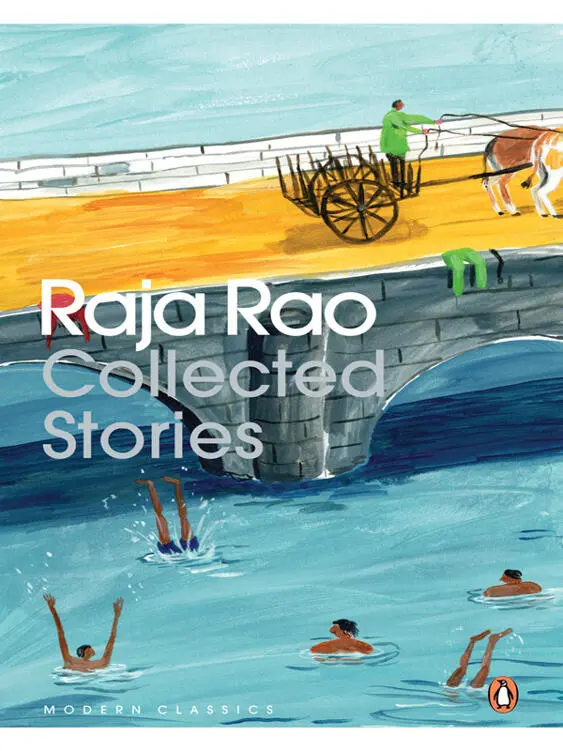
- Название:Collected Stories
- Автор:
- Издательство:Penguin
- Жанр:
- Год:2014
- ISBN:нет данных
- Рейтинг книги:5 / 5. Голосов: 1
-
Избранное:Добавить в избранное
- Отзывы:
-
Ваша оценка:
Collected Stories: краткое содержание, описание и аннотация
Предлагаем к чтению аннотацию, описание, краткое содержание или предисловие (зависит от того, что написал сам автор книги «Collected Stories»). Если вы не нашли необходимую информацию о книге — напишите в комментариях, мы постараемся отыскать её.
Collected Stories — читать онлайн бесплатно полную книгу (весь текст) целиком
Ниже представлен текст книги, разбитый по страницам. Система сохранения места последней прочитанной страницы, позволяет с удобством читать онлайн бесплатно книгу «Collected Stories», без необходимости каждый раз заново искать на чём Вы остановились. Поставьте закладку, и сможете в любой момент перейти на страницу, на которой закончили чтение.
Интервал:
Закладка:
The fire was still to be lit, and the cow to be milked, and the milk boiled. All this had to be done before eight o’clock, when the customers would begin to come in numbers, one after the other. This morning, her fire too would not take well. It had been twice dead. What a bad sign to begin a day with, she said to herself, and she resolved to bear quietly any threats or beatings from Motilal. A bad day, for her, meant just that. At last the fire slowly lit up, and, placing a pot of water on the oven, she went out to milk the cow. The calf somehow had managed to slip away from its noose, and half the milk was gone. She banged the calf in fury, and thrusting it aside, beat the teats in the hope of getting even half a seer of milk. Fortunately there was still a little left — in fact there was a great deal left — and driving the cow on to the street, she went back to the kitchen. The fire was but feebly burning, and the water was not warm. She cursed herself, cursed the fuel, cursed the calf, and blowing air into the oven, she sat thinking of all that might happen that evil-omened day — that dark day to be. Even a cough from Motilal would disturb her and send a shiver through her spine. But in a moment, as though to console her, the fire made the luck-bringing hiss. She was happy about this. So after all it was not going to be a bad day! The fire god had prophesied. . Motilal entered. He too was happy.
‘Beti,’ he cried enthusiastically, ‘do you know, a lizard fell upon my right shoulder!’
‘Really!’
She had round tears in her eyes.
‘Yes! Just now. I was sitting in the grocery and it fell on my right shoulder and disappeared. I wonder what it will bring us!’
He drew two long puffs from his hookah and let them go into the air with a pouted mouth, like a child that is blowing bubbles.
‘Perhaps Chota will come back,’ murmured Beti, turning away towards the fire.
‘Chota. . Chota. . you still dream of him! I will not let him set his foot in this house. No! But really, Beti, I think we shall get something, something wonderful. Who knows? Perhaps the Nawab Sahib will accept my terms. Fifteen per cent interest. . it is nothing for a rich man like him.’
‘Perhaps he will,’ she muttered mechanically.
‘He will,’ he assured himself. ‘Yesterday when I saw his secretary, he said he would see to it. You see, Beti, as I told you, fifty rupees to the secretary and fifteen per cent interest. Imagine how much it will bring us, on twenty thousand rupees! We shall be rich, Beti!’
‘What for? My mother is dead, and Chota. . ’
‘Shut up, you donkey’s child!’ he cried, and walked away to the grocery, calculating again and again how much he would make out of this affair.
The morning slowly rolled along, and the afternoon too creaked heavily away, and yet nothing had happened. Every moment Motilal was expecting a servant from the Nawab Sahib or even the Nawab Sahib himself. Twice in the day he had counted his money, and put the twenty thousand rupees — all in thousand-rupee notes — aside. Every car that passed in the street looked like the Nawab Sahib’s, and every client who came looked like a messenger from him. At lunch he did not eat at all. He said he was not hungry, and poor Beti was sad to see him anxious. Her own heart was beating hard. She too was expecting something wonderful to happen. But what? Naturally, the idea of Chota coming back filled her with strange happiness and fear. Oh! if he should come back! Oh! if he really should! He would go to Gujarat and marry Bapan Lal’s daughter. She was meant for him, she was. Hardly had she seen the light of the sun than she had been engaged to Chota, then her little baby boy. It seemed the girl had now grown up into a charming little maid. And she was still meant for Chota. To have a daughter-in-law at home, how very fine, how natural. Half the work in the house would be done by her, and then Beti would have but little to scrub, sew and grind. Yes! Chota would come back. He would! Chota!. . Chota!. . She wept. Motilal entered the kitchen to get some hot cinders for his hookah and he asked her why she was in tears.
‘I was afraid. . I was afraid. .,’ she blurted between her sobs, ‘I was afraid you would die before me. . ’
‘Poor thing!’ he murmured, caressing her hair, and went back to the grocery.
Now the sun was setting, and it being Saturday, Motilal had to go to Maruthi’s temple. Usually he went in the afternoon, but today he had intended to take a larger present to the God on hearing of his success with the Nawab Sahib. And so he waited and waited. But now he had to go. If not, the door of the temple would be closed. And the temple was at least three miles away. Sad, therefore, but still expectant, he put on his old velvet coat, and placing his wiry turban upon his head, he stood yawning for a moment, went and lighted his hookah, talked to the parrot, and yet. . Now there was no hope, and he started off for Maruthi’s temple deep in the Bhendi Bazaar. ‘If the Nawab Sahib comes,’ he ran back and told Beti, ‘tell him I’ll see him tonight, this very night if he so desires.’
‘All right,’ she answered drily. The Nawab Sahib, always the same story. .
She was still dreaming of her son coming back and her good daughter-in-law to be, when the sun suddenly sank, and going in she lighted the shop lantern, and chanted her usual lighting-time prayers.
Mahalakshmi, I offer you my worship,
You giver of the desired boons,
Rising out of the Lotus-ocean,
Begarlanded with the nine precious gems,
Mother, be gracious, be gracious unto me.
She even lit the little oil lamp by the picture of Rama that hung in the kitchen. A little oil now, but perhaps it would bring luck. The gods after all are not so cruel. They might make you wait. But they will surely answer your prayers.
It was about eight o’clock. In an hour or so Motilal would be back. So Beti went back into the kitchen and sat cooking. Somebody coughed outside. She turned round. It was just darkness, dense darkness, and not a sign of any living soul. But still the cough strangely disturbed her. How? She did not know. But it gave her some unnatural joy. She would have risen and gone to see who it was. But then, the person had surely disappeared. Besides, the darkness was so heavy. . Unconsciously she dozed away. She was accustomed to it. Suddenly somebody seemed to call her in a familiar voice. ‘Mai, mai. . Mother. . Mai. . ’ Before she opened her eyes Chota had embraced her. And they wept together, mother and son.
Motilal came back a little earlier than usual. Had the Nawab Sahib. .? He howled and blazed in fury. But he let Chota stay. After all, the son had come back. That was enough.
Mata Bapan Lal was happy that Chota had come back. So, in three weeks’ time, he came down to Hyderpur to settle about the dowry. Motilal insisted on fifty thousand rupees. Chota was the great-grandson of Bhata Tata Lal of Khodi. But Bapan Lal had already married two daughters and had two more to marry. No, he could not pay that heavy sum. Anyway, as Beti was less ambitious and but too happy to have her son marry the daughter of Mata Bapan Lal — yes, of Mata Bapan Lal of Gorakhpur — she forced Motilal to accept only thirty thousand. So, it was all agreed, and the marriage took place with all pomp and generosity. The expenses were all met by Mata Bapan Lal and the bridegroom’s party had everything they wanted. Beti had a three-hundred-rupee Benares sari, Motilal a Calcutta dhoti, and there was actually a marriage procession with a bridal Rolls-Royce car, beginning at the corner of the Bade Bazaar and ending at the market square, by the clock tower. When Beti saw her son with a gold-laced turban, a filigree-worked achkan, garlanded from head to foot, and followed by hundreds and hundreds of people as the procession moved along amidst illumination and fireworks, she could not control her tears, and repeated a thousand times to herself that now she could die, happily, contentedly. And the daughter-in-law was such a sweet creature. She looked healthy and strong, and she would work so well.
Читать дальшеИнтервал:
Закладка:
Похожие книги на «Collected Stories»
Представляем Вашему вниманию похожие книги на «Collected Stories» списком для выбора. Мы отобрали схожую по названию и смыслу литературу в надежде предоставить читателям больше вариантов отыскать новые, интересные, ещё непрочитанные произведения.









Обсуждение, отзывы о книге «Collected Stories» и просто собственные мнения читателей. Оставьте ваши комментарии, напишите, что Вы думаете о произведении, его смысле или главных героях. Укажите что конкретно понравилось, а что нет, и почему Вы так считаете.