Jonathan Foer - Here I Am
Здесь есть возможность читать онлайн «Jonathan Foer - Here I Am» весь текст электронной книги совершенно бесплатно (целиком полную версию без сокращений). В некоторых случаях можно слушать аудио, скачать через торрент в формате fb2 и присутствует краткое содержание. Год выпуска: 2016, Издательство: Hamish Hamilton, Жанр: Историческая проза, на английском языке. Описание произведения, (предисловие) а так же отзывы посетителей доступны на портале библиотеки ЛибКат.
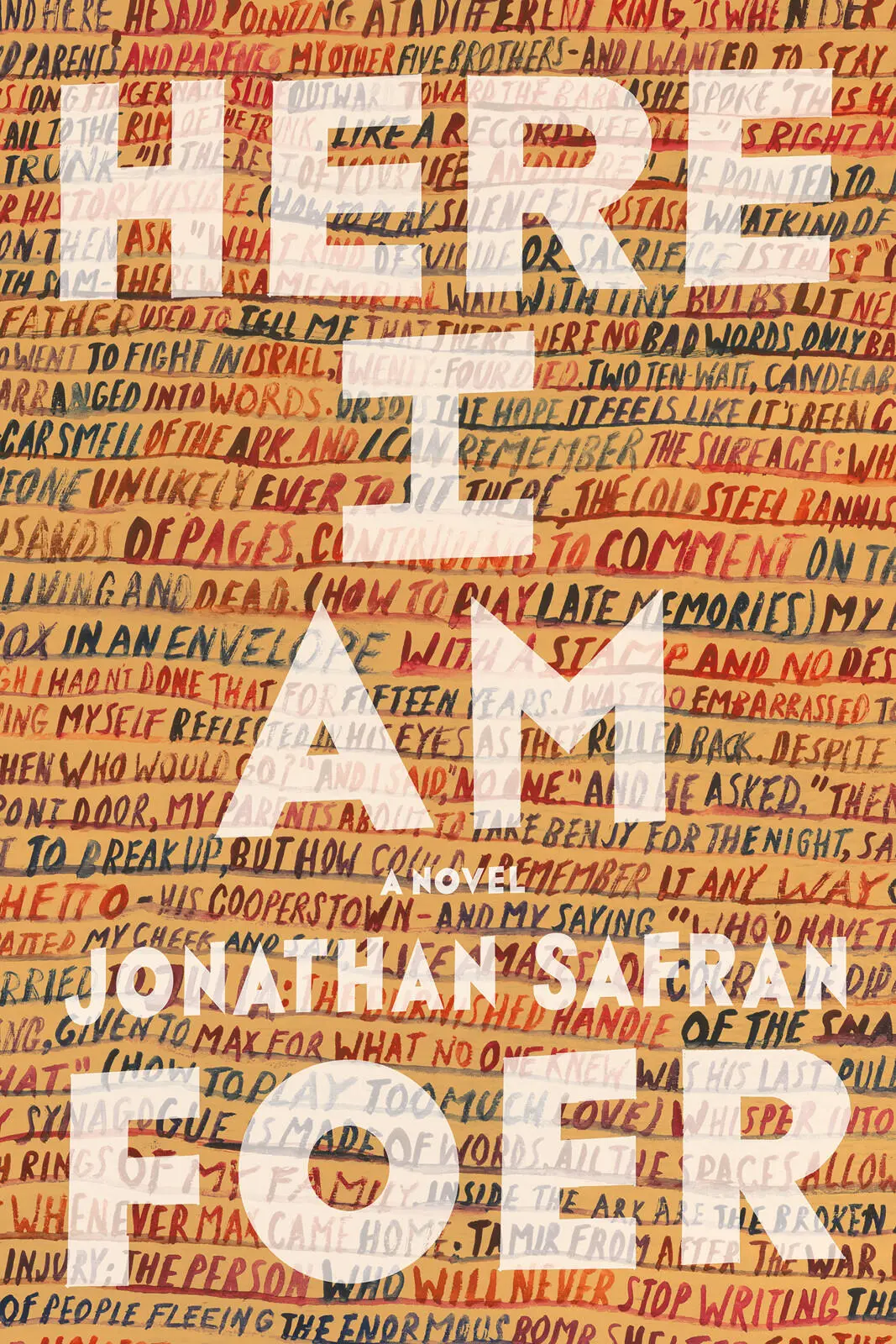
- Название:Here I Am
- Автор:
- Издательство:Hamish Hamilton
- Жанр:
- Год:2016
- ISBN:нет данных
- Рейтинг книги:5 / 5. Голосов: 1
-
Избранное:Добавить в избранное
- Отзывы:
-
Ваша оценка:
Here I Am: краткое содержание, описание и аннотация
Предлагаем к чтению аннотацию, описание, краткое содержание или предисловие (зависит от того, что написал сам автор книги «Here I Am»). Если вы не нашли необходимую информацию о книге — напишите в комментариях, мы постараемся отыскать её.
How do we fulfill our conflicting duties as father, husband, and son; wife and mother; child and adult? Jew and American? How can we claim our own identities when our lives are linked so closely to others’? These are the questions at the heart of Jonathan Safran Foer’s first novel in eleven years-a work of extraordinary scope and heartbreaking intimacy.
Unfolding over four tumultuous weeks in present-day Washington D.C.,
is the story of a fracturing family in a moment of crisis. As Jacob and Julia and their three sons are forced to confront the distances between the lives they think they want and the lives they are living, a catastrophic earthquake sets in motion a spiraling conflict in the Middle East. At stake is the very meaning of home — and the fundamental question of how much life one can bear.
Showcasing the same high-energy inventiveness, hilarious irreverence, and emotional urgency that readers and critics loved in his earlier work,
is Foer’s most searching, hard-hitting, and grandly entertaining novel yet. It not only confirms Foer’s stature as a dazzling literary talent but reveals a mature novelist who has fully come into his own as one of the most important writers of his generation.
Here I Am — читать онлайн бесплатно полную книгу (весь текст) целиком
Ниже представлен текст книги, разбитый по страницам. Система сохранения места последней прочитанной страницы, позволяет с удобством читать онлайн бесплатно книгу «Here I Am», без необходимости каждый раз заново искать на чём Вы остановились. Поставьте закладку, и сможете в любой момент перейти на страницу, на которой закончили чтение.
Интервал:
Закладка:
“Are you implying it’s what I secretly want?”
“Is it? That hadn’t even occurred to me, but it obviously occurred to you.”
“Are you serious?”
“What will you become?”
“I have no idea what water it is you’re trying to lead me to, but I’m fucking tired, and tired of this conversation, so if you have something to say—”
“Why won’t you just tell me you want me to stay?”
“What?”
“I don’t understand why you can’t bring yourself to say that you don’t want me to go.”
“It’s what I’ve been saying for the last five minutes.”
“No, you’ve been saying it’s unfair to the kids. That it’s unfair to you.”
“ Unfair is your word.”
“Not once have you said that you — you Julia — don’t want me to go because you don’t want me to go.”
She opened a silence as the rabbi had opened the rip in Irv’s jacket at the funeral.
“A widow,” Jacob said. “That’s what you’ll become. You’re constantly projecting your needs and fears onto the kids, or me, or whoever is within reach. Why can’t you just admit that you— you —don’t want to be a widow?”
He heard, he thought he heard, the springs of a mattress return to their state of rest. What bed was she rising from? How much of her body was uncovered, in what degree of darkness?
“Because I wouldn’t be a widow,” she said.
“Yes, you would.”
“No, Jacob, I wouldn’t. A widow is someone whose spouse has died.”
“And?”
“And you’re not my spouse.”
In the 1970s there was no infrastructure to care for deaf children in Nicaragua — no schools, no educational or informational resources, there wasn’t even a codified sign language. When the first Nicaraguan school for the deaf was opened, the teachers taught the lip-reading of Spanish. But on the playground the children communicated using the signs they had developed in their homes, organically generating a shared vocabulary and grammar. As generations of students moved through the school, the improvised language grew and matured. It is the only documented instance of a language being created entirely from scratch by its speakers. No adult helped, nothing was recorded on paper, there were no models. Only the children’s will to be understood.
Jacob and Julia had tried. They had created signs, and they would spell words in front of the still-young kids, and there were codes. But the language they had created, and were even then creating, made the world smaller rather than clearer.
I’m not your spouse.
Because of those texts? Destroy everything because of the arrangement of a few hundred letters? What did he think was going to happen? And what did he think he was doing? Julia was right: it wasn’t a moment of weakness. He pushed the exchange into sexuality, he bought the second phone, he was forming the words whenever he wasn’t typing them, stealing off to read hers as soon as they came through. He’d more than once put Benjy in front of a movie so he could jerk off to a new message. Why?
Because it was perfect. He was a father to the boys, a son to his father, a husband to his wife, a friend to his friends, but to whom was he himself? The digital veil offered a self-disappearing that made self-expression, finally, possible. When he was no one, he was free to be himself. It’s not that he was bursting with stifled sexuality, though he was. It was the freedom that mattered. Which is why, when she texted, my husband is away this weekend with the kids, come fuck me for real , she got no response. And why you can’t STILL be jerking off! got no response. And why what happened to you? were the last words to pass between their phones.
“I don’t know how I could be any more sorry for what I did,” he said.
“You could start by telling me you’re sorry.”
“I’ve apologized many times.”
“No, many times you’ve told me that you’ve apologized. But you’ve never once apologized to me.”
“I did that night in the kitchen.”
“You didn’t.”
“In bed.”
“No.”
“On the phone in the car, when you were at Model UN.”
“You told me you’d apologized, but you didn’t apologize. I pay attention, Jacob. I remember. Exactly once, since I found the phone, did you say, ‘I’m sorry.’ When I told you your grandfather died. And you weren’t saying it to me. Or to anyone.”
“Well, it doesn’t matter if that’s the case—”
“It is the case, and it does matter.”
“It doesn’t matter if that’s the case, because if you don’t remember an apology, I obviously didn’t apologize fully enough. So hear me now: I’m so sorry, Julia. I’m ashamed, and I’m sorry.”
“It’s not the texts.”
The night Julia found the phone, she told Jacob, “You seem happy, but you aren’t.” And more: “You find unhappiness so threatening that you would rather go down with the ship than acknowledge a leak.” What if she wouldn’t go down with the ship? Because if it wasn’t the texts, then it was everything. What if, when Jacob closed himself in the unoccupied room, he closed Julia in the unoccupied house? What if the thing he needed to apologize for was everything?
“Tell me,” he said, “just tell me, why are you going to destroy this family?”
“Don’t you dare say that.”
“But it’s true. You’re destroying our family.”
“I’m not. I’m ending our marriage.”
He couldn’t believe what she had just dared to say.
“Ending our marriage will destroy our family.”
“No. It won’t.”
“Why? Why are you ending our marriage?”
“Who have I been having all of those conversations with for the last three weeks?”
“We were talking .”
She let that reverberate for a moment, then said, “ That’s why.”
“Because we were talking?”
“Because you’re always talking, and your words never mean anything. You hid your greatest secret behind a wall, remember that?”
“No.”
“Our wedding. I walked seven circles around you, and I surrounded you with love, for years I did, and the wall toppled. I toppled it. But you know what I discovered? Your greatest secret is that you’re wall all the way to the centermost stone. There is nothing there .”
And now he had no choice: “I’m going to Israel, Julia.”
And either because of the addition of her name, or a shift in his tone, or more likely because the conversation had reached the point of breakage, the sentence took on a new meaning — one that Julia believed.
“I can’t believe this,” she said.
“I have to.”
“For whom?”
“Our kids. And their kids.”
“Our kids don’t have kids.”
“But they will.”
“So that’s the trade: lose a father, gain a kid?”
“You said it yourself, Julia: they’re going to put me behind a computer.”
“I didn’t say that.”
“You said they wouldn’t be dumb enough to give me a gun.”
“No, I didn’t say that, either.”
Jacob could hear the click of a lamp. A hotel? Mark’s apartment? How could he ask her where she was in a way that didn’t convey judgment or jealousy or imply that he was going to Israel to punish her for having gone to Mark’s?
More than a thousand “constructed languages” have been invented — by linguists, novelists, hobbyists — each with the dream of correcting the imprecision, inefficiency, and irregularity of natural language. Some constructed languages are based on the musical scale and sung. Some are color-based and silent. The most admired constructed languages were designed to reveal what communication could be, and none of them is in use.
Читать дальшеИнтервал:
Закладка:
Похожие книги на «Here I Am»
Представляем Вашему вниманию похожие книги на «Here I Am» списком для выбора. Мы отобрали схожую по названию и смыслу литературу в надежде предоставить читателям больше вариантов отыскать новые, интересные, ещё непрочитанные произведения.




Обсуждение, отзывы о книге «Here I Am» и просто собственные мнения читателей. Оставьте ваши комментарии, напишите, что Вы думаете о произведении, его смысле или главных героях. Укажите что конкретно понравилось, а что нет, и почему Вы так считаете.