Jonathan Foer - Here I Am
Здесь есть возможность читать онлайн «Jonathan Foer - Here I Am» весь текст электронной книги совершенно бесплатно (целиком полную версию без сокращений). В некоторых случаях можно слушать аудио, скачать через торрент в формате fb2 и присутствует краткое содержание. Год выпуска: 2016, Издательство: Hamish Hamilton, Жанр: Историческая проза, на английском языке. Описание произведения, (предисловие) а так же отзывы посетителей доступны на портале библиотеки ЛибКат.
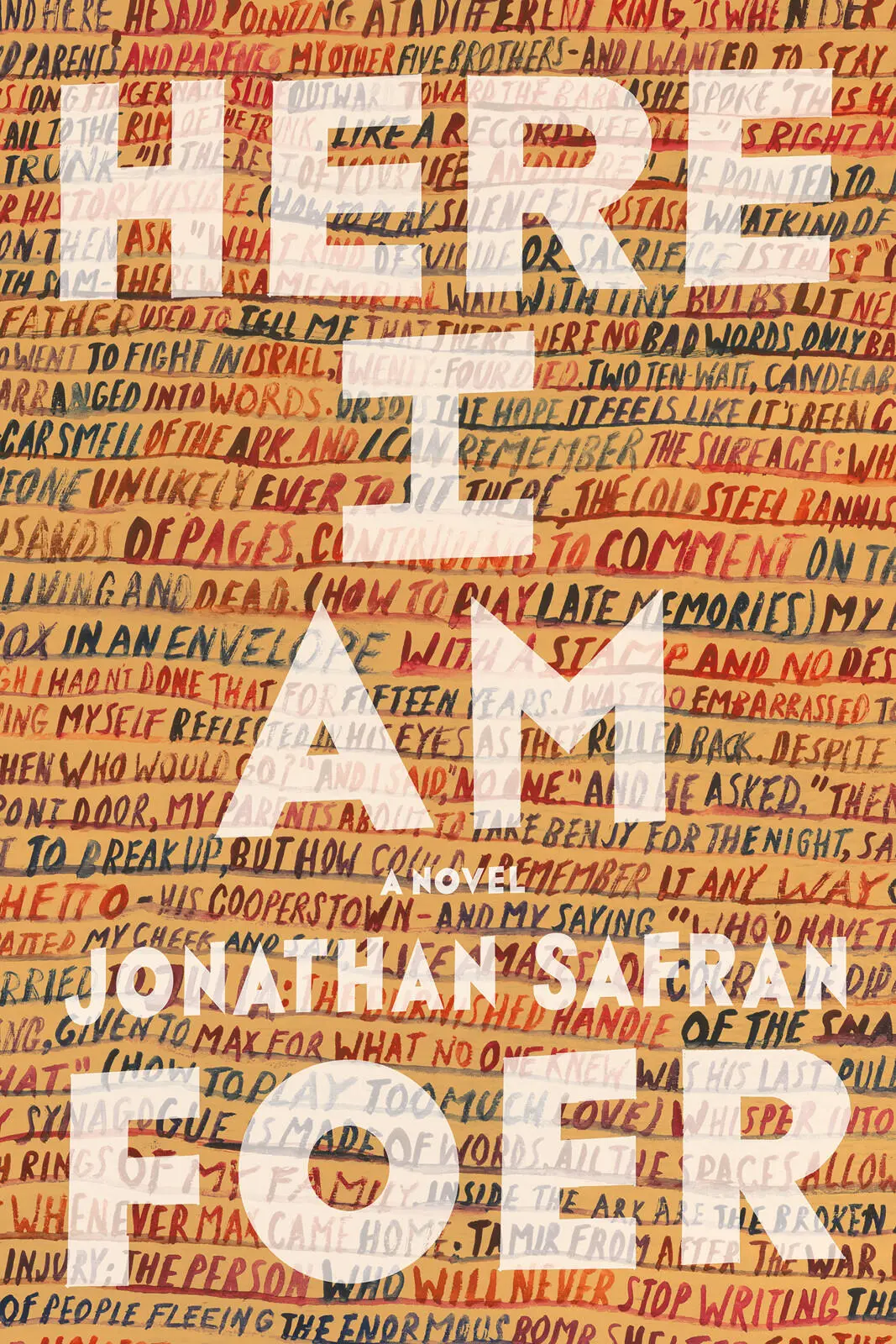
- Название:Here I Am
- Автор:
- Издательство:Hamish Hamilton
- Жанр:
- Год:2016
- ISBN:нет данных
- Рейтинг книги:5 / 5. Голосов: 1
-
Избранное:Добавить в избранное
- Отзывы:
-
Ваша оценка:
Here I Am: краткое содержание, описание и аннотация
Предлагаем к чтению аннотацию, описание, краткое содержание или предисловие (зависит от того, что написал сам автор книги «Here I Am»). Если вы не нашли необходимую информацию о книге — напишите в комментариях, мы постараемся отыскать её.
How do we fulfill our conflicting duties as father, husband, and son; wife and mother; child and adult? Jew and American? How can we claim our own identities when our lives are linked so closely to others’? These are the questions at the heart of Jonathan Safran Foer’s first novel in eleven years-a work of extraordinary scope and heartbreaking intimacy.
Unfolding over four tumultuous weeks in present-day Washington D.C.,
is the story of a fracturing family in a moment of crisis. As Jacob and Julia and their three sons are forced to confront the distances between the lives they think they want and the lives they are living, a catastrophic earthquake sets in motion a spiraling conflict in the Middle East. At stake is the very meaning of home — and the fundamental question of how much life one can bear.
Showcasing the same high-energy inventiveness, hilarious irreverence, and emotional urgency that readers and critics loved in his earlier work,
is Foer’s most searching, hard-hitting, and grandly entertaining novel yet. It not only confirms Foer’s stature as a dazzling literary talent but reveals a mature novelist who has fully come into his own as one of the most important writers of his generation.
Here I Am — читать онлайн бесплатно полную книгу (весь текст) целиком
Ниже представлен текст книги, разбитый по страницам. Система сохранения места последней прочитанной страницы, позволяет с удобством читать онлайн бесплатно книгу «Here I Am», без необходимости каждый раз заново искать на чём Вы остановились. Поставьте закладку, и сможете в любой момент перейти на страницу, на которой закончили чтение.
Интервал:
Закладка:
The planes weren’t fueled until just before takeoff, as no one knew, even approximately, how heavy they would be.
TODAY I AM NOT A MAN
“We need to have a family conversation,” Sam said. It was the night before his makeshift bar mitzvah. In twelve hours, catered food would begin to arrive. And not long after, the handful of cousins and friends who could make it on such short notice. Then manhood.
Max and Benjy sat on Sam’s bed, their feet growing toward the floor, and Sam gave his ninety-two pounds to his beloved swivel chair — beloved because the range of motion made him feel capable, and beloved because it had been his dad’s. His desktop flickered with footage of an army moving across the Sinai.
With parental gentleness, Sam recounted an age-appropriate version of what had happened with their father’s phone, and what he knew — from the snippets Max had overheard in the car, what Billie had witnessed and inferred at Model UN, and his own piecing together — of their mother’s relationship with Mark. (“I don’t get what’s the big deal,” Benjy said. “People kiss people all the time and it’s nice?”) Sam shared what Billie had overheard of their parents’ separation-conversation rehearsal (mortared with the results of Max’s snooping), as well as what Barak had been told of their fathers’ decision to go to Israel. Everyone knew that Jacob was lying when he said Julia had spent the night at a site visit, but they also sensed that he didn’t know where she’d actually been, so no one mentioned it.
Sam often had fantasies of killing his brothers, but he also had fantasies of saving them. He’d felt the opposing pulls for as long as they’d been his brothers — with the same arms that cradled baby Benjy, he wanted to crush his rib cage — and the intensity of those coexisting impulses defined his brotherly love.
But not now. Now he only wanted to cradle them. Now he felt no possessiveness, no diminishment at their gain, no scorching, referentless annoyance.
When Sam reached the climax—“Everything is about to change”—Max started to cry. Reflexively, Sam wanted to say, “It’s funny, it’s funny,” but a yet stronger reflex prevailed, and he said, “I know, I know.” When Max started to cry, Benjy started to cry — like a reservoir that floods into an overflow reservoir, overflowing it. “It sucks,” Sam said. “But it’s all going to be OK. We just can’t let it happen.”
Through his tears, Benjy said, “I don’t get it. Kissing is nice.”
“What are we going to do?” Max asked.
“They keep putting everything off until after my bar mitzvah. They’re going to tell us about their divorce after my bar mitzvah. Dad is going to move out after my bar mitzvah. And now he’s going to go to Israel after my bar mitzvah. So I’m not going to have a bar mitzvah.”
“That’s a good plan,” Benjy said. “You’re smart.”
“But they’ll just force you to,” Max said.
“What are they gonna do? Pinch my nose until I expel my haftorah?”
“Ground you.”
“Who cares?”
“Take away your screen time.”
“Who cares?”
“You do.”
“I won’t.”
“You could run away?” Benjy suggested.
“Run away?” his brothers asked at the same time, and Max couldn’t resist calling, “Jinx!”
“Sam, Sam, Sam,” Benjy said, relieving his brother of his imposed silence.
“I can’t run away,” Sam said.
“Just until the war ends,” Max said.
“I wouldn’t leave you guys.”
“And I would miss you,” Benjy said.
When Jacob and Julia had shared the news that Sam and Max were going to get a little brother, Jacob made the mistake of suggesting the boys name him — a sweet idea that if carried out one hundred million times would never once produce an acceptable result. Max quickly settled on Ed the Hyena, after Scar’s loyal henchman in The Lion King , assuming, presumably, that that’s what his new brother would be: his loyal henchman. Sam wanted to name him Foamy, because it was the third word his finger landed on when he was riffling through the dictionary — he’d promised to commit to the first word, whatever it was, but it was extortion , and the second was ambivalent . The problem wasn’t that the brothers disagreed, but that both were such terrific names — Ed the Hyena and Foamy. Great names that any human would be privileged to have and that would all but guarantee a cool life. They flipped a coin, and then did best out of three, then seven, and Julia, being Julia, gently folded the winning name into an origami bird that she released from an open window, but made the boys T-shirts with iron-on letters that read “Foamy’s Brother,” and, of course, a “Foamy” onesie. There was a photograph of the three of them in their Foamy-wear, asleep in the backseat of the Volvo that was christened Ed the Hyena as an easy-to-give concession to Max.
Sam patted his knees, beckoning Benjy over, and said, “I’d miss you, too, Foamy.”
“Who’s Foamy?” Benjy asked, climbing onto his brother.
“You almost were.”
Max found all of this too emotional to acknowledge or name. “If you run away, I’m coming, too.”
“No one is running away,” Sam said.
“Me, too,” Benjy said.
“We need to stay,” Sam said.
“Why?” they asked.
“Jinx!”
“Benjy, Benjy, Benjy.”
Sam could have said, Because you need to be taken care of, and I can’t do that myself. Or, Because it’s only my bar mitzvah, so only I need to run from it. Or, Because life isn’t a Wes Anderson movie . But instead he said, “Because then our house would be completely empty.”
“It should be,” Max said. “It deserves to be.”
“And Argus.”
“He’ll come with us.”
“He can’t walk to the corner. How would he run away?”
Max was becoming desperate: “So we’ll put him to sleep, and then we’ll run away.”
“You would kill Argus to stop a bar mitzvah?”
“I would kill Argus to stop life.”
“Yeah, his life.”
“Our life.”
“I have a question,” Benjy said.
“What?” his brothers asked in unison.
“Jinx!”
“Jesus, Max.”
“Fine. Sam, Sam, Sam.”
“What’s your question?”
“Max said you could run away until the war stops.”
“No one is running away.”
“What if the war never stops?”
O JEWS, YOUR TIME HAS COME!
Julia came home in time to put the boys to bed. It wasn’t nearly as painful as either she or Jacob had imagined, but only because she had imagined a night of silence and Jacob had imagined a night of screaming. They hugged, exchanged gentle smiles, and got to work.
“My dad procured a Torah.”
“And a rabbi?”
“It was a two-for-one.”
“Please, not a cantor.”
“Thank God, no.”
“And you found everything at Whole Foods?”
“I got a caterer.”
“The day before?”
“Not the best caterer. Some unsubstantiated accusations of salmonella.”
“Rumors, I’m sure. We should have about what, fifteen people? Twenty?”
“We’ll have food for one hundred.”
“All those snow globes…,” Julia said, genuinely wistfully.
They were gridded on three linen-closet shelves, fifteen across and eight deep. They would stay there, untouched, for years — so much trapped water, like all the trapped air in the saved bubble wrap, like the words trapped in thought bubbles. There must have been tiny cracks in their domes, as the water slowly evaporated — maybe a quarter-inch a year? — and by the time Benjy was ready to have, or not have, a bar mitzvah, the snow was resting on dry city streets, still pure.
Читать дальшеИнтервал:
Закладка:
Похожие книги на «Here I Am»
Представляем Вашему вниманию похожие книги на «Here I Am» списком для выбора. Мы отобрали схожую по названию и смыслу литературу в надежде предоставить читателям больше вариантов отыскать новые, интересные, ещё непрочитанные произведения.





Обсуждение, отзывы о книге «Here I Am» и просто собственные мнения читателей. Оставьте ваши комментарии, напишите, что Вы думаете о произведении, его смысле или главных героях. Укажите что конкретно понравилось, а что нет, и почему Вы так считаете.