Upton Sinclair - Dragons’s teeth
Здесь есть возможность читать онлайн «Upton Sinclair - Dragons’s teeth» весь текст электронной книги совершенно бесплатно (целиком полную версию без сокращений). В некоторых случаях можно слушать аудио, скачать через торрент в формате fb2 и присутствует краткое содержание. Жанр: Историческая проза, на английском языке. Описание произведения, (предисловие) а так же отзывы посетителей доступны на портале библиотеки ЛибКат.
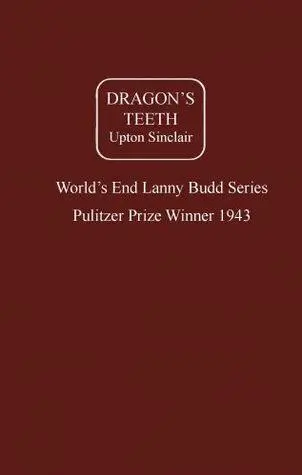
- Название:Dragons’s teeth
- Автор:
- Жанр:
- Год:неизвестен
- ISBN:нет данных
- Рейтинг книги:3 / 5. Голосов: 1
-
Избранное:Добавить в избранное
- Отзывы:
-
Ваша оценка:
Dragons’s teeth: краткое содержание, описание и аннотация
Предлагаем к чтению аннотацию, описание, краткое содержание или предисловие (зависит от того, что написал сам автор книги «Dragons’s teeth»). Если вы не нашли необходимую информацию о книге — напишите в комментариях, мы постараемся отыскать её.
Dragons’s teeth — читать онлайн бесплатно полную книгу (весь текст) целиком
Ниже представлен текст книги, разбитый по страницам. Система сохранения места последней прочитанной страницы, позволяет с удобством читать онлайн бесплатно книгу «Dragons’s teeth», без необходимости каждый раз заново искать на чём Вы остановились. Поставьте закладку, и сможете в любой момент перейти на страницу, на которой закончили чтение.
Интервал:
Закладка:
Johannes judged it certain that the Nazis would make heavy gains at the coming elections, but he refused to worry about this. He had several of them on his payroll, but what he counted upon most was the fact that Hitler had gone to Dusseldorf and had a long session with Thyssen and other magnates of the Ruhr. They wanted the Red labor unions put down, and Hitler had satisfied them that he was ready to do the job. You might fool one or two of those tough steelmen, but not many; they knew politicians, and dealt with one crop after another; it was part of the game of conducting industry in a world full of parliaments and parties. A nuisance, but you learned to judge men and saw to it that none got into power who couldn’t be trusted. The same thing applied to the great landlords of Prussia; they wanted above all things a bulwark against Bolshevism, and were willing to pay a heavy price for that service. These two powers, the industrialists of the west and the landed gentry of the east, had governed Germany since the days of Bismarck and would go on doing so.
"But aren’t you afraid of Hitler’s anti-Semitism?" asked Lanny.
"Herrgott!" exclaimed the owner of the Bessie Budd. "I was brought up in the midst of pogroms, and what could I do then? It is said that there once lived a Jew called Jesus, and other Jews had him executed by the Romans; such things happened ten thousand times, no doubt; but because of this one time my poor people have to be spat upon and clubbed and stabbed to death. What can any of us do, except to pray that it will not break out in the street where we live?"
"But they threaten it wholesale, Johannes!"
"It is a means of getting power in a world where people are distracted and must have some one to blame. I can only hope that if ever the Nazis come into office they will have real problems to deal with, so that the spotlight will be turned away from my unfortunate people."
IV
Irma had voted to keep out of German political affairs, but that couldn’t be arranged entirely. There was the workers' school, in which Freddi was so deeply interested, and which had been more or less modeled upon Lanny’s own project. When they came back to Berlin Lanny’s wife played bridge while he went with Freddi and Rahel to a reception at which he met the teachers and friends of the enterprise, heard its problems discussed, and told them how things were going in the Midi.
In his way of thinking Lanny was nearer to these young Socialists than to any other group; yet what a variety of opinion there was among them, and how difficult to get them together on any program of action! A few days before the election the von Papen government had effected a coup d’Etat in the state of Prussia, which includes Berlin; the premier and the principal officials, all Social-Democrats, were turned out of office and threatened with arrest if they attempted to resist—which they did so feebly that it amounted to submission. As a result, the Socialists were buzzing like a swarm of bees whose hive has been upset; but alas, they appeared to be bees which had lost their stingers! The Communists had proposed a general strike of the workers and called upon the Socialists to co-operate with them; but how could anybody cooperate with Communists? They would take advantage of an uprising to seize the reins themselves; they would turn upon their allies as they had done with Kerensky in Russia. The Socialists were more in fear of the Communists than of the reactionaries; they were afraid of acting like Communists, of looking like Communists, of being called Communists.
So the Cabinet of the Barons seized control of the Berlin police and all the other powers of the local government. How different it had been twelve years ago during the "Kapp Putsch"! Then the workers hadn’t waited for their leaders, they had known instantly what to do—drop their tools and come into the streets and show their power. But now, apparently, they had lost interest in the Republic. What good had it done them these twelve years? It couldn’t prevent hard times and unemployment, it couldn’t even make promises any more! It was so chained by its own notions of legality that it couldn’t resist the illegality of others.
Lanny listened to the discussions of these Berlin intellectuals. They came from all classes, brought together by community of ideas. They had the keenest realization of danger to the cause of freedom and social justice. They all wanted to do something; but first they had to agree what to do, and apparently they couldn’t; they talked and argued until they were exhausted. Lanny wondered, is this a disease which afflicts all intellectuals? Is it a paralysis which accompanies the life of the mind? If so, then it must be that the thinkers will be forever subject to the men of brute force, and Plato’s dream of a state ruled by philosophers will remain forever vain.
Lanny thought: "Somebody ought to lead them!" He wanted to say: "My God, it may be settled this very night. Your republic will be dead! Let’s go now, and call the workers out!" But then he thought: "What sort of a figure would I cut, taking charge of a German revolution? I, an American!" He settled back and listened to more arguments, and thought: "I’m like all the others. I’m an intellectual, too! I happen to own some guns, and know how to use them—but I wouldn’t!"
V
There was a teacher of art at the school, by name Trudi Schultz, very young, herself a student at an art school, but two or three evenings a week she came to impart what she knew to the workers, most of them older than herself. She was married to a young commercial artist who worked on a small salary for an advertising concern and hated it. Both Trudi and Ludi Schultz were that perfect Aryan type which Adolf Hitler lauded but conspicuously was not; the girl had wavy fair hair, clear blue candid eyes, and sensitive features which gave an impression of frankness and sincerity. Lanny watched her making sketches on a blackboard for her class, and it seemed to him that she had an extraordinary gift of line; she drew something, then wiped it out casually, and he hated to see it go.
She was pleased by his interest and invited him to come and see her work. So, on another evening while Irma played bridge, Lanny drove Freddi and Rahel to a working class quarter of the city where the young couple lived in a small apartment. Lanny inspected a mass of crayon drawings and a few water-colors, and became interested in what he believed was a real talent. This girl drew what she saw in Berlin; but she colored it with her personality. Like Jesse Blackless she loved the workers and regarded the rich with moral disapprobation; that made her work "propaganda," and hard to sell. But Lanny thought it ought to appeal to the Socialist press and offered to take some with him and show it to Leon Blum and Jean Longuet. Of course the Schultzes were much excited— for they had heard about Lanny’s having selected old masters for the palace of Johannes Robin, and looked upon the wealthy young American as a power in the art world.
Lanny, for his part, was happy to meet vital personalities in the workers' movement. More and more he was coming to think of art as a weapon in the social struggle, and here were young people who shared his point of view and understood instantly what he said.
He had traveled to many far places, while they knew only Berlin and its suburbs and the countryside where they sometimes had walking trips; yet they had managed to get the same meaning out of life. More and more the modern world was becoming one; mass production was standardizing material things, while the class struggle was shaping the minds and souls of workers and masters. Lanny had watched Fascism spread from Italy to Germany, changing its name and the color of its shirts, but very little else; he heard exactly the same arguments about it here in Berlin as in Paris, the Midi, and the Rand School of Social Science in New York.
Читать дальшеИнтервал:
Закладка:
Похожие книги на «Dragons’s teeth»
Представляем Вашему вниманию похожие книги на «Dragons’s teeth» списком для выбора. Мы отобрали схожую по названию и смыслу литературу в надежде предоставить читателям больше вариантов отыскать новые, интересные, ещё непрочитанные произведения.








Обсуждение, отзывы о книге «Dragons’s teeth» и просто собственные мнения читателей. Оставьте ваши комментарии, напишите, что Вы думаете о произведении, его смысле или главных героях. Укажите что конкретно понравилось, а что нет, и почему Вы так считаете.