Upton Sinclair - Dragons’s teeth
Здесь есть возможность читать онлайн «Upton Sinclair - Dragons’s teeth» весь текст электронной книги совершенно бесплатно (целиком полную версию без сокращений). В некоторых случаях можно слушать аудио, скачать через торрент в формате fb2 и присутствует краткое содержание. Жанр: Историческая проза, на английском языке. Описание произведения, (предисловие) а так же отзывы посетителей доступны на портале библиотеки ЛибКат.
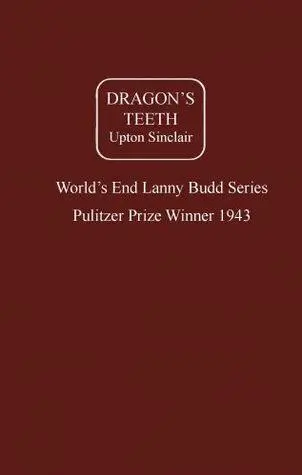
- Название:Dragons’s teeth
- Автор:
- Жанр:
- Год:неизвестен
- ISBN:нет данных
- Рейтинг книги:3 / 5. Голосов: 1
-
Избранное:Добавить в избранное
- Отзывы:
-
Ваша оценка:
Dragons’s teeth: краткое содержание, описание и аннотация
Предлагаем к чтению аннотацию, описание, краткое содержание или предисловие (зависит от того, что написал сам автор книги «Dragons’s teeth»). Если вы не нашли необходимую информацию о книге — напишите в комментариях, мы постараемся отыскать её.
Dragons’s teeth — читать онлайн бесплатно полную книгу (весь текст) целиком
Ниже представлен текст книги, разбитый по страницам. Система сохранения места последней прочитанной страницы, позволяет с удобством читать онлайн бесплатно книгу «Dragons’s teeth», без необходимости каждый раз заново искать на чём Вы остановились. Поставьте закладку, и сможете в любой момент перейти на страницу, на которой закончили чтение.
Интервал:
Закладка:
Farther up the lake was Lausanne, where the premiers and foreign ministers were gathered to debate the ancient question of reparations. Lanny Budd greeted his friend Pete and other journalists whom he had been meeting off and on since the great peace conference thirteen summers ago. They remembered him and were glad to see him; they knew about his gold-embossed wife and her palace in Paris; they knew about Rick and his play. Here was another show, and a fashionable young couple was taken right behind the scenes.
Lausanne is built on a mountainside, with each street at a different level. The French had a hotel at the top, the British one at the bottom, and the other nations in between; the diplomats ascended or descended to have their wrangles in one another’s suites, and the newspapermen wore themselves thin chasing the various controversies up hill and down. Such, at any rate, was Corsatti’s description. The statesmen were trying to keep their doings secret, and Pete declared that when one saw you he dived into his hole like a woodchuck. Your only chance was to catch one of them in swimming.
It was good clean fun, if you were a spectator who liked to hear gossip and ferret out mysteries, or a devil-may-care journalist with an expense account which you padded freely. The food was of the best, the climate delightful, the scenery ditto, with Mont Blanc right at your back door—or so it seemed in the dustless Alpine air. You would be unhappy only if you thought about the millions of mankind whose destiny was being gambled with by politicians. The gaming-table was a powder-keg as big as all the Alps, and the players had no thought but to keep their own country on top, their own class on top within their country, and their own selves on top within their class.
IX
The statesmen had to drop the Young Plan, by which Germany had been bound to pay twenty-five billion dollars in reparations. But France couldn’t give up the hope of getting something; so now with incessant wrangling they were adopting a plan whereby at the end of three years Germany was to give bonds for three billion marks. But most observers agreed that this was pure futility; Germany was borrowing, not paying. Germany was saying to the bankers of the United States: "We have five billions of your money, and if you don’t save us you will lose it all!" The people of Germany were saying: "If you don’t feed us we shall vote for Hitler, or worse yet for Thalmann, the Bolshevik." The statesmen of Germany were saying: "We are terrified about what will happen"—and who could say whether they were really terrified or only pretending? Who could trust anybody in power, anywhere in all the world?
Robbie Budd had told his son a story, which he said all business men knew. A leather merchant went to his banker to get his notes renewed and the banker refused to comply with the request. The leather merchant told his troubles and pleaded hard; at last he asked: "Were you ever in the leather business?" When the banker replied: "No," the other said: "Well, you’re in it now." And that, opined Pietro Corsatti, was the position of the investing public of the United States; they were in the leather business in Germany, in the steel and coal and electrical and chemical businesses, to say nothing of the road-building business and the swimming-pool business. Nor was it enough to renew the notes; it was necessary to put up working capital to keep these businesses from falling into ruins and their workers from turning Red!
Irma knew that this was the "great world" in which her career was to be carried on, so she listened to the gossip and learned all she could about the eminent actors in the diplomatic drama. Lanny had met several of the under-secretaries, and these realized that the wealthy young couple were entitled to be introduced to the "higher ups." Irma was told that next winter would probably see more negotiations in Paris, and it was her intention that these important personages should find her home a place for relaxation and perhaps for private conferences. Emily herself couldn’t have done better.
Lanny observed his wife "falling for" the British ruling class. Many Americans did this; it was a definite disease, known as "Anglomania." Upper-class Englishmen were tall and good-looking, quiet and soft-spoken, cordial to their friends and reserved to others; Irma thought that was the right way to be. There was Lord Wickthorpe, whom Lanny had once met on a tally-ho coach driving to Ascot; they had both been youngsters, but now Wickthorpe was a grave diplomat, carrying a brief-case full of responsibility— or so he looked, and so Irma imagined him, though Lanny, who had been behind many scenes, assured her that the sons of great families didn’t as a rule do much hard work. Wickthorpe was divinely handsome, with a tiny light brown mustache, and Irma said: "How do you suppose such a man could remain a bachelor?"
"I don’t know," said the husband. "Margy can probably tell you. Maybe he couldn’t get the girl he wanted."
"I should think any girl would have a hard time refusing what he has."
"It can happen," replied Lanny. "Maybe they quarrel, or something goes wrong. Even the rich can’t always get what they want." Lanny’s old "Pink" idea!
X
The assembled statesmen signed a new treaty of Lausanne, in which they agreed to do a number of things, now that it was too late. Having signed and sealed, they went their various ways, and Irma and Lanny motored out of Switzerland by way of Basle, and before dinner-time were in Stuttgart. A bitterly fought election campaign had covered the billboards with slogans and battle-cries of the various parties. Lanny, who got hold of a newspaper as soon as he arrived anywhere, read the announcement of a giant Versammlung of the Nazis to be held that evening, the principal speaker being that Reich Organization Leader Number One who had received such a dressing-down from his Führer in Lanny’s presence some twenty months ago. Lanny remarked: "I’d like to hear what he’s saying now."
"Oh, dear!" exclaimed Irma. "Such a bore!" But she didn’t want to be left in a hotel room alone, so she said: "Let’s not stay too late."
During those twenty months a Franco-American playboy had been skipping over the world with the agility conferred by railroads and motor-cars, airplanes, steamships, and private yachts. He had been over most of western Europe, England, and New England. He had read books on many subjects, he had played thousands of musical compositions, looked at as many paintings, been to many theaters, danced in many ball-rooms, and swum in many seas; he had chatted with his friends and played with his baby, eaten the choicest of foods, drunk the best wines, and enjoyed the love of a beautiful and fashionable wife. In short, he had had the most delightful sort of life that the average man could imagine.
But meantime the people of Germany had been living an utterly different life; doing hard and monotonous labor for long hours at low wages; finding the cost of necessities creeping upward and insecurity increasing, so that no man could be sure that he and his family were going to have their next day’s bread. The causes of this state of affairs were complex and hopelessly obscure to the average man, but there was a group which undertook to make them simple and plain to the dullest. During the aforementioned twenty months the customs official’s son from Austria, Adi Schicklgruber, had been skipping about even more than Lanny Budd, using the same facilities of railroad trains and motor-cars and airplanes. But he hadn’t been seeking pleasure; he had been living the life of an ascetic, vegetarian, and teetotaler, devoting his fanatical energies to the task of convincing the German masses that their troubles were due to the Versailles Diktat, to the envious foreigners who were strangling the Fatherland, to the filthy and degraded Jews, and to their allies the international bankers and international Reds.
Читать дальшеИнтервал:
Закладка:
Похожие книги на «Dragons’s teeth»
Представляем Вашему вниманию похожие книги на «Dragons’s teeth» списком для выбора. Мы отобрали схожую по названию и смыслу литературу в надежде предоставить читателям больше вариантов отыскать новые, интересные, ещё непрочитанные произведения.






Обсуждение, отзывы о книге «Dragons’s teeth» и просто собственные мнения читателей. Оставьте ваши комментарии, напишите, что Вы думаете о произведении, его смысле или главных героях. Укажите что конкретно понравилось, а что нет, и почему Вы так считаете.