Lynne Barrett-Lee - Able Seacat Simon
Здесь есть возможность читать онлайн «Lynne Barrett-Lee - Able Seacat Simon» весь текст электронной книги совершенно бесплатно (целиком полную версию без сокращений). В некоторых случаях можно слушать аудио, скачать через торрент в формате fb2 и присутствует краткое содержание. Город: London, Год выпуска: 2016, ISBN: 2016, Издательство: Simon & Schuster UK, Жанр: Историческая проза, на английском языке. Описание произведения, (предисловие) а так же отзывы посетителей доступны на портале библиотеки ЛибКат.
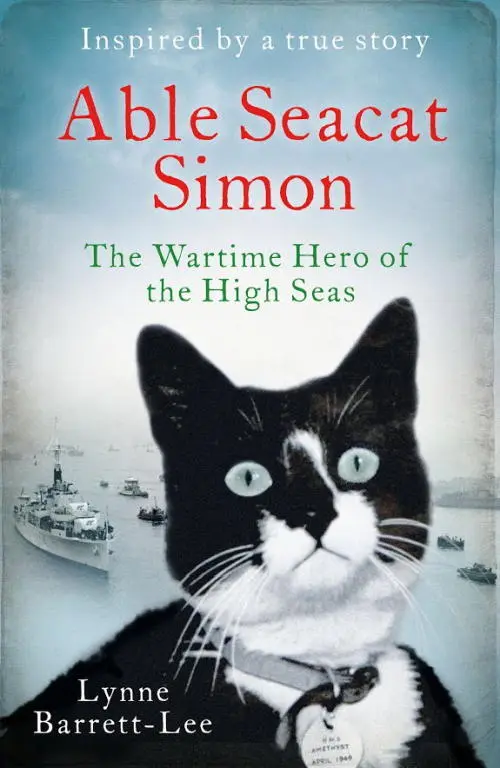
- Название:Able Seacat Simon
- Автор:
- Издательство:Simon & Schuster UK
- Жанр:
- Год:2016
- Город:London
- ISBN:978-1-47115-183-5
- Рейтинг книги:4 / 5. Голосов: 1
-
Избранное:Добавить в избранное
- Отзывы:
-
Ваша оценка:
Able Seacat Simon: краткое содержание, описание и аннотация
Предлагаем к чтению аннотацию, описание, краткое содержание или предисловие (зависит от того, что написал сам автор книги «Able Seacat Simon»). Если вы не нашли необходимую информацию о книге — напишите в комментариях, мы постараемся отыскать её.
Simon is discovered in the Hong Kong docks in 1948 and smuggled on board the H.M.S
by a British sailor who takes pity on the malnourished kitten. The young cat quickly acclimates to his new water-borne home, establishing himself as the chief rat-catcher in residence while also winning the hearts of the entire crew.
Then the
is ordered to sail up the Yangtze to take over the guarding of the British Embassy, and tragedy strikes as the ship comes under fire from Communist guns. Many of the crew are killed and Simon is among those who are seriously wounded. Luckily, with the help of the ship’s doctor, the brave cat makes a full recovery and is soon spending time with the injured men in the sick bay, purring and keeping their spirits up. News of Simon’s heroism spreads and he becomes famous world-wide – but it is still a long journey back to England for both the crew and the plucky little cat known as ‘Able Seacat Simon’…
Lynne Barrett-Lee is a successful novelist and ghostwriter with several
bestselling titles to her name, including the Julie Shaw series of gritty Bradford-based dramas, and the global bestseller
, which has been translated into 26 languages. Her recent bestseller,
has recently been adapted for children. When not busy writing books, Lynne runs a novel writing course at Cardiff University, and pens a weekly column for
. To find out more about Lynne and her books, visit
. Review
About the Author ‘The story of plucky orphaned kitten Simon, rescued from the docks of Hong Kong in 1948 to join the crew of HMS
, cannot fail to warm the cockles of even the coldest heart… Barrett Lee brilliantly reimagines the trials and tribulations of life on board through the eyes of her feline protagonist… painstakingly researched, this is more than a heart warming animal story: it is also an inspiration and an informative tale. This is great historical fiction – and a must for any cat lover’ (
) ‘During the 1949 Yangtse Incident, HMS
lost 22 crew and was trapped for three months before escaping. Also on board was a kitten adopted in Hong Kong by an
sailor. This is Able Seacat Simon’s nail biting story’ (
) ‘Heartwarming’ (
)
Able Seacat Simon — читать онлайн бесплатно полную книгу (весь текст) целиком
Ниже представлен текст книги, разбитый по страницам. Система сохранения места последней прочитанной страницы, позволяет с удобством читать онлайн бесплатно книгу «Able Seacat Simon», без необходимости каждый раз заново искать на чём Вы остановились. Поставьте закладку, и сможете в любой момент перейти на страницу, на которой закончили чтение.
Интервал:
Закладка:
Watching her doing this, I was very glad no one considered me enough of a nuisance to put such a contraption round my neck. Though, once I thought about it, if they had got such an idea into their heads, I’d have probably ‘skedaddled’, just like George used to, before they even tried.
I felt very much like skedaddling, in any case, if I was honest, because the closer we got to our berth at the dockside the more the press of people began to alarm me. So much shouting, so much waving, such a huge number of people, adding an extra layer of anxiety to that which was already welling, at the fire crackers and hooters that kept going off and making me jump.
Not that I would be given much chance to escape, because while the ship was being oiled, resupplied and fixed up as much as was necessary, there was a certain naval function Peggy and I had been told we must attend.
‘You are the hero of the hour!’ Captain Kerans announced a few days after we’d docked. ‘You and Peggy both, but particularly you, it seems, Simon. And guess what. You are not only going to be awarded an Amethyst Campaign Medal, you are going to get another medal too!’
He was sitting in his cabin, with Lieutenant Hett and Lieutenant Berger. Berger had rejoined the ship after our escape, having recovered from the wounds he’d suffered back in April.
The captain was half hidden under mountains of paperwork. It had been the same since we’d docked. All sorts of paperwork had been delivered, to replace all the charts and documents Lieutenant Weston had had to burn, I supposed, as well as all sorts of official-looking files.
He flapped a piece of paper he held in one hand, and patted his knee with the other. I didn’t need to jump, though, because Lieutenant Hett scooped me up and plonked me on the captain’s lap.
‘Now then, see this?’ he told me. ‘This is a letter of confirmation that you are to be officially awarded the Dickin Medal, which is a decoration awarded to only the bravest and most courageous animals, who have helped their human friends in times of war. And there’s more – you are the very first cat ever to be awarded one. How about that? How about that ?’ he repeated to the other men. ‘I had no idea about that, did you?’ Both shook their heads. ‘Pigeons, dogs, horses, but never a cat. Quite something, eh?’ He turned back to me, his eyes bright. He seemed amused by it all. ‘And now a cat has been awarded one. You , Simon.’ He looked pretty pleased with himself, I decided. ‘You are going to be decorated twice ! At the Royal Navy Fleet Club, tomorrow night, as it happens.’
‘ If we manage to get him there,’ Lieutenant Hett pointed out.
‘Shall I have Dusty see if he can rustle up a crate for us?’ asked Lieutenant Berger. ‘We can’t risk carrying him down there, can we?’
The captain shook his head. ‘No, we can’t. Good idea. Or a strong cardboard box. See what he can come up with. Anyway, how about that, Simon? The hero of the hour!’ he looked more than pleased. He looked delighted.
‘Or a trunk,’ Lieutenant Hett was saying. A trunk ? I was alarmed now. ‘We could always pop him in a trunk. And if we put a lead on him, just in case…’
A lead ? I was not liking this one little bit.
‘And you can be sure there’ll be a hullaballoo once this hits the press,’ the captain added. ‘They’re sending a collar for him as well, by all accounts. That’s for you to wear in lieu of the medal, Simon,’ he explained to me. ‘Then, when we return to England you’ll be presented with the medal itself – in London. Bit of pomp and circumstance for you to enjoy!’
He still looked delighted. He couldn’t have looked more delighted. But all this talk of collars and hullaballoos was beginning to make me anxious. Not to mention trunks and leads and strong cardboard boxes. And presentations at fleet clubs, whatever they were. It all sounded very, very worrying to me.
I decided that a course of evasive action would be necessary. They would have to have their presentation without me. I made myself scarce. For two days.
We were just over a month in Hong Kong. The Amethyst was restocked with supplies and refuelled, and such repairs that were immediately necessary were completed, and such hullaballoos as were deemed necessary were also completed, all of which I tried to give an equally wide berth.
Not so my shipmates, who seemed to revel in their new status as heroes, and deservedly so. It was only now, with them safe and rested, that I think I truly realised how much of a toll the whole experience had taken.
Everyone had been given leave, and they were making the most of it, allowing me to see them in a very different and welcome light. Now our ordeal was over, they seemed energised; bright-eyed and smiling. To an extent it was as if they’d been reborn – as if they too had nine lives and, having just lost one, were determined to plunge enthusiastically into the next.
So, while I kept to my routines (the Amethyst might be berthed, but there were still rats that needed hunting) my friends came and went, often seeming almost as over-excited as Peggy. I was reminded of the tottering revellers I used to observe at night back when I was still a kitten, sitting on an oil drum or pile of pallets in the moonlight, more often than not mystified by all the strange activities.
Now I studied my friends’ antics from up on the bridge, where I still stood watch for at least some portion of the night, my view of them so different now, and in such an unexpected way.
What a long way we’d all come together.
Though I’d had no particular desire to leave the ship during our time in Hong Kong, on our last day in dock I had a sudden change of heart. It suddenly struck me we’d be sailing for England in a matter of hours.
I knew everything and nothing about this fabled place called England. I knew it was home for most of my friends, that it was always spoken of with love and reverence, and that the men seemed to almost ache for it, so keen were they to see it again. But I also knew it was far away – far further than I’d ever been – and in the north, where it was apparently often cold; a kind of cold I’d been told I would’ve ‘never known the likes of’ and which, in the oppressive heat of a Yangtse night, my friends would yearn for.
I had no such yearning. I didn’t see why anyone would like the cold. As with being ‘wet through’, which had turned out to be decidedly unpleasant, I suspected I wouldn’t like ‘cold’ one little bit. But as all I wanted was to stay on the Amethyst , I was happy enough. I would go where she went; where my friends went.
It did occur to me that with England being so far away, it might be a very long time before I saw Hong Kong again. Who knew? I might never come back here. In thinking that, I felt a sudden powerful urge to say goodbye to it. To sit, for a while, on the end of the jetty. To be close, for just a short time, to my mother. So while everyone was busy with the last of the preparations I slipped away down the gangway onto the dock I hadn’t set my paws on for well over a year.
It was the strangest thing. I remembered the way. All that time away at sea – all those adventures, all those trials, all those lives I’d been living – and yet it wasn’t even as if I had to consciously remember. It was the opposite. It was as if I’d never been away.
I padded away from the quay, feeling unexpected waves of nostalgia and sadness come over me. Having been away so long, I soon realised just how much I’d forgotten, from the sight of my beloved banyans and the caws of the cockatoos, to the green softness of the hills that rose up beyond the city, as if hugging it in their protective embrace. Particularly intense was the feel of sand and earth beneath my paws, both so unexpectedly soft and warm and fragrant after the cold unyielding corticene I’d grown so used to. But I also understood why my senses had forgotten them. Because that was what being a cat was all about. We thrived because we knew how to live where we were, rather than – as humans often seemed to, I’d discovered – where our hearts wished to be.
Читать дальшеИнтервал:
Закладка:
Похожие книги на «Able Seacat Simon»
Представляем Вашему вниманию похожие книги на «Able Seacat Simon» списком для выбора. Мы отобрали схожую по названию и смыслу литературу в надежде предоставить читателям больше вариантов отыскать новые, интересные, ещё непрочитанные произведения.











Обсуждение, отзывы о книге «Able Seacat Simon» и просто собственные мнения читателей. Оставьте ваши комментарии, напишите, что Вы думаете о произведении, его смысле или главных героях. Укажите что конкретно понравилось, а что нет, и почему Вы так считаете.